May 30, 2023
Maximizing Brand Power with Lara Balazs, Chief Marketing Officer at Intuit

Lara Balazs
Chief Marketing Officer
This is some text inside of a div block.
This is some text inside of a div block.
LISTEN ANYWHERE YOU FIND YOUR PODCASTS
%20(400%20x%20100%20px)%20(300%20x%2050%20px)%20(150%20x%2050%20px).avif)

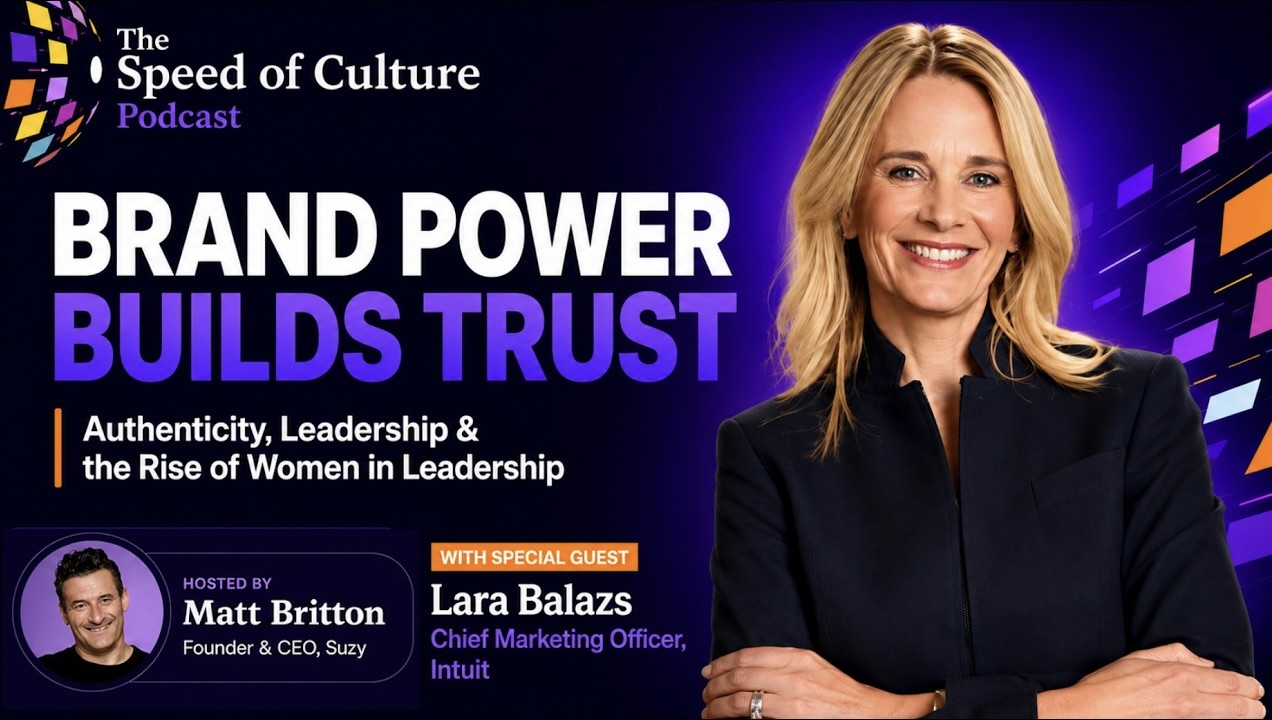
In an era where financial technology companies compete fiercely for consumer attention and market share, the role of strategic brand marketing has never been more critical. On May 30, 2023, Matt Britton, founder and CEO of Suzy, the AI-powered consumer intelligence platform, sat down with Lara Balazs, Chief Marketing Officer at Intuit, to explore how enterprise brands maximize their power in the financial technology space.
This conversation on The Speed of Culture podcast reveals the sophisticated strategies that drive brand loyalty, consumer engagement, and business growth for one of the world's most recognized fintech companies. Balazs brings her unique perspective as a recognized leader in CMO innovation and brand storytelling, having been named a Forbes World's Most Influential CMO and recipient of AdWeek's CMO Vanguard Award.
The episode challenges conventional wisdom about how B2B and financial technology companies approach branding. Rather than defaulting to functional messaging about tax software or accounting tools, Intuit's marketing philosophy centers on deeply understanding consumer pain points, aspirations, and the emotional journey of small business owners navigating financial complexity.
This human-centered approach to brand building represents a fundamental shift in how legacy financial services companies compete in a crowded marketplace increasingly dominated by AI-driven solutions and consumer-first platforms.
For marketing leaders, brand strategists, and executives responsible for building financial services brands, this conversation provides actionable insights into consumer intelligence, emotional branding, and the intersection of artificial intelligence with authentic storytelling. Balazs discusses how Intuit moves beyond transactional product marketing to create genuine value propositions that resonate with millions of customers managing everything from personal taxes to complex small business finances.
Her perspective on brand power emphasizes that in the fintech space, trust, clarity, and emotional connection form the foundation of sustainable competitive advantage.
The broader context of this conversation is essential: traditional financial institutions and newer fintech disruptors are increasingly recognizing that brand differentiation matters deeply. Companies like Intuit that successfully build powerful brands win by becoming trusted partners in their customers' financial lives, beyond product features or price.
This episode explores the strategic frameworks, organizational alignment, and consumer insights that enable this transformation.
At the heart of modern brand strategy lies a fundamental truth: understanding your consumer deeply requires more than demographic targeting or surface-level preference analysis. Lara Balazs emphasizes that Intuit's approach to brand building is grounded in sophisticated consumer intelligence, the kind that reveals not just what customers do, but why they do it, what they fear, and what aspirations drive their financial decisions.
Intuit's massive platform serves over 100 million customers globally, providing the company with extraordinarily rich longitudinal data about consumer and small business financial behavior. This data advantage is transformative: Intuit understands customer income streams, expense patterns, profitability trends, and cash flow dynamics across millions of data points.
For Balazs and her marketing team, this consumer intelligence becomes the foundation for authentic brand storytelling that speaks directly to customer needs and anxieties.
The strategic application of consumer insights in brand marketing differs dramatically from traditional approaches. Rather than building brands around product attributes, “Our tax software is easier to use” Intuit builds around customer transformation and emotional outcomes.
The brand positioning asks: How does this product make a small business owner feel more in control? More confident? More capable of achieving their dreams? This shift from feature-focused to outcome-focused brand messaging requires deep consumer understanding and the willingness to continually test and refine messaging based on real customer feedback.
Suzy's AI-powered consumer intelligence platform exemplifies this trend toward data-driven brand strategy. By combining quantitative analytics with qualitative consumer insights, modern brands can understand the emotional and rational drivers behind customer decision-making.
This dual approach, leveraging both hard data and empathetic understanding, enables marketing leaders like Balazs to build brands that feel both credible and emotionally resonant. The consumers and small business owners in Intuit's ecosystem are looking for partners who understand their financial anxiety, celebrate their business growth, and make complex processes feel manageable, as much as they are looking for tools.
The investment in consumer intelligence also supports innovation in brand messaging across multiple touchpoints. Whether customers interact with Intuit through TurboTax during tax season, QuickBooks for year-round accounting, or emerging AI-powered features like Intuit Assist, the brand voice and positioning should feel cohesive and purpose-driven.
This consistency across the platform ecosystem requires deep organizational alignment around consumer insights and a shared commitment to authentic storytelling.
Intuit's strategic pivot toward becoming an AI-driven expert platform represents one of the most significant transformations in fintech marketing and brand positioning. Rather than viewing artificial intelligence as a commodity feature or technical differentiator, Balazs and her team have positioned AI as the enabling force behind a fundamental shift in value proposition: from products that enable customers to complete financial tasks to platforms that intelligently handle tasks on behalf of customers.
This philosophical shift, from “do it yourself” to “done for you” is revolutionary for an industry built on empowering individual consumers to manage their own finances. Intuit Assist, the company's generative AI-powered financial assistant introduced in 2023, exemplifies this transformation.
Rather than simply automating data entry or streamlining workflows, Intuit Assist provides personalized, intelligent financial recommendations powered by the company's vast data repository and advanced machine learning capabilities. For brand marketing purposes, this represents a compelling narrative: the evolution of a trusted financial partner.
For marketing leaders responsible for fintech brands, the integration of AI into brand strategy raises important questions about trust, transparency, and consumer acceptance. How do you market AI-powered financial recommendations without triggering concerns about data privacy, algorithmic bias, or the replacement of human expertise?
Balazs addresses this challenge by positioning Intuit's AI not as a substitute for financial expertise, but as an augmentation, a way to combine machine intelligence with human judgment to deliver superior outcomes.
This positioning strategy reflects broader trends in enterprise and consumer marketing. As AI becomes more prevalent across industries, customers increasingly expect brands to be transparent about how artificial intelligence influences their experience.
The brands that build trust during this transition are those that clearly articulate the purpose behind AI implementation, demonstrate measurable benefits to customers, and maintain human oversight in contexts where human judgment matters. Intuit's brand strategy emphasizes that its AI-powered platform is designed to give customers more time to focus on what matters most (growing their business, managing their family finances, and planning for the future) rather than drowning in administrative work.
The marketing implication is profound: AI isn't presented as a mysterious black box or a substitute for expertise. Instead, it's framed as a partner in customer success, enabling faster decisions, smarter recommendations, and more confident financial management.
This approach to brand storytelling around AI-powered solutions is increasingly relevant as companies across industries navigate the AI revolution and seek to maintain customer trust while implementing transformative technology.
Intuit's brand power derives significantly from its ability to connect emotionally with small business owners, entrepreneurs who are simultaneously excited by growth opportunities and anxious about financial management complexity. Lara Balazs recognizes that the most compelling brand narratives in the fintech space aren't built on technical superiority or feature checklists.
Instead, they're built on genuine empathy for the customer journey and recognition of the emotional stakes involved in financial decision-making.
Small business owners represent a uniquely compelling audience for brand marketing because their financial decisions carry personal consequences. Unlike enterprise customers evaluating software based on ROI calculations, small business owners are managing personal financial risk, family livelihoods, and long-term dreams.
This emotional dimension of small business financial management creates an opportunity for brands like Intuit to position themselves as genuine partners in customer success. The brand narrative becomes: “We understand what you're building. We celebrate your growth. We make the financial complexity manageable so you can focus on what you do best.”
This approach to B2B brand strategy, emphasizing human connection and emotional resonance, represents a significant shift from traditional enterprise software marketing. As noted in recent marketing research, B2B companies are increasingly embracing the brand-building discipline historically associated with consumer brands.
Companies are recognizing that emotional connection, brand differentiation, and authentic storytelling matter in B2B contexts, not just B2C. This realization has implications for marketing budgets, organizational structure, and how companies measure brand value.
For Intuit, the small business audience also represents a natural platform for brand expansion and ecosystem integration. When a platform becomes truly embedded in a customer's business operations (handling tax management, accounting, payroll, and financial advisory functions) it achieves a level of brand intimacy that's difficult for competitors to disrupt.
The brand becomes not just a software provider, but a trusted business partner. This positioning requires consistent delivery on brand promises, responsiveness to customer feedback, and continuous innovation to maintain relevance as business needs evolve.
The marketing strategy surrounding small business as Intuit's emotional core also extends to community building and content marketing. By creating educational resources, success stories, and practical guidance specifically designed for small business owners, Intuit strengthens its brand positioning as a genuine advocate for entrepreneurial success.
This content strategy goes beyond promotional messaging to provide real value, helping customers succeed with or without Intuit's products. This generous approach to content and education builds brand loyalty and positions Intuit as a thought leader in the fintech space.
One of the most insightful aspects of Lara Balazs's approach to CMO leadership is her emphasis on organizational alignment. Building powerful brands in complex organizations requires more than creative advertising campaigns or sophisticated digital marketing tactics.
It requires fundamental alignment between brand strategy, product development, customer service, and organizational culture.
For Intuit, this alignment challenge is particularly significant given the company's diverse product portfolio spanning tax software, accounting platforms, financial advisory services, and emerging AI-powered tools. How do you ensure that customers experience consistent brand messaging and brand promises across this ecosystem?
The answer lies in organizational structures and governance that prioritize brand coherence. Every product team, customer service representative, and technology initiative should understand and support the core brand narrative.
Balazs's leadership approach emphasizes that the most powerful brands are those where the organization genuinely lives the brand promise. When customer service teams understand the brand's commitment to small business success, they respond to customer issues with that perspective in mind.
When product teams design new features, they consider how those features align with the brand positioning. When executives make strategic decisions about acquisition or partnership, they evaluate these decisions against brand values.
This level of organizational alignment is difficult to achieve, but it's increasingly recognized as a core competitive advantage.
The challenge of organizational alignment becomes more complex in the context of technological transformation. As Intuit invests in AI-powered capabilities and reimagines its product offerings, marketing leaders must ensure that internal stakeholders understand how these changes support the broader brand strategy.
Employees need to understand that Intuit Assist is a manifestation of the brand's commitment to making financial management less burdensome for customers, beyond its value as a technical innovation. When employees understand this connection between product innovation and brand purpose, they become advocates for the brand, both internally and externally.
This emphasis on organizational alignment represents a sophisticated understanding of modern brand management. In the social media age, where customer experiences are instantly broadcast and internal inconsistencies are quickly exposed, the surface-level brand promise isn't sufficient.
The brand must be authentically embedded in organizational culture, decision-making processes, and customer interactions. Companies like Intuit that successfully maintain brand coherence across complex organizations gain significant competitive advantage because customers experience consistent brand delivery regardless of which product, channel, or customer service interaction they engage with.
At its core, Lara Balazs's philosophy of brand marketing is fundamentally about storytelling. She emphasizes that the best marketers are great storytellers, not because storytelling is merely a tactical tool for advertising or promotion, but because authentic storytelling is how brands establish credibility, build trust, and create emotional connection.
In the fintech space, where trust is paramount and customer anxiety about financial management is high, the ability to tell compelling stories about transformation and success becomes a core competitive differentiator.
Intuit's brand story is primarily about the customers the company serves. It's the story of a small business owner starting a venture with hope and anxiety, navigating financial complexity, growing the business, and achieving success.
It's the story of a family managing their household finances with clarity and confidence. It's the story of financial empowerment and clarity replacing confusion and anxiety.
By positioning the brand narrative around customer transformation rather than corporate achievement, Intuit creates emotional resonance that extends far beyond functional product benefits.
This storytelling approach has implications for content strategy, advertising creative, customer communications, and employee engagement. Every communication touchpoint becomes an opportunity to reinforce the brand narrative.
Success stories from real customers become more compelling than corporate press releases. Educational content that helps customers succeed becomes more valuable than promotional messaging.
Community forums where customers support each other strengthen brand loyalty more effectively than traditional customer acquisition tactics. This shift toward narrative-driven brand marketing requires marketers to embrace a more sophisticated understanding of content strategy and customer communication.
The integration of artificial intelligence into brand storytelling also creates new opportunities and challenges. As Intuit deploys AI-powered tools like Intuit Assist, the brand narrative must incorporate these technological capabilities in ways that feel authentic and aligned with the broader brand story.
Rather than positioning AI as a standalone feature, the brand narrative frames AI as the latest evolution in Intuit's commitment to customer empowerment and financial confidence. This narrative consistency, connecting new technology to core brand purpose, enables organizations to implement transformative technology while maintaining brand coherence and customer trust.
For marketing leaders seeking to maximize brand power, the lesson is clear: invest in storytelling capabilities and narrative consistency. This isn't about creating fictional narratives or exaggerating customer benefits.
It's about recognizing that authentic stories about customer challenges, aspirations, and success are far more compelling than feature-focused marketing messages. Brands that commit to authentic, consistent storytelling build deeper customer relationships and create sustainable competitive advantages that are difficult for competitors to replicate.
As Lara Balazs reflects on the evolution of fintech marketing and brand strategy, several trends emerge that will likely shape the industry over the coming years. First is the continued integration of artificial intelligence into customer experience and brand delivery.
As AI capabilities become more sophisticated and more prevalent, the brands that win will be those that successfully integrate AI into their customer value proposition while maintaining transparency, trust, and human oversight.
This requires marketing leaders to develop new competencies in communicating about AI, addressing customer concerns, and highlighting genuine customer benefits.
Second is the trend toward greater personalization and customer-centric customization. As companies like Intuit accumulate more data about customer preferences, behaviors, and financial situations, they can deliver increasingly personalized experiences.
This creates opportunities for more targeted, relevant brand messaging, but it also creates risks around data privacy and ethical use of consumer information.
Brands that build trust by being transparent about data usage and demonstrating clear customer benefits from personalization will have competitive advantage.
Third is the increasing importance of purpose-driven brand positioning in the fintech space. Consumers and small business owners increasingly evaluate financial services brands based on their commitment to social impact, sustainability, and ethical business practices.
For Intuit, this means that the brand's purpose, empowering individuals and small businesses to achieve financial success, becomes a cornerstone of brand differentiation.
Marketing leaders must recognize that modern consumers increasingly want to align their financial relationships with brands that share their values.
Fourth is the evolution of customer engagement models from transactional to relational. Rather than viewing customers as one-time purchasers of software licenses, fintech brands increasingly view customers as long-term partners in shared success.
This relational orientation has implications for customer service, product development, content strategy, and brand communication.
Brands that position themselves as genuine partners in customer success, rather than mere vendors of financial software, build stronger customer relationships and achieve higher lifetime value.
Finally, the competitive landscape for fintech will continue to intensify as new competitors emerge, regulatory environments evolve, and technological capabilities advance.
In this increasingly competitive environment, brand power, the ability to differentiate from competitors and create customer loyalty based on emotional connection, trust, and perceived value, becomes increasingly important.
Companies that invest in brand building, consumer intelligence, and authentic customer engagement will have competitive advantage, while companies that focus solely on product features and price competition will struggle to differentiate.
Rather than emphasizing technical superiority or feature checklists, Intuit positions itself as a genuine partner in customer financial success. The brand narrative focuses on empowerment, confidence, and transformation, addressing the emotional dimensions of financial management alongside functional problem-solving.
This approach combines sophisticated consumer intelligence with authentic storytelling, creating emotional resonance that extends far beyond product attributes. By building organizational alignment around this brand purpose, Intuit ensures consistent brand delivery across its diverse product ecosystem spanning tax software, accounting platforms, and AI-powered financial advisory tools.
Trust in fintech is foundational, and the integration of artificial intelligence requires particular care. The most effective approach combines transparency about AI implementation with clear articulation of customer benefits.
Rather than positioning AI as a mysterious black box, brands should frame AI as an intelligent partner that augments human expertise and enables customers to make more confident financial decisions. Intuit's approach emphasizes that AI-powered tools like Intuit Assist are designed to reduce administrative burden and free customers to focus on strategic financial decisions.
Additionally, companies should maintain human oversight in contexts where human judgment matters, and be transparent about how customer data is used to power AI recommendations.
Small business owners and individual consumers making financial decisions are engaging in personally consequential decision-making. Financial management carries emotional weight, anxiety about complexity, excitement about growth, fear of financial mistakes.
Brands that acknowledge and address these emotional dimensions create deeper customer relationships than brands focused solely on functional problem-solving. By positioning themselves as genuine advocates for customer success rather than mere product vendors, fintech brands build loyalty that extends beyond any individual feature or product iteration.
This emotional connection becomes particularly important in competitive markets where multiple competitors offer similar functionality.
Authentic brand building requires that the organization genuinely lives the brand promise. This means that product development teams, customer service representatives, sales professionals, and executives throughout the organization should understand how their work supports the core brand narrative.
Marketing leaders should invest in internal communication and education about brand strategy, create governance structures that ensure brand consistency across product and functional areas, and empower teams throughout the organization to make decisions that align with brand values.
When employees understand that their work contributes to meaningful customer outcomes, they become advocates for the brand, both internally and externally.
Consumer intelligence, understanding not just what customers do, but why they do it, what they fear, and what aspirations drive their decisions, forms the foundation of authentic brand strategy.
By combining quantitative behavioral data with qualitative consumer insights, marketing leaders can understand the emotional and rational drivers behind customer decision-making. This insight enables more targeted, relevant brand messaging that resonates with customer needs and aspirations.
For fintech companies with access to extensive customer data, consumer intelligence becomes a significant competitive advantage, enabling brand strategies that feel personalized, relevant, and genuinely empathetic to customer challenges.
The evolution of fintech brand strategy, as articulated by Intuit's Chief Marketing Officer Lara Balazs, reflects broader shifts in how companies build competitive advantage in technology-driven markets.
As artificial intelligence becomes increasingly prevalent, consumer expectations for authentic, purpose-driven brand positioning will intensify. Marketing leaders who invest in consumer intelligence, organizational alignment, and authentic storytelling will build brands that differentiate in competitive markets and create sustainable customer loyalty.
For further insights into brand strategy, consumer intelligence, and AI-driven marketing innovation, explore these complementary resources: