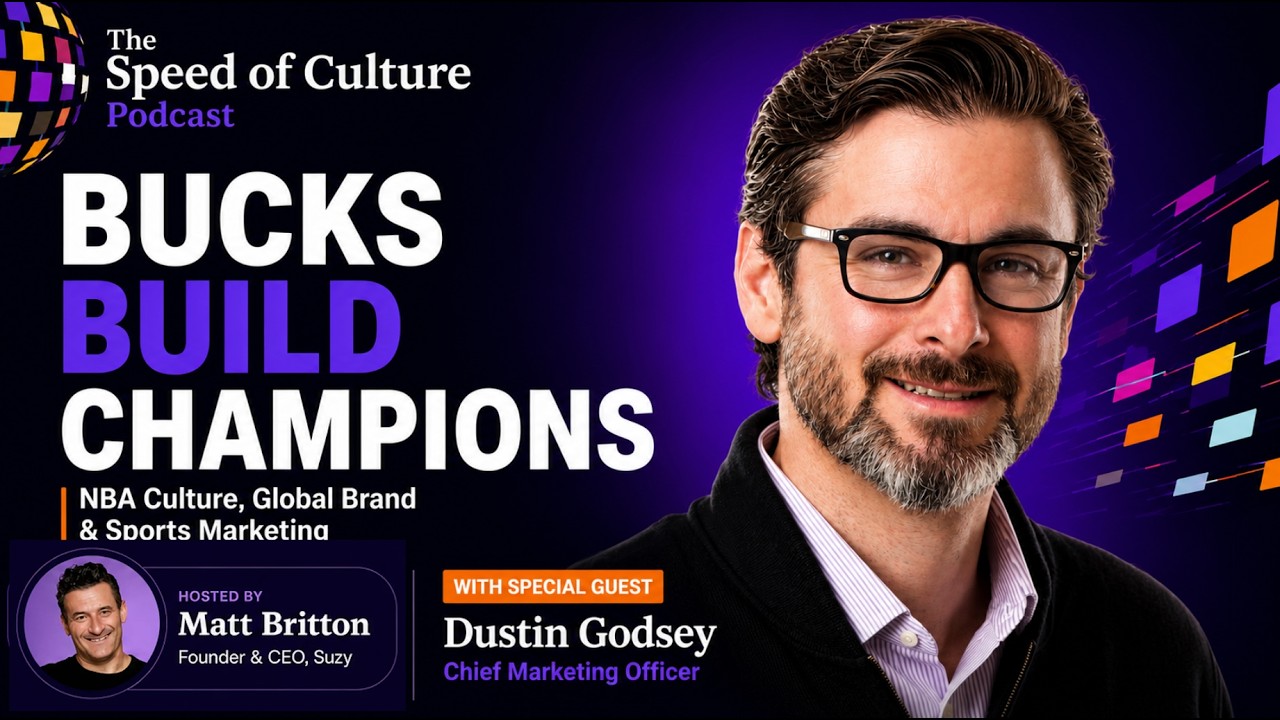
Building a Championship Culture: How the Milwaukee Bucks Transformed Brand Marketing Under Dustin Godsey
When the Milwaukee Bucks won the 2021 NBA championship with superstar Giannis Antetokounmpo, the victory represented far more than just an on-court achievement. It symbolized the culmination of a deliberate, data-driven marketing transformation that began nearly a decade earlier, when the franchise had virtually no established brand identity or marketing infrastructure.
In this episode of the Speed of Culture podcast, Suzy founder and CEO Matt Britton sits down with Dustin Godsey, chief marketing officer at the Milwaukee Bucks, to explore how a championship culture mindset fundamentally reshaped the organization's approach to fan engagement, brand partnerships, and global expansion. This conversation reveals actionable insights for any enterprise leader looking to build organizational alignment around shared values and vision, regardless of industry.
Godsey's journey to becoming an innovation leader in sports marketing offers a masterclass in strategic transformation. Named Business Insider's 2022 Innovative CMO of the Year, he transformed the Bucks from a struggling franchise into a global brand powerhouse. His story is one of strategic hiring, organizational culture, authentic storytelling, and leveraging technology to create fan-first experiences at scale.
From Journalism to NBA: The Path That Led to Championship-Caliber Marketing
Dustin Godsey's career trajectory defies the conventional sports marketing playbook. Originally, he dreamed of becoming an NBA player, but his path took a pivot when he decided to pursue journalism at the University of Iowa. While many might view this as a detour, Godsey's educational foundation in storytelling would prove instrumental in his later work building the Bucks brand narrative.
His early marketing career unfolded in the trenches of minor-league baseball with the Cedar Rapids Kernels and the Iowa Cubs. These roles taught him the fundamentals of building fan connections on a limited budget, a skillset that would become invaluable when he joined the Bucks organization in 2012.
Before arriving in Milwaukee, Godsey worked as a regional marketing director at Global Spectrum (now Spectra), and later as director of marketing at Comcast Spectacor, where he gained enterprise-level insights into sports venue operations and fan experience management.
In 2012, Godsey became the Milwaukee Bucks' first dedicated marketing hire, joining an organization that was “dealing with significant challenges.” The franchise had limited brand recognition beyond Wisconsin, minimal marketing infrastructure, and no clear positioning in an increasingly competitive sports entertainment landscape. Yet this challenging situation presented an unprecedented opportunity: the chance to build a marketing organization from the ground up, aligned from day one around championship principles.
The Championship Culture: Building Organizational Alignment Around a Shared Vision
The transformation of the Milwaukee Bucks' brand identity crystallized in 2014 when new ownership took control of the franchise. This transition became a pivotal moment for redefining the organization's core identity. Rather than chase trends or attempt quick marketing fixes, Godsey and leadership implemented a comprehensive strategy centered on a single concept: championship culture.
“When you think about what we are as a brand, we're a championship culture.”
This wasn't merely a tagline or marketing slogan. It became the organizing principle for every decision across the organization, from player acquisitions to partnership selections to fan experience design.
Championship culture means several things in practice. First, it requires alignment across all teams and departments. Every marketer, operations professional, sales associate, and front-office executive embraced this vision as the cornerstone of their efforts.
Marketing didn't operate in isolation; it became interwoven with business development, arena operations, talent management, and community engagement.
Second, championship culture creates accountability. Teams adopted a shared goal of winning a championship while establishing Milwaukee as a championship city. This was a strategic commitment that shaped resource allocation, hiring decisions, and performance metrics.
When internal teams operate under a unified objective, previously siloed functions begin collaborating naturally.
Third, championship culture attracts talent that resonates with the brand mission. As the organization grew and evolved, it became easier to recruit marketing and PR professionals who understood and embraced this foundational value. This alignment reduced friction during execution and accelerated decision-making velocity.
Building a Winning NBA Brand: Strategic Digital Integration and Fan Experience
Creating a successful brand story for the Milwaukee Bucks required more than visionary thinking, it demanded operational excellence. Godsey and his team undertook a comprehensive integration of all marketing channels and customer data infrastructure. They unified digital platforms, direct marketing channels, customer databases, and email marketing efforts “under one roof,” creating a cohesive brand experience across all touchpoints.
This integration served multiple strategic purposes. First, it ensured messaging consistency. When a fan encountered the Bucks brand across their mobile app, social media, email communications, and in-arena experiences, they received a unified narrative.
Second, it enabled data visibility. By consolidating disparate data sources, Godsey's team could identify which fans engaged with which content, which promotional offers drove ticket sales, and which partnerships created genuine value.
Third, unified marketing operations provided the foundation for personalization at scale. Rather than broadcasting generic messages to all fans, the Bucks could tailor communications based on individual preferences, purchase history, and engagement patterns.
A season ticket holder attending 41 games per year receives different communications than a casual fan interested in a single playoff game.
Throughout this process, the Bucks maintained an unwavering focus on delivering world-class experience and value to fans. In professional sports, this commitment transcends the product on the court. It encompasses arena amenities, digital engagement, customer service responsiveness, and the overall feeling fans have when interacting with the organization.
Giannis Antetokounmpo: Authentic Storytelling and the “Greek Freak” Brand
Perhaps no single marketing decision shaped the Bucks' brand trajectory more powerfully than acquiring Giannis Antetokounmpo. From a pure basketball perspective, “The Greek Freak” transformed the Bucks into championship contenders. From a brand perspective, Antetokounmpo's personality, work ethic, and authenticity created a marketing gift: a superstar whose personal values aligned perfectly with the organization's championship culture positioning.
Antetokounmpo brings several critical brand attributes. He's a hardworking player whose mentality mirrors the championship culture ethos. He arrived in the NBA from humble circumstances, demonstrating determination and gratitude.
His global background, being Greek-Nigerian and playing in the NBA, naturally extends the Bucks' appeal beyond traditional American sports fans. And perhaps most importantly, his personality is genuine. He doesn't require extensive brand management or controversial handling.
From a marketing perspective, this alignment enabled the Bucks to tell Antetokounmpo's story authentically. Rather than fabricating narratives or exaggerating accomplishments, the team could simply amplify his impressive background and compelling personality.
This approach illustrates a critical principle in modern sports marketing: authenticity trumps manufactured mythology. Fans can detect insincerity immediately. When brands attempt to create false narratives or position athletes dishonestly, the strategy typically backfires on social media and through word-of-mouth.
The Bucks' approach of identifying an athlete whose genuine character aligns with brand values, then amplifying that authentic story, proves far more effective and sustainable.
Strategic Partnership Architecture: Prioritizing Values Alignment Over Revenue
The Milwaukee Bucks operate in a paradoxical position within professional sports. As a small-market team with a limited local corporate sponsor base compared to franchises in New York, Los Angeles, or Chicago, the organization cannot simply accept every partnership opportunity that presents itself.
Instead, Godsey and leadership implemented a rigorous partnership philosophy that prioritizes values alignment and cultural fit.
This approach reflects sophisticated long-term thinking. Revenue from a single sponsorship deal provides short-term financial benefit but potentially damages brand equity if the partner doesn't align with the organization's championship culture positioning.
Conversely, a more selective partnership strategy attracts premium partners who view association with the Bucks as strategically valuable for their own brand objectives.
For Godsey, effective partnerships require several elements:
- Aligned goals between both parties.
- Shared values that reinforce the championship culture positioning.
- Collaborative working relationships rather than transactional exchanges.
- Authentic story creation that provides genuine value to fans.
Rather than transactional relationships where a company purchases naming rights and receives promotional inventory, the Bucks seek partners willing to co-create marketing experiences that provide genuine value to fans.
Digital Innovation and First-Party Data: Fiserv Forum as Innovation Hub
Looking toward the future, Godsey identifies digital innovation and fan data strategy as central to the Bucks' competitive advantage. The organization invested significantly in its mobile app, recognizing that digital touchpoints increasingly shape fan experiences alongside in-arena attendance.
The Bucks' mobile app serves as a comprehensive platform for fan engagement. It provides real-time game information, merchandise shopping, parking coordination, and exclusive content access.
More strategically, the mobile app collects valuable first-party data. Unlike third-party cookie data, which faces increasing regulatory restrictions and privacy concerns, first-party data represents information fans voluntarily provide when using the app.
This first-party data becomes enormously valuable for the Bucks' analytics and insights team. Understanding which fans engage most enthusiastically with which content enables increasingly sophisticated personalization.
The data strategy also supports Fiserv Forum's evolution beyond a traditional arena. The venue becomes a laboratory for innovation, testing new fan experience technologies, engagement mechanics, and sponsorship activations.
Private Label Retail: Extending Brand Narrative Beyond the Arena
Beyond digital innovation, the Bucks launched a private label retail line, merchandise products bearing the Bucks brand. This seemingly simple initiative actually represents sophisticated brand extension strategy.
Private label retail accomplishes several strategic objectives. First, it deepens fan engagement. Fans wearing private label merchandise become walking brand ambassadors, extending the Bucks' reach beyond Wisconsin and beyond traditional sports markets.
Second, it strengthens direct-to-consumer relationships. By selling merchandise directly rather than through intermediaries, the Bucks capture higher margins while gathering additional customer data.
Most importantly, private label retail extends the Bucks' reach to global audiences. As interest in NBA basketball grows internationally, particularly following the success of international players like Giannis, merchandise becomes a vehicle for engaging fans worldwide.
Championship Culture as Organizational Framework: Lessons for Enterprise Leaders
While this episode focuses specifically on sports marketing, the principles underlying the Milwaukee Bucks' transformation apply broadly to organizational leadership and brand building across industries. Championship culture represents more than a sports metaphor. It's a framework for organizational alignment, authentic brand building, and sustained competitive advantage.
The Bucks' success illustrates that championship culture requires several elements. First, clear articulation of shared values and vision. Everyone in the organization must understand what the championship culture represents and how their role contributes to achieving it.
Second, ruthless alignment of all decisions, from hiring to partnerships to marketing tactics, around those core values. Inconsistency undermines cultural coherence.
Third, authentic storytelling grounded in genuine capabilities and character. The Bucks don't pretend to be a glamorous New York organization; they celebrate Milwaukee's blue-collar authenticity.
Finally, leadership clarity. Godsey's role as CMO extends beyond traditional marketing functions. He became a cultural guardian, ensuring that all marketing decisions reinforced the championship culture positioning.
Key Takeaways: Actionable Insights from Championship Culture Marketing
- Championship culture provides an organizing principle for all organizational decisions. When every team understands and embraces a unified vision, decision-making becomes faster and more consistent.
- Authentic storytelling trumps manufactured narratives. Fans, customers, and audiences detect inauthenticity immediately.
- Strategic partnerships require values alignment, not just revenue potential.
- Digital integration creates competitive advantage. By unifying marketing channels and customer data, organizations gain visibility into customer behavior and can deliver more personalized experiences at scale.
- First-party data strategy represents the future of customer insights.
- Selective positioning in crowded markets often proves more effective than attempting to appeal to everyone.
Frequently Asked Questions
How did Dustin Godsey approach building a marketing organization from scratch at the Milwaukee Bucks?
Godsey joined the Bucks in 2012 as the organization's first dedicated marketing hire. Rather than implementing predetermined systems, he began by understanding the organization's championship aspirations and aligning all marketing infrastructure (digital platforms, customer databases, marketing channels) around that central vision. He built a team of marketing and PR professionals who understood and embraced the championship culture positioning, which accelerated execution and reduced internal friction.
What role did Giannis Antetokounmpo play in the Bucks' brand development?
Giannis became the perfect embodiment of the Bucks' championship culture brand positioning. His hardworking mentality, impressive background, global appeal, and authentic personality aligned naturally with the organization's values. Rather than requiring extensive brand management, the Bucks simply amplified his genuine story to diverse audiences. This authentic alignment between athlete personality and organizational brand positioning proved far more effective than manufactured narratives.
How does the Bucks' approach to partnerships differ from typical sports franchises?
Rather than pursuing every sponsorship opportunity for revenue, the Bucks prioritize values alignment and cultural fit. Godsey evaluates partnerships based on shared objectives, collaborative potential, and ability to create authentic value for fans. This selective approach attracts premium partners who view association with the Bucks as strategically valuable for their own brands, while ensuring that sponsorship announcements feel meaningful rather than purely commercial.
What is the strategic importance of the Bucks' mobile app and first-party data collection?
The mobile app serves dual functions: enhancing fan experience through real-time information, exclusive content, and seamless transactions, while simultaneously collecting valuable first-party data about fan interests and behaviors. This data enables increasingly sophisticated personalization and customer segmentation. As third-party tracking becomes less viable due to privacy regulations, first-party data provides competitive advantage in customer insights and marketing effectiveness.
Looking Ahead: The Future of Sports Marketing and Fan Engagement
The conversation between Matt Britton and Dustin Godsey reveals critical insights about the evolution of sports marketing in the digital age. As fan expectations continue rising, organizations that invest in integrated digital experiences, data-driven personalization, and authentic brand storytelling will increasingly differentiate themselves in crowded markets.
For teams operating in smaller markets, the lessons are particularly valuable. Limited corporate sponsor bases and regional media coverage require strategic partnerships, efficient digital marketing, and global brand reach. The Bucks' success demonstrates that geography doesn't determine destiny, championship culture, authentic storytelling, and strategic innovation can build global franchises regardless of market size.
To explore more insights about championship culture, sports marketing innovation, and fan engagement best practices, listen to the full episode on the Speed of Culture podcast. For ongoing updates on consumer trends and marketing innovation, visit Matt Britton's website.
About the Resources Mentioned
Suzy. Suzy is the AI-powered consumer intelligence platform used by leading brands to understand consumer behavior, preferences, and trends. The platform enables real-time consumer research and insights that inform marketing strategy and product development.
Speed of Culture Podcast. A weekly podcast featuring conversations with world-leading innovators and decision-makers across industries. Hosted by Matt Britton, Suzy founder and CEO, the podcast explores consumer culture, technology trends, and organizational leadership.
Generation AI: The Book. Matt Britton's comprehensive guide to understanding artificial intelligence, consumer behavior, and the future of marketing in an AI-driven world.
Matt Britton: AI Keynote Speaker. Matt Britton offers keynote presentations on AI, generational consumer behavior, and digital transformation for organizations seeking to understand the future of marketing and customer engagement.
Speaker HQ. A platform connecting enterprise organizations with expert speakers and thought leaders on technology, marketing, and business innovation.
Meta Information
Episode: 038
Air Date: March 7, 2023
Guest: Dustin Godsey, Chief Marketing Officer, Milwaukee Bucks
Host: Matt Britton, Founder & CEO, Suzy
Podcast: Speed of Culture (in collaboration with Adweek)
Duration: 27 minutes, 40 seconds
Topics: Sports marketing, championship culture, fan engagement, digital innovation, brand building, first-party data strategy, mobile app marketing, sports technology
Keywords: Milwaukee Bucks, NBA marketing, CMO insights, sports brand building, championship culture, fan engagement innovation, Fiserv Forum, Giannis Antetokounmpo, digital marketing strategy
The Speed of Culture podcast explores how today's leading marketers, technologists, and entrepreneurs are shaping consumer culture. Listen to new episodes weekly and discover insights that inform organizational strategy and marketing excellence.
%20(400%20x%20100%20px)%20(300%20x%2050%20px)%20(150%20x%2050%20px).avif)