Understanding the Hispanic Audience: Complexity and Opportunity
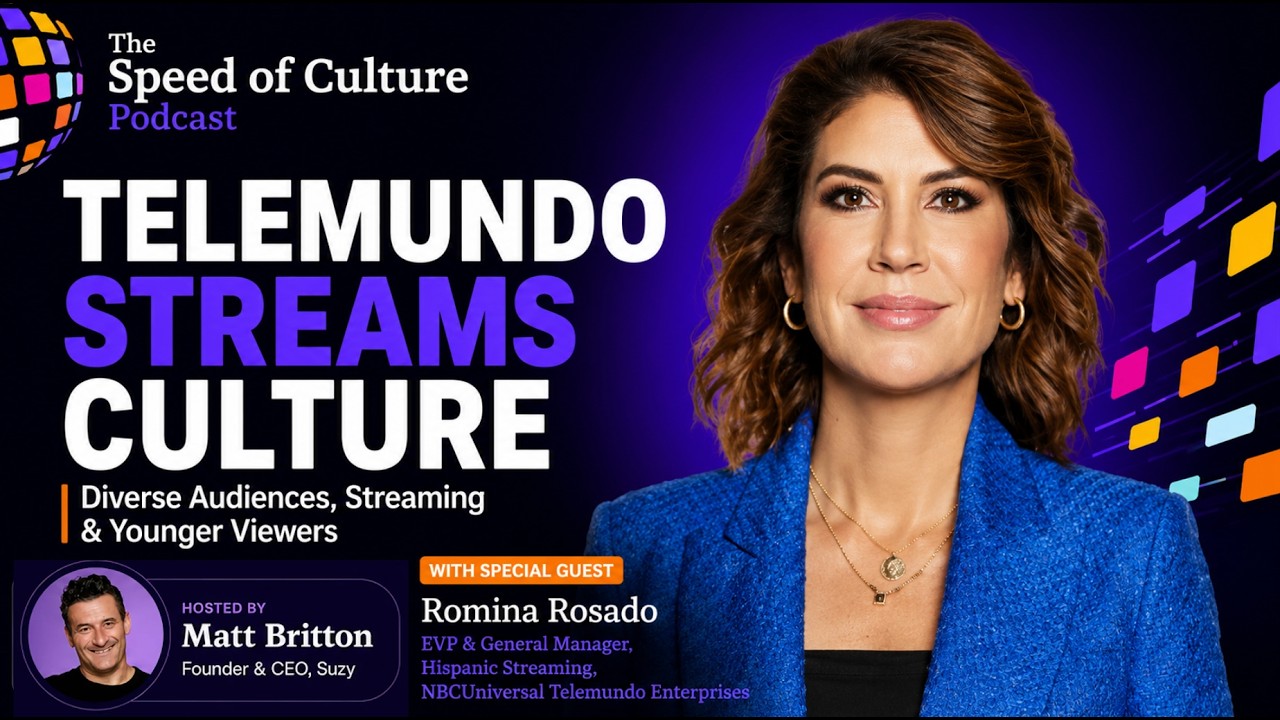
In the rapidly evolving digital landscape, understanding how audiences consume media has become essential for media companies and brands alike. Matt Britton, founder and CEO of Suzy, an AI-powered consumer intelligence platform, sits down with Romina Rosado, Executive Vice President and General Manager of Hispanic Streaming at NBCUniversal Telemundo Enterprises, to explore the transformative shifts happening in media consumption, particularly within the Hispanic market.
This conversation reveals critical insights into streaming strategies, audience engagement, content diversification, and the future of entertainment in an increasingly digital world. Rosado brings decades of experience navigating digital transformation across legacy media organizations, from print to cable to broadcast.
Her perspective on how Telemundo is reaching diverse audiences across multiple platforms while maintaining relevance in a competitive streaming environment offers valuable lessons for media executives, marketing leaders, and content strategists.
As traditional television consumption declines among younger demographics and streaming services dominate the market, understanding how to balance SVOD (subscription video-on-demand) and AVOD (ad-supported video-on-demand) models, along with leveraging first-party data for personalization, has become paramount.
The Speed of Culture Podcast Episode 96, recorded on March 12, 2024, features an in-depth discussion of how companies like Telemundo are navigating these challenges and positioning themselves for long-term success in the streaming era. Listen to the full episode on The Speed of Culture Podcast.
The Hispanic audience in the United States represents one of the most dynamic and complex demographic groups in America, yet it remains significantly under-recognized by many advertisers and media companies. Romina Rosado emphasizes that the Hispanic audience is far from monolithic.
The U.S. Hispanic population comprises individuals from diverse national origins, generations, and cultural backgrounds, each with distinct media consumption preferences and habits. This diversity requires media companies to adopt nuanced strategies that acknowledge both the shared cultural values and the distinct differences within this community.
One critical insight Rosado highlights is that the younger Hispanic demographic, particularly those under 34, consumes content bilingually and across multiple platforms simultaneously. Young Latinos often move seamlessly between English and Spanish-language content, depending on context, mood, and social setting.
This bilingual consumption pattern is fundamentally different from previous generations and presents unique opportunities for media companies willing to invest in culturally relevant, language-appropriate content that reflects the authentic experiences of modern Hispanic Americans.
Latino households are frequently multi-generational and multi-ethnic, adding additional layers of complexity to content strategy and distribution. These households may include grandparents who prefer traditional Spanish-language television, parents who consume a mix of English and Spanish content, and children who primarily engage with digital platforms and streaming services.
For media companies like Telemundo, this means creating content ecosystems that serve all members of the family while maintaining authentic cultural representation.
Rosado notes that Telemundo faces a particular challenge in this environment: with two-thirds of their audience under the age of 34, the company must develop strategies to reach viewers who are increasingly abandoning traditional linear television in favor of non-linear, on-demand platforms.
This generational shift requires both understanding platform preferences and creating content forms that resonate with digital-native audiences who expect personalization, variety, and control over their viewing experience.
Navigating the Shifting Landscape of Streaming and Content Distribution
The streaming landscape underwent seismic shifts in 2023 and beyond, marked by the writers' strike, production delays stemming from COVID-19 impacts, and fundamental changes in consumer behavior. Despite these disruptions, the demand for quality content has remained remarkably strong, suggesting that audiences are hungry for compelling stories regardless of format or distribution channel.
However, the way content is produced, distributed, and monetized has transformed significantly.
Rosado advocates for a diversified approach to content distribution that balances traditional television with multiple streaming platforms, including both subscription-based (SVOD) and ad-supported (AVOD) models.
This diversification strategy acknowledges that different audience segments prefer different consumption models. Some viewers are willing to pay premium prices for ad-free experiences, while others prefer ad-supported options that require lower financial commitment.
By offering content across both models, media companies can maximize reach and revenue while meeting diverse customer preferences.
Telemundo's parent company, NBCUniversal, provides significant competitive advantages through NBCUnified, a comprehensive advertising sales strategy that leverages data to understand audiences across the entire NBCUniversal ecosystem.
This approach enables Telemundo to offer advertisers access to a vast network of potential customers, the company serves 226 million monthly engagements across NBCUniversal's platforms.
This scale gives Telemundo unprecedented ability to reach Hispanic audiences across multiple touchpoints, from traditional television to streaming services to social media channels.
The transition from linear television to streaming requires more than simply moving existing content to new platforms. It demands a fundamental rethinking of content form factors, distribution windows, and audience engagement strategies.
Rosado emphasizes that understanding specific consumption patterns and preferences allows media companies to create targeted content offerings that resonate with different audience segments. This might mean developing short-form content for TikTok, extended versions for YouTube, and traditional-length programming for Peacock or television broadcasts.
The Role of Personalization and Data in Audience Engagement
In an era where audience attention is fragmented across numerous platforms and content options, personalization has emerged as a critical differentiator for media companies.
Rosado explains that understanding the audience through first-party data collection and analysis allows media companies like Telemundo to tailor content and marketing messages that resonate on a deeply personal level.
This personalization extends beyond simply recommending content based on viewing history; it involves creating content specifically designed for particular platforms, audience segments, and consumption contexts.
Data-driven personalization enables Telemundo to leverage its extensive library of content (decades of Spanish-language programming, recent acquisitions, and original productions) to create highly relevant offerings on fast-growing channels, free ad-supported platforms, and subscription services.
By understanding the specific consumption patterns of their viewers, including what time of day they watch, what genres they prefer, whether they watch with family or alone, and how they engage with interactive features. Telemundo can optimize content placement and recommendation strategies.
Telemundo's approach includes creating content specifically designed for social media platforms like TikTok and YouTube, while also ensuring this content can be monetized effectively through advertising, sponsorships, or bundled distribution.
This multi-platform strategy recognizes that younger audiences often discover content through social media before deciding to engage with full episodes or series on dedicated streaming platforms. By meeting audiences where they naturally gather, media companies can build awareness and drive engagement that translates into subscription sign-ups or advertising impressions.
The personalization imperative also extends to understanding how different audience segments prefer to discover content. Some viewers rely on algorithmic recommendations, while others prefer curated collections or social recommendations from friends.
Effective media companies will invest in multiple discovery mechanisms that accommodate diverse preferences and behavior patterns. This investment in understanding audience psychology and behavior represents a significant advantage for companies like Telemundo that have invested heavily in data infrastructure and analytics capabilities.
Addressing Advertiser Perceptions and the Value of Hispanic Media
Despite the significant purchasing power of the Hispanic market. Hispanic consumers account for hundreds of billions in annual spending across virtually all product categories, the Hispanic audience remains considerably under-recognized and under-invested by many major advertisers.
This perception gap represents both a challenge and an opportunity for media companies like Telemundo.
Rosado acknowledges that educating advertisers about the value and opportunity within the Hispanic market remains a critical part of Telemundo's strategy.
Many advertisers underestimate Hispanic purchasing power or assume that marketing to Hispanic audiences requires separate, specialized campaigns rather than recognizing that inclusive, diverse advertising can enhance brand value across all audiences.
Additionally, many advertisers fail to recognize that effectively reaching Hispanic consumers often requires investing in both Spanish and English language content, as many Hispanic households consume both languages.
By demonstrating the reach, engagement, and demographic value of their audience across various platforms, Telemundo can attract more advertising dollars and position itself as an essential partner for brands seeking to reach one of America's most economically powerful demographic segments.
This requires not only sharing viewership data but also providing case studies demonstrating how Hispanic-focused marketing drives business results, increases brand affinity, and builds long-term customer relationships.
The challenge of advertiser education becomes more complex in an era of streaming and data fragmentation, where traditional television ratings provide clear audience metrics while streaming engagement can be more opaque.
Media companies like Telemundo that invest in transparent, standardized metrics for streaming engagement will have a significant advantage in convincing advertisers to increase investment. This transparency builds trust and demonstrates accountability, both critical factors when asking advertisers to shift budget from proven channels to emerging platforms.
The Evolution of Media Consumption: From Linear to Non-Linear and Digital
The media consumption habits of younger audiences differ dramatically from previous generations in ways that fundamentally challenge traditional media business models.
For example, college students today rarely maintain television sets in their dorm rooms. Instead, they consume entertainment exclusively through streaming services on personal devices, laptops, tablets, and smartphones.
This generational shift requires media companies to completely rethink their approach to content form factors and distribution methods.
For Telemundo, this evolution necessitates creating content that works effectively across devices, screen sizes, and contexts. What works as a 42-minute broadcast episode may not work as effectively for a mobile viewer consuming content during a commute.
Short-form content, vertical video, and interactive elements become increasingly important for engaging mobile-first audiences. Simultaneously, media companies must maintain the ability to produce traditional-length programming that serves audiences who prefer immersive, cinematic viewing experiences on larger screens.
Telemundo has embraced this evolution by focusing on creating short-form content, developing digital-first productions, and leveraging "digital windows" for its programming.
Digital windows, exclusive periods when content is available on streaming platforms before, after, or instead of traditional broadcast windows, have become strategically important for driving engagement on streaming platforms while maintaining traditional television's role in the overall distribution strategy.
The shift toward non-linear, on-demand viewing also creates opportunities for media companies willing to invest in real-time, interactive content experiences.
Watching a sporting event live on a streaming platform creates fundamentally different engagement opportunities than watching a recorded episode, particularly when audiences can interact with each other or with the content in real-time. Understanding and optimizing for these different viewing contexts becomes essential for modern media companies.
Live and Interactive Content: Building Community and Loyalty
Live sports and major events continue to serve as significant drivers of audience engagement, particularly in attracting younger demographics who might not otherwise watch traditional television.
Romina Rosado highlights the success of live sports broadcasts (World Cup matches, Olympic coverage, Latin American sporting events) on platforms like Peacock.
These events not only draw large audiences but also create powerful opportunities for interactive and communal viewing experiences that strengthen audience loyalty and engagement.
The power of live content extends beyond sports. Live events, award shows, and interactive programs create shared cultural moments that audiences want to experience together, whether physically in the same room or virtually across a distributed audience.
Telemundo has recognized this opportunity and is developing strategies to create events and experiences that extend beyond traditional broadcasts, tapping into the fandom and cultural passion surrounding their properties.
BravoCon, the annual celebration of Bravo's programming and community, demonstrates how media companies can leverage fan passion to create experiences that strengthen emotional connections with content and brands.
Telemundo is exploring similar strategies to create events and experiences that deepen audience engagement and create content opportunities that extend value beyond the initial broadcast or streaming episode.
This might include live fan experiences, interactive voting opportunities, virtual watch parties, or creator collaborations that bring audiences into the production and creative process.
Interactive content also creates opportunities for second-screen engagement, where viewers actively participate in conversations about content on social media while watching.
Media companies that encourage and facilitate this second-screen engagement (through hashtags, branded social campaigns, real-time polling, or creator collaborations) can significantly increase the cultural relevance and reach of their programming.
The Path Forward: Digital Transformation in Legacy Media
Rosado's career journey, moving from print to cable to broadcast to digital streaming, illustrates both the challenges and opportunities inherent in driving digital transformation within legacy media organizations.
Successfully navigating this transformation requires more than simply uploading existing content to new platforms; it demands a fundamental rethinking of how content is created, distributed, and monetized while preserving the core strengths and competitive advantages of the legacy organization.
The ability to manage this complex transition while maintaining stakeholder alignment, from talent and production teams to advertisers and investors, requires exceptional leadership and strategic clarity.
Media executives like Rosado must balance short-term financial performance with long-term positioning, maintain organizational culture while driving change, and develop new capabilities without abandoning proven business processes.
This experience underscores the critical importance of adaptability and the ability to manage change effectively.
Media companies that remain static in their approach to content and distribution face inevitable decline as consumer preferences and technological capabilities evolve.
However, those willing to experiment, learn, and adapt, while maintaining clarity about their audience and their unique value proposition, position themselves to thrive across multiple technological and business model transitions.
Telemundo's continued success will depend on its ability to maintain focus on understanding and serving the Hispanic audience while embracing new technologies, distribution platforms, and monetization models.
This requires ongoing investment in data infrastructure, audience research, and original content development that reflects the authentic experiences and cultural values of modern Hispanic Americans across all generations and language preferences.
Key Takeaways
- Bilingual, Multicultural Content Strategy: The Hispanic audience is diverse, with younger viewers consuming content in both English and Spanish across multiple platforms. Media companies must develop content ecosystems that serve bilingual audiences and recognize the distinct preferences within multi-generational households.
- Diversified Distribution and Monetization Models: Success in streaming requires balancing subscription (SVOD) and ad-supported (AVOD) platforms while maintaining traditional television distribution. Different audience segments prefer different consumption models, and media companies that offer flexibility maximize reach and revenue.
- Data-Driven Personalization at Scale: Understanding audiences through first-party data enables media companies to create highly personalized content recommendations and marketing messages. Leveraging extensive content libraries and platform ecosystems allows companies like Telemundo to serve audience segments with remarkable precision.
- Educating Advertisers About Market Value: The Hispanic market represents enormous purchasing power, yet remains under-recognized by many advertisers. Media companies must invest in demonstrating reach, engagement, and business impact to attract appropriate advertising investment.
- Adapting to Non-Linear, Mobile-First Consumption: Younger audiences increasingly consume content on mobile devices and streaming platforms rather than traditional television. Media companies must create content that works effectively across devices while maintaining cinematic experiences for audiences who prefer immersive viewing.
Frequently Asked Questions
How is Telemundo adapting to the shift from linear television to streaming?
Telemundo is embracing a multi-platform strategy that includes creating short-form content optimized for social media and mobile devices, developing digital-first productions, and leveraging digital windows to drive engagement on streaming platforms.
The company is also investing in understanding platform-specific consumption patterns to optimize content distribution and recommendation strategies. Additionally, Telemundo continues to maintain strong traditional television programming while expanding its presence across Peacock and other streaming services.
Why is the Hispanic audience important for media companies and advertisers?
The Hispanic population in the United States represents one of the largest and most economically powerful demographic groups in America. Hispanic consumers account for hundreds of billions in annual spending, yet the market remains significantly under-recognized by many advertisers.
Hispanic households are increasingly diverse and multicultural, with younger viewers consuming content bilingually and across multiple platforms. For media companies, reaching this audience requires understanding its nuances and investing in culturally relevant content that reflects authentic experiences.
What role does data play in Telemundo's content and marketing strategy?
Data-driven decision-making is central to Telemundo's strategy. By collecting and analyzing first-party data about audience preferences, consumption patterns, and engagement behaviors, Telemundo can create highly personalized content recommendations, optimize platform-specific content delivery, and demonstrate audience value to advertisers.
NBCUniversal's comprehensive ad sales strategy, NBCUnified, leverages data across the entire platform ecosystem to serve 226 million monthly engagements, providing advertisers with unprecedented reach and targeting precision.
How can brands effectively reach Hispanic audiences through streaming platforms?
Brands seeking to reach Hispanic audiences should work with media partners like Telemundo that understand the cultural nuances and consumption patterns of Hispanic viewers.
This includes investing in both English and Spanish language content, understanding that many Hispanic consumers are bilingual and bicultural, recognizing generational differences in platform preference and content consumption, and partnering with media companies that can provide data-driven targeting and measurement capabilities to demonstrate campaign effectiveness.
Looking Ahead
The transformation of media consumption, from linear television to streaming, from passive viewing to interactive engagement, from demographic targeting to personalized relevance, represents one of the most significant shifts in entertainment industry history.
Companies like Telemundo that invest in understanding their audiences deeply, embrace new technologies and distribution platforms, and maintain authentic cultural representation will position themselves for sustained success in this evolving landscape.
For media executives, marketing leaders, and content strategists seeking to understand these transformations and their implications, The Speed of Culture Podcast offers invaluable insights from industry leaders navigating these challenges in real-time.
Matt Britton's conversations with executives like Romina Rosado provide the kind of firsthand perspective and strategic thinking that guides successful organizational transformation.
To dive deeper into consumer trends, media strategy, and digital innovation, explore these resources:
- Suzy. AI-powered consumer intelligence platform providing real-time consumer insights
- The Speed of Culture Podcast. Weekly conversations with leaders shaping culture and business strategy
- Generation AI. Matt Britton's book exploring AI's impact on consumer behavior and business strategy
- AI keynote speaker. Engaging speaking presentations on AI, consumer trends, and digital transformation
- Speaker HQ. Resources and speaking opportunities for business and industry events

%20(400%20x%20100%20px)%20(300%20x%2050%20px)%20(150%20x%2050%20px).avif)