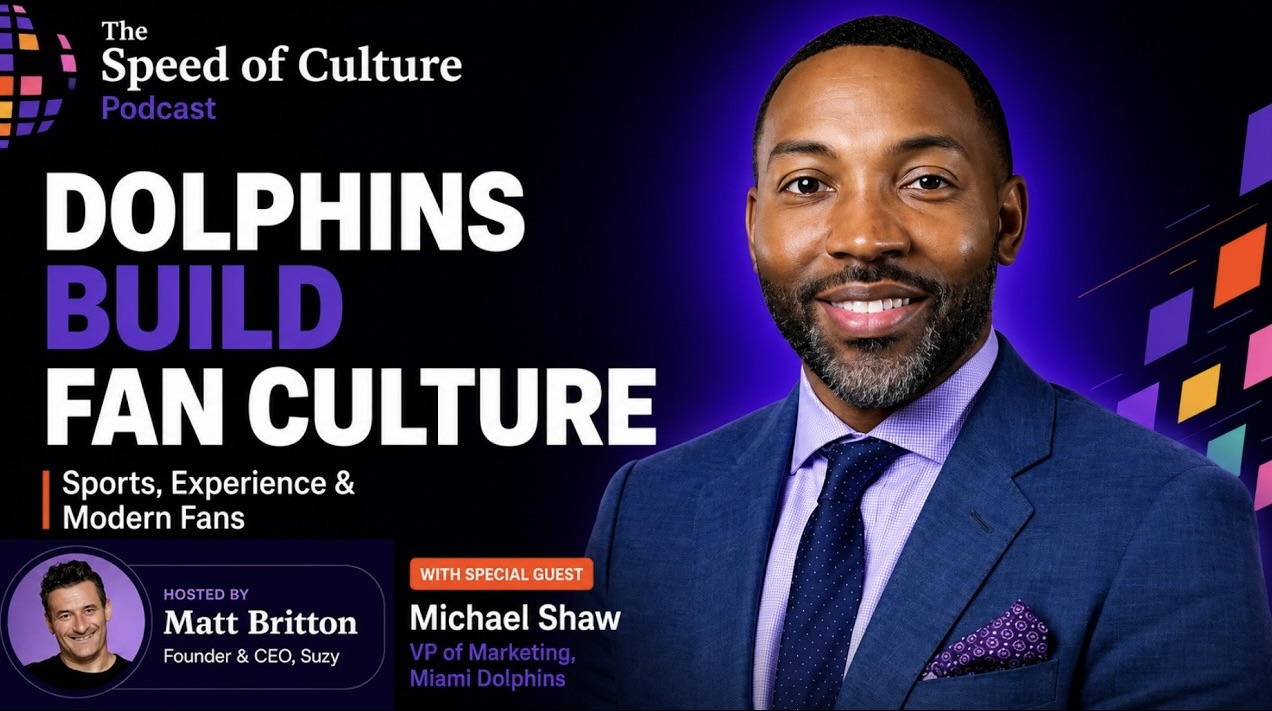
In an era where demographic shifts fundamentally reshape consumer behavior and brand expectations, sports franchises face unprecedented challenges in capturing the attention of younger audiences. The Miami Dolphins, one of the National Football League's most storied franchises, has emerged as a forward-thinking organization that recognizes the critical importance of understanding and engaging Gen Z consumers. In Episode 78 of The Speed of Culture Podcast, Matt Britton, founder and CEO of Suzy, the AI-powered consumer intelligence platform, sat down with Michael Shaw, VP of Marketing at the Miami Dolphins, to explore how the franchise is reshaping its marketing approach to resonate with the next generation of fans.
The conversation reveals a sophisticated, data-driven strategy that transcends traditional sports marketing playbooks. Rather than relying solely on game-day experiences and celebrity endorsements, the Miami Dolphins are deploying advanced consumer intelligence, cultural relevance, and authentic engagement tactics to build meaningful connections with Gen Z audiences. This episode provides invaluable insights for marketing leaders, sports industry professionals, and anyone seeking to understand how legacy brands maintain relevance in an increasingly competitive and digitally-native consumer landscape.
The podcast explores the intersection of sports, culture, technology, and youth engagement, examining how the Dolphins' marketing initiatives reflect broader trends in consumer behavior, social media strategy, and the growing importance of brand authenticity. Michael Shaw's leadership demonstrates that winning Gen Z requires more than flashy campaigns; it demands a fundamental shift in how organizations think about fan relationships, community involvement, and cultural positioning.
Understanding Gen Z: The New Foundation of Sports Marketing
The fundamental challenge facing modern sports franchises involves understanding what Gen Z consumers actually value. Unlike previous generations, Gen Z, typically defined as those born between 1997 and 2012, grew up in a digitally native environment characterized by unprecedented access to information, global connectivity, and skepticism toward traditional advertising. This demographic doesn't simply consume sports; they participate, critique, and demand authenticity from the brands they support.
The Miami Dolphins' marketing strategy, guided by Shaw's vision, begins with a commitment to deeply understanding Gen Z psychographics rather than relying on outdated demographic assumptions. The franchise invests in consumer intelligence tools and methodologies to identify what drives engagement, loyalty, and advocacy among younger fans. This approach reflects a broader industry recognition that Gen Z consumers demonstrate fundamentally different priorities compared to millennial or Gen X audiences.
Data reveals that Gen Z sports fans prioritize experiences over passive consumption, value social impact and corporate responsibility, and expect brands to take authentic positions on issues that matter to them. The Miami Dolphins have internalized these insights, recognizing that simply being a football team is insufficient. The organization must function as a cultural entity that understands and reflects the values of the communities it serves.
The Dolphins' commitment to research-driven marketing demonstrates Shaw's belief that successful engagement requires moving beyond gut instinct or outdated playbooks. By leveraging consumer intelligence platforms and continuous feedback mechanisms, the franchise gathers real-time data about fan sentiment, preferences, and behaviors. This intelligence-first approach enables the organization to make informed decisions about content creation, partnership development, and community initiatives.
Moreover, the Dolphins recognize that Gen Z is inherently skeptical of organizations that appear inauthentic or performative in their engagement efforts. The franchise has therefore prioritized transparency and genuine community involvement over surface-level sponsorships or celebrity partnerships that don't align with organizational values. This commitment to authenticity has become a differentiating factor in an industry often characterized by transactional relationships with fans.
Digital-First Strategy: Meeting Gen Z Where They Are
The modern sports franchise exists in a complex media ecosystem where traditional television viewership has declined among younger audiences while social media engagement has exploded. The Miami Dolphins' digital-first marketing strategy acknowledges this fundamental shift in how content is consumed, shared, and discussed.
Michael Shaw emphasizes that engaging Gen Z requires a sophisticated understanding of platform dynamics, content formats, and community management practices. Rather than simply repurposing traditional broadcast content for social media platforms, the Dolphins create platform-specific content that respects the norms, expectations, and communication styles native to each channel. This approach demonstrates recognition that Gen Z audiences quickly detect and dismiss inauthentic brand voice or content that appears designed by committees lacking genuine cultural understanding.
The franchise's social media strategy reflects several key principles identified through consumer intelligence research. First, the Dolphins prioritize user-generated content and fan participation over brand-controlled narratives. This approach recognizes that Gen Z trusts peer recommendations and authentic fan voices more than official organizational communications.
Second, the Dolphins understand the critical importance of speed and relevance in social media engagement. Cultural moments move rapidly in Gen Z-dominated spaces, and brands that fail to capitalize on trends or respond swiftly to emerging conversations risk appearing out-of-touch or irrelevant. The organization has developed internal processes and partnerships that enable rapid content creation and distribution, ensuring the Dolphins remain part of ongoing cultural conversations.
Third, the franchise recognizes that different platforms serve different functions in Gen Z consumer journeys. TikTok drives awareness and entertainment, Instagram facilitates community connection and aspiration, Twitter enables real-time conversation and humor, and YouTube serves as a long-form content destination. By tailoring content strategy to each platform's unique characteristics, the Dolphins maximize engagement across the digital ecosystem rather than attempting one-size-fits-all approaches that inevitably fail to resonate.
The Dolphins' digital strategy also reflects understanding that Gen Z values entertainment and authenticity alongside promotional messaging. Rather than constant hard-sell approaches, the franchise invests in content that entertains, educates, or inspires, creating value for followers independent of immediate commercial objectives. This content-first philosophy builds goodwill and positions the Dolphins as a cultural entity worthy of attention, not merely a commercial organization demanding consumer support.
Community Integration and Social Impact: Marketing with Purpose
Beyond digital engagement and traditional sponsorships, the Miami Dolphins' marketing strategy increasingly centers on community integration and social impact initiatives that resonate with Gen Z values. Research consistently demonstrates that younger consumers expect organizations to demonstrate commitment to social responsibility, environmental sustainability, and community wellbeing. The Dolphins have therefore positioned social impact not as a peripheral corporate responsibility initiative, but as central to brand identity and marketing narrative.
Michael Shaw's leadership reflects understanding that Gen Z supports organizations that take stands on issues they care about. Rather than attempting to remain neutral or apolitical, a stance that typically reads as inauthentic to younger audiences, the Dolphins have identified core values and social initiatives aligned with both community needs and organizational mission.
The franchise's community programs create authentic touchpoints that generate marketing value while delivering genuine social impact. Youth football clinics, scholarship programs, job training initiatives, and community health partnerships create real-world connections between the organization and Gen Z consumers who increasingly evaluate brands through the lens of social contribution. These initiatives generate organic word-of-mouth, social media content, and positive brand associations that prove far more valuable than traditional paid advertising.
The Dolphins also recognize that Gen Z consumers, increasingly diverse and globally connected, expect organizations to reflect demographic reality and embrace inclusivity. The franchise's commitment to diverse hiring, inclusive marketing representation, and community partnerships across different demographic groups demonstrates alignment with Gen Z values rather than appearing as performative or surface-level diversity gestures.
Furthermore, the franchise understands that community impact creates storytelling opportunities that resonate across digital and traditional platforms. A youth receiving a scholarship through the Dolphins' education initiative becomes a brand ambassador whose authentic story carries more persuasive power than any manufactured advertisement. By consistently generating real-world impact stories, the organization maintains a steady stream of authentic, emotionally resonant content that supports marketing objectives while advancing genuine community benefit.
Data-Driven Personalization: Technology Meets Fan Engagement
The modern sports franchise generates unprecedented volumes of consumer data through digital platforms, ticket sales systems, mobile applications, merchandise purchases, and social media interactions. The Miami Dolphins, guided by Shaw's strategic vision, have invested in sophisticated data analytics and artificial intelligence technologies that transform this information into actionable insights supporting personalized fan engagement at scale.
Consumer intelligence platforms, including solutions like Suzy, enable the Dolphins to understand fan preferences, behaviors, and interests with granular detail. Rather than treating all ticket holders or social media followers identically, the organization can identify specific audience segments and tailor communications, offers, and experiences accordingly.
This data-driven personalization approach reflects several critical advantages in the modern marketing environment. First, it maximizes engagement by ensuring communications align with individual preferences and interests rather than broadcasting generic messages to broad audiences. Research demonstrates that personalized communications generate significantly higher engagement rates, conversion rates, and customer satisfaction compared to one-size-fits-all approaches.
Second, personalization enables more efficient marketing investment. Rather than distributing marketing budgets across broad campaigns with uncertain reach and impact, the Dolphins concentrate resources on segments most likely to respond positively to specific messages.
Third, personalized engagement builds stronger customer relationships and loyalty. When the Dolphins recognize that a specific fan prefers certain content types, game formats, or experience styles, and tailor interactions accordingly, the organization demonstrates understanding and respect for individual preferences. This recognition builds emotional connection and perceived value that transcends transactional relationships and fosters genuine fan loyalty.
The franchise also leverages predictive analytics to identify fans at risk of disengagement, anticipate lifecycle moments, and recommend experiences most likely to resonate based on individual preference profiles. This proactive approach to fan relationship management prevents churn, identifies expansion opportunities, and maximizes customer lifetime value.
Authentic Partnership Strategy: Collaboration Over Exploitation
Gen Z skepticism extends to commercial partnerships, particularly those appearing inauthentic or exploitative. The Miami Dolphins' partnership strategy, therefore, reflects careful consideration of brand alignment, shared values, and mutual benefit. Rather than accepting any sponsorship opportunity offering financial resources, the franchise prioritizes partnerships that genuinely align with organizational values and enable authentic co-creation of value for fans.
This selective partnership approach demonstrates recognition that Gen Z consumers quickly identify and resent brands perceived as mercenary or opportunistic. Aligned partnerships enable authentic storytelling that resonates with Gen Z values while generating commercial benefits.
The franchise also recognizes the importance of transparency in partnership relationships. Rather than hiding commercial arrangements, the Dolphins clearly communicate partnership details, demonstrating that relationships serve mutual interests while delivering genuine fan value. This transparency builds trust by showing that the organization isn't attempting to deceive or manipulate fans through hidden commercial agendas.
Furthermore, the Dolphins prioritize partnerships enabling fan participation and creative expression. By designing partnerships that create value for the broader fan community rather than exclusively for corporate partners, the franchise demonstrates commitment to fan interests that generates positive brand sentiment.
Measuring Success: Moving Beyond Vanity Metrics
A critical element of the Dolphins' Gen Z-focused marketing strategy involves sophisticated measurement and accountability practices that move beyond vanity metrics such as social media follower counts or website traffic. Michael Shaw emphasizes the importance of measuring marketing impact against objectives that genuinely matter to the organization: fan engagement, loyalty, revenue growth, and community impact.
The franchise invests in analytics infrastructure that tracks customer journeys across multiple touchpoints, measuring how different marketing initiatives influence fan behavior, attendance patterns, merchandise purchases, and social media engagement. Rather than crediting individual campaigns with isolated metrics, the Dolphins understand that modern marketing success results from coordinated, multichannel efforts that require sophisticated attribution modeling to properly measure.
This measurement approach enables the organization to identify which initiatives drive actual business results and allocate budgets accordingly. By measuring complete customer journeys rather than isolated campaigns, the Dolphins optimize overall marketing effectiveness.
The franchise also emphasizes measuring brand health metrics that indicate long-term strategic progress. Brand awareness, consideration, preference, and sentiment among Gen Z audiences provide leading indicators of future revenue growth. By continuously monitoring these metrics, the Dolphins can assess whether marketing efforts successfully shift perceptions and strengthen brand positioning among younger demographics.
Key Takeaways
- Data-Driven Decision Making: The Miami Dolphins leverage consumer intelligence platforms like Suzy to understand Gen Z preferences, enabling personalized fan engagement at scale and optimized marketing investment allocation.
- Digital-First Platform Strategy: Success with Gen Z requires platform-specific content that respects community norms and communication styles, moving beyond one-size-fits-all approaches that fail to resonate with younger audiences.
- Authentic Community Integration: Genuine social impact initiatives and community partnerships generate stronger brand loyalty than performative gestures, creating authentic storytelling opportunities that resonate across digital and traditional channels.
- Personalization at Scale: Data analytics enable the franchise to recognize individual fan preferences and tailor communications accordingly, building emotional connection and loyalty that transcends transactional relationships.
- Measurement Accountability: Sophisticated attribution modeling and customer journey tracking enable the organization to measure marketing impact against business objectives, supporting evidence-based budget allocation and continuous optimization.
Frequently Asked Questions
How is the Miami Dolphins' approach to Gen Z marketing different from traditional sports marketing strategies?
Traditional sports marketing often relied on broadcast advertisements, celebrity endorsements, and generic messaging distributed to broad audiences. The Dolphins' approach prioritizes data-driven personalization, platform-specific content creation, authentic community engagement, and measurement discipline. Rather than assuming what Gen Z wants based on historical precedent, the franchise invests in consumer intelligence to understand what actually resonates with younger audiences.
What role does consumer intelligence technology play in the Dolphins' marketing strategy?
Consumer intelligence platforms enable the franchise to understand fan preferences, behaviors, and interests at granular detail, moving beyond demographic assumptions to psychographic understanding. The Dolphins use these insights to identify audience segments, personalize communications and experiences, predict fan behavior, and measure marketing impact against business objectives.
How can other organizations apply the Dolphins' Gen Z engagement model to their industries?
The Dolphins' framework translates across industries by emphasizing research-driven audience understanding, authentic engagement, digital-first strategy, and measurement discipline. Organizations should invest in consumer intelligence, audit authenticity in current marketing efforts, evaluate digital presence, align purpose with audience values, and establish measurement practices that track complete customer journeys.
Why is authenticity so critical for Gen Z marketing, and how can organizations demonstrate genuine commitment?
Gen Z grew up in a digitally native environment with unprecedented access to information and peer-generated content, making them exceptionally skilled at identifying inauthentic corporate messaging and advertising. Organizations can demonstrate authenticity by aligning marketing messages with actual practices, involving diverse audiences in creative processes, taking meaningful positions on issues important to target audiences, and measuring social impact alongside commercial objectives.
Looking Ahead: The Evolution of Sports Marketing and Cultural Relevance
The conversation between Matt Britton and Michael Shaw reflects broader industry recognition that sports franchises must evolve beyond traditional entertainment providers to become cultural entities that engage audiences across multiple dimensions. As Gen Z increasingly dominates consumer behavior and social influence, organizations that successfully navigate this demographic transition will build sustainable competitive advantage.
The Miami Dolphins' commitment to data-driven marketing, authentic community engagement, and digital innovation provides a blueprint for sports organizations and brands across industries seeking to build meaningful relationships with Gen Z audiences. As the podcast demonstrates, winning Gen Z requires more than flashy campaigns or celebrity endorsements, it demands genuine commitment to understanding what younger audiences value and delivering authentic benefit that extends beyond commercial transactions.
For more insights on Gen Z consumer behavior, AI-powered consumer intelligence, and marketing innovation, explore Suzy, the platform enabling organizations to understand and engage modern consumers at scale. For additional perspectives on culture, consumer behavior, and business adaptation, listen to The Speed of Culture Podcast featuring Matt Britton.
For a deeper exploration of how organizations can adapt to rapid change and leverage AI for competitive advantage, discover Generation AI by Matt Britton. For organizations seeking to communicate insights about generational trends, consumer behavior, and marketing innovation, consider engaging Matt Britton as an AI keynote speaker to inspire teams and shape strategic thinking around cultural relevance and consumer adaptation. For teams seeking ongoing guidance on marketing excellence and team development, explore Speaker HQ resources.

%20(400%20x%20100%20px)%20(300%20x%2050%20px)%20(150%20x%2050%20px).avif)