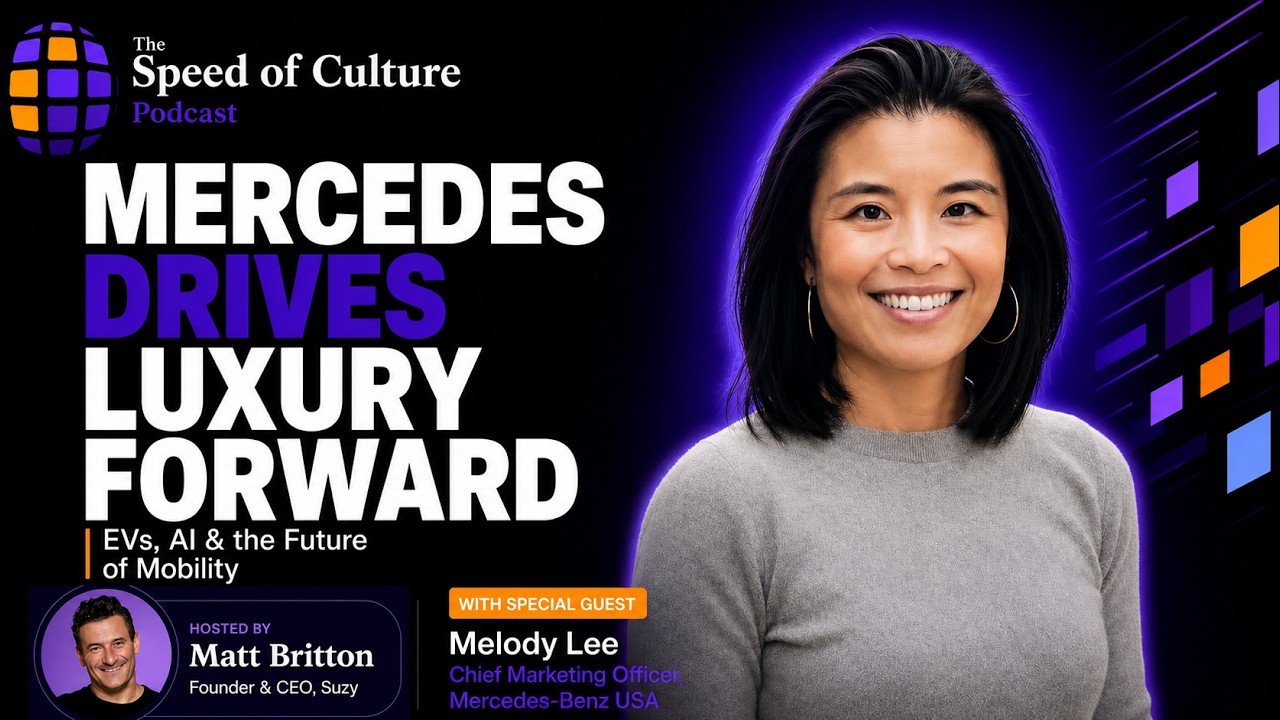
Luxury in Motion: How CMO Melody Lee is Steering Mercedes-Benz into the Future
In an era of unprecedented transformation, luxury automotive brands face a unique challenge: honoring heritage while embracing radical innovation. Few leaders understand this balance better than Melody Lee, Chief Marketing Officer at Mercedes-Benz USA.
In Episode 132 of The Speed of Culture Podcast, hosted by Matt Britton, founder and CEO of Suzy, the AI-powered consumer intelligence platform, Melody provides a masterclass in navigating the post-COVID automotive landscape, driving electrification strategy, and building meaningful connections with the next generation of luxury consumers.
With over 140 years of Mercedes-Benz heritage anchoring her decisions, Melody shares her vision for transforming the luxury automotive industry through consumer insights, bold marketing initiatives, and strategic innovation. Her journey from crisis communications specialist to architect of Mercedes-Benz's modern marketing approach offers invaluable lessons for executives navigating industry disruption.
As automotive supply chains stabilize, consumer preferences shift toward electrification, and artificial intelligence reshapes the customer experience, Mercedes-Benz under Melody's leadership demonstrates how legacy brands can remain at the forefront of innovation while staying true to their core values.
The automotive industry has always been cyclical, but the current transformation differs fundamentally from previous market shifts. Unlike gradual evolutions of the past, today’s disruption is occurring simultaneously across multiple dimensions: supply chain restructuring, powertrain electrification, autonomous vehicle development, artificial intelligence integration, and generational preference shifts.
This episode captures a pivotal moment in automotive history, where the decisions being made today will define the luxury cars, and the driving experiences, of tomorrow.
The Post-COVID Automotive Landscape: A Seismic Shift in Consumer Mobility
The global pandemic didn't just disrupt supply chains and production schedules, it fundamentally rewired consumer behavior, preferences, and expectations in the automotive industry. Melody Lee emphasizes that the changes witnessed over the past three to four years have been more dramatic than transformations that occurred over the previous hundred years in automotive history.
This unprecedented acceleration forced luxury brands to rethink everything from product strategy to customer touchpoints. Dealerships closed, production halted, supply chains fractured, and consumer mobility patterns shifted dramatically. Yet paradoxically, demand for luxury vehicles remained resilient, and in some cases stronger than pre-pandemic levels.
Supply Chain Realities and Inventory Dynamics
The post-COVID period revealed critical vulnerabilities in traditional automotive supply chain models. With semiconductor shortages, component delays, and manufacturing constraints dominating headlines, luxury brands faced a paradoxical situation: extreme scarcity coinciding with strong demand.
Where pre-pandemic automotive marketing emphasized selection and choice, post-pandemic markets prioritized availability and immediate gratification. Melody acknowledges that Mercedes-Benz navigated these challenges by maintaining transparency with consumers about inventory levels and production timelines.
Rather than oversell or create false expectations, the brand focused on delivering honest communication, a strategic decision that built trust during uncertain times. As supply stabilized and inventory normalized, this commitment to transparency became a differentiator that strengthened customer relationships.
Evolving Consumer Mobility Preferences
The pandemic triggered a fundamental reassessment of personal transportation. With concerns about crowded public transit, airplanes, and trains, consumers rekindled their appreciation for private vehicles.
The trend toward road trips, weekend getaways, and personal mobility experiences accelerated adoption of premium vehicle ownership, particularly in urban markets where transit alternatives previously dominated consumer choices.
The luxury consumer base, traditionally affluent, financially resilient, and positioned to weather economic uncertainty, demonstrated remarkable spending power despite pandemic disruptions. Mercedes-Benz's focus on serving this premium segment, combined with clear communication about availability and value, created a competitive moat that persisted even as industry conditions normalized.
The Pivot Toward Powertrain Flexibility
Perhaps the most significant strategic shift involves the brand's approach to electrification. Rather than mandating a dramatic switch from internal combustion engines to purely electric powertrains, Mercedes-Benz recognized that different customer segments have different mobility needs, infrastructure access, and readiness for electric vehicles.
This insight informs Mercedes-Benz's strategy to offer consumers the luxury of choice. The post-COVID market demonstrated that consumer adoption of new technologies follows psychological and practical constraints, not corporate mandates.
Charging infrastructure remains limited in many regions, consumer anxiety about range and battery longevity persists, and many luxury buyers still prefer the proven reliability of traditional powertrains. Mercedes-Benz's pragmatic approach (offering hybrid, plug-in hybrid, and fully electric options) acknowledges these realities while positioning the brand to serve the entire spectrum of luxury consumer preferences.
Building Brands and Navigating Risk: Melody Lee's Leadership Philosophy
Melody's career trajectory provides a masterclass in strategic risk-taking and continuous learning. Her journey from crisis communications specialist to luxury brand marketing leader reveals principles that resonate far beyond the automotive industry.
The Power of High-Stakes Assignments
Early in her career at Hill+Knowlton Strategies, Melody specialized in crisis communications for Fortune 500 corporations. This role demanded composure under pressure, rapid information processing, and the ability to craft messaging in environments where missteps carried significant consequences.
Her transition to Cadillac marked a significant inflection point. As head of brand marketing, she oversaw comprehensive brand strategy, global planning, strategic partnerships, and marketing innovation during a period when Cadillac was actively reinventing itself for modern consumers.
Subsequently, at Herman Miller and Knoll, Melody expanded her perspective beyond automotive, learning how different industries approached brand positioning, customer engagement, and premium pricing. This diverse experience informed her arrival at Mercedes-Benz with a unique vantage point.
Strategic Insights for Aspiring Leaders
Melody's advice to professionals navigating career decisions emphasizes embracing calculated risks. Rather than seeking comfortable roles within known domains, she advocates for pushing beyond comfort zones, taking assignments that stretch capabilities, and extracting maximum learning from challenging situations.
The professionals who advance most rapidly, she observes, are those willing to attempt difficult things and learn from inevitable failures.
Competitive Context: Why Leadership Matters Now
The automotive industry has become extraordinarily competitive. Traditional competitors like BMW and Audi pursue their own electrification and AI strategies, while new entrants, from Tesla to Chinese EV manufacturers, challenge established premium positioning.
In this hypercompetitive environment, differentiation through authentic brand connection, consumer understanding, and cultural relevance becomes essential. Mercedes-Benz cannot compete on price; it must compete on heritage, innovation, and emotional resonance.
Shaping Generational Luxury: Building Aspirational Brands for Future Buyers
One of Melody's most forward-thinking priorities involves building brand affinity among consumers who aren't yet ready to purchase. Luxury brand preferences form during youth, often years before purchasing power materializes.
For Gen Z and emerging Gen Alpha consumers, today's Mercedes-Benz touchpoints, from motorsports sponsorships to pop culture collaborations to digital-first campaigns, are planting seeds that will influence purchasing decisions one or two decades hence.
Generational Marketing and Long-Term Brand Equity
Mercedes-Benz's strategy involves presence and authenticity in youth culture spaces. Sponsorships of esports tournaments, collaborations with gaming platforms, partnerships with musicians and cultural icons, and engagement with user-generated content campaigns create touchpoints where Gen Z encounters the brand as a cultural force.
Research shows that brand preferences solidify during formative years, typically between ages 16 and 24. When young consumers develop emotional attachments to premium brands during this critical window, those preferences often remain stable throughout their adult lives.
Through AI-powered analytics and platforms like Suzy, the brand can understand precisely which messaging resonates with younger audiences and refine campaigns based on genuine consumer response rather than executive instincts.
Lifetime Value Creation Through Early Engagement
From a business perspective, building brand affinity among future generations represents extraordinary long-term value creation. A 20-year-old who develops Mercedes-Benz preference today may carry that loyalty throughout their productive earning years.
When they reach their thirties and forties, the traditional peak luxury vehicle purchasing demographic, that cultivated preference influences not just their personal purchasing but also their influence over peers and family members.
Powering the Shift to Electric: Marathon, Not Sprint
The electrification of luxury automobiles represents one of the most consequential strategic challenges in automotive history. Melody characterizes this transformation as a marathon rather than a sprint.
The Realities of Infrastructure and Consumer Adoption
Despite ambitious political targets for EV adoption, infrastructure expansion remains a genuine constraint. Public charging networks remain underdeveloped in many regions, and home charging installation creates barriers for apartment dwellers and urban consumers.
Mercedes-Benz plans to establish 2,500 high-power charging stations, directly investing in removing adoption barriers rather than waiting for third parties. This vertical integration reinforces brand differentiation while addressing real consumer concerns.
Luxury consumers also engage in rational economic analysis of total cost of ownership, comparing residual values, service costs, and long-term reliability. By offering hybrids and plug-in hybrids, Mercedes-Benz enables gradual transition toward electrification.
Strategic Portfolio Expansion
The brand currently offers six fully electric models and continues developing plug-in hybrid options, including the upcoming hybrid GLC.
The upcoming electrified CLA will offer both battery electric vehicle (BEV) and high-tech 48-volt electrified internal combustion engine options. By sharing platforms and design languages across powertrain types, Mercedes-Benz achieves manufacturing efficiency while offering meaningful consumer choice.
Long-Term Vision and Environmental Commitment
Mercedes-Benz maintains ambitious sustainability targets, including a commitment to net carbon-neutral operations by 2039 across the entire vehicle lifecycle.
This dual approach, pragmatic near-term flexibility paired with aggressive long-term sustainability goals, balances stakeholder expectations with realistic market dynamics.
Driving Innovation with Artificial Intelligence
Artificial intelligence is reshaping both automotive marketing and the driving experience itself. Melody's vision for AI integration spans the entire customer journey, from initial awareness through dealership interaction to in-vehicle experience and post-sale service.
AI-Enhanced Customer Service and Dealership Experience
AI-powered chatbots provide immediate responses to inquiries and personalized vehicle recommendations. Dealership systems use machine learning to identify high-intent buyers and tailor pitches accordingly.
Importantly, AI augments rather than replaces human interaction. For luxury consumers, trust-building, status affirmation, and expert guidance remain irreplaceable elements of the purchase journey.
In-Vehicle AI and Connected Driving
Mercedes-Benz's collaboration with ChatGPT enables drivers to interact with their vehicles using natural language. Vehicles can adjust comfort settings based on learned preferences, recommend optimal routes, and provide proactive maintenance recommendations.
This integration positions Mercedes-Benz as an innovator in human-vehicle interaction, creating emotional connections and practical benefits that enhance satisfaction and loyalty.
Data Privacy and Consumer Trust
As AI systems collect increasing amounts of customer data, Mercedes-Benz prioritizes transparent communication about data usage and robust privacy protections.
The brand treats privacy not as a compliance burden but as a customer relationship asset, building trust among increasingly sophisticated luxury consumers.
Key Takeaways
- Post-COVID Transformation Exceeds a Century of Change: The automotive industry has experienced more disruption in the past four years than during the previous hundred.
- Consumer Choice Drives Adoption: Offering hybrid, plug-in hybrid, and fully electric options creates a sustainable path toward electrification.
- Generational Brand-Building Creates Long-Term Advantage: Early engagement with Gen Z and Gen Alpha builds lifetime loyalty.
- AI Augments Human Interaction: The most effective strategies combine machine learning efficiency with human expertise.
- Authentic Cultural Leadership Differentiates Luxury Brands: Cultural relevance builds emotional connections that transcend product specifications.
Frequently Asked Questions
How is Mercedes-Benz addressing the electric vehicle infrastructure challenge?
Mercedes-Benz is investing directly in infrastructure, including plans for 2,500 high-power charging stations. The brand is also pursuing partnerships with public entities and other automakers to support broader expansion.
What is Mercedes-Benz's strategy for engaging younger consumers who aren't yet car buyers?
The brand builds early affinity through cultural partnerships, gaming collaborations, music festival sponsorships, and digital-first campaigns. This generational strategy influences purchasing decisions one or two decades into the future.
How does artificial intelligence enhance the customer experience at Mercedes-Benz?
AI powers personalized chatbots, predictive dealership analytics, and in-vehicle natural language interfaces through partnerships like ChatGPT. Post-sale, AI analyzes driving patterns to provide proactive service recommendations.
Why is electrification described as a marathon rather than a sprint?
Consumer adoption faces real constraints including infrastructure gaps and total-cost-of-ownership concerns. Mercedes-Benz respects these realities by offering flexible powertrain options while maintaining long-term sustainability commitments.
The Role of Consumer Intelligence in Strategic Decision-Making
Throughout her discussion with Matt Britton, Melody emphasizes the importance of understanding consumer behavior, preferences, and aspirations. Platforms like Suzy provide real-time consumer insights that inform product development and campaign strategy.
Rather than assuming market readiness for electrification, she asks consumers directly about their concerns, preferences, and timelines. This evidence-based approach ensures marketing investments address genuine consumer needs.
For executives seeking to emulate Mercedes-Benz's success, the blueprint is clear: invest in robust consumer intelligence capabilities, create feedback loops that inform strategy, and maintain humility about what you don't know.
Looking Ahead
The conversation between Melody Lee and Matt Britton captures a transformative moment in automotive history, where legacy heritage and radical innovation must coexist.
To explore the full conversation and discover additional insights from industry leaders, visit:
- Suzy. The AI-powered consumer intelligence platform providing real-time insights for brands navigating market disruption
- The Speed of Culture Podcast. Matt Britton's weekly podcast featuring interviews with world-class innovators and disruptors
- Generation AI. Matt Britton's bestselling book on

%20(400%20x%20100%20px)%20(300%20x%2050%20px)%20(150%20x%2050%20px).avif)