Oreo spent no media dollars and roughly five minutes of production time to win Super Bowl XLVII. When the lights went out in the Superdome in 2013, the brand posted a single image with the line "You can still dunk in the dark," and generated a level of earned attention that a $5 million in-game spot could not buy. The lesson most marketers took away was about speed. The actual lesson was about preparation.
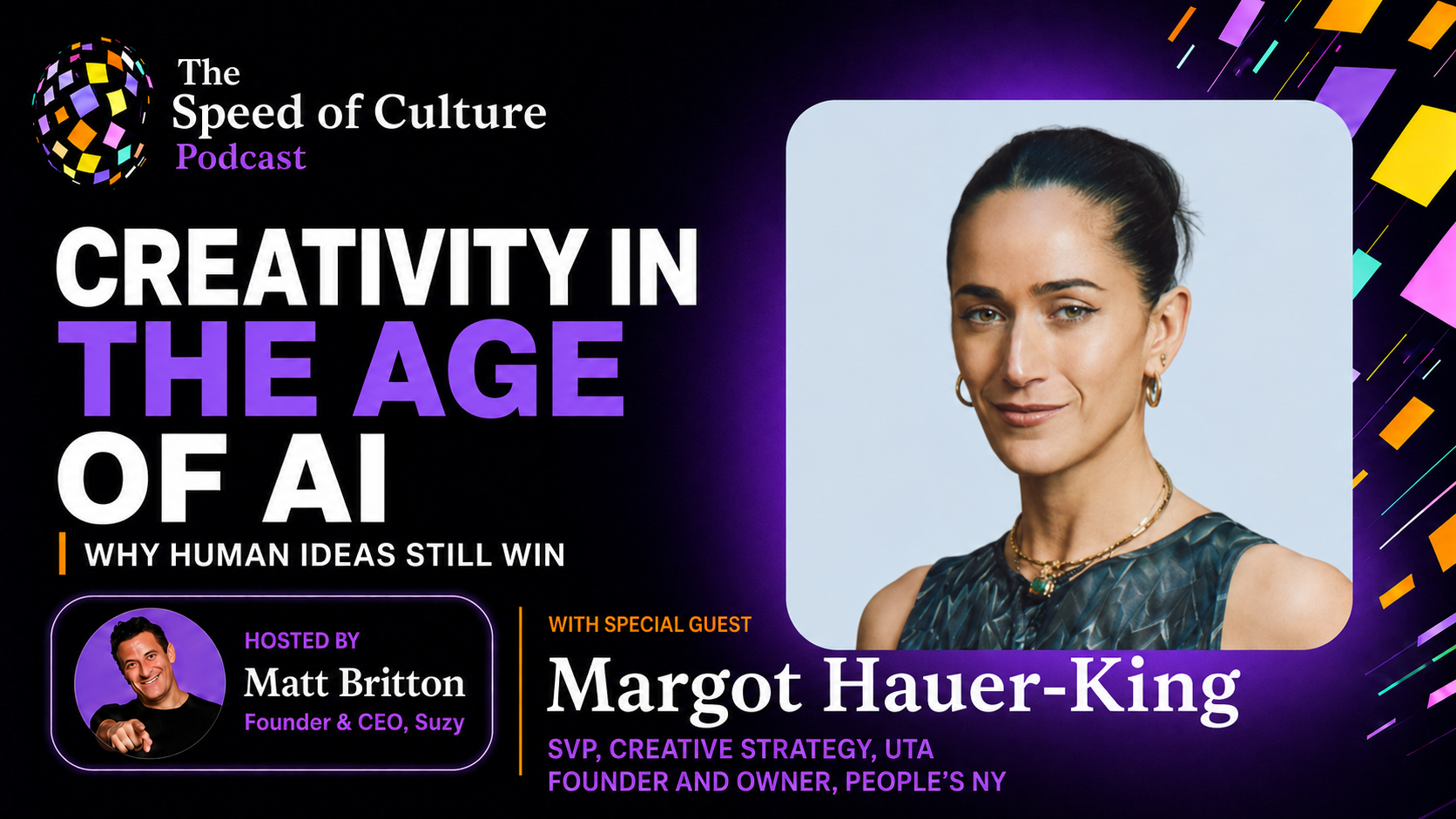
That distinction sits at the center of a recent conversation on The Speed of Culture podcast between Matt Britton and Margot Hauer-King, SVP of Creative Strategy at United Talent Agency and founder of the New York bar People's. Hauer-King's framing is the most useful metaphor for cultural participation to surface in years: hockey players on the bench do not take their skates off and open a book. They sit in full gear, watching the ice, ready to jump the boards in a second. Most brands, by contrast, are in the locker room when the play develops.
For any consumer trends keynote speaker tracking where brand strategy is heading, this reframes the problem. The constraint on cultural relevance is readiness, ahead of creative talent or media budget. And readiness is a function of self-knowledge rather than spend.
The business stakes are concrete. Marketing budgets have compressed to roughly 7.7 percent of company revenue according to Gartner's CMO Spend Survey, down from 9.1 percent the prior year, while performance expectations have moved in the opposite direction. Britton, founder of Suzy and bestselling author of Generation AI, has spent two decades watching brands respond to that squeeze by cutting the exact capability that makes cheap ideas work. They cut the deep strategic work first because it does not produce a deliverable this quarter. Then they cannot act when a moment arrives, so they buy attention instead of earning it, at ten times the cost.
The Attention Problem Most Brands Are Solving Backwards
Hauer-King describes her current obsession as a question of posture: everyone is screaming for attention, so how do brands create cultural moments rather than chase them. The distinction matters because chasing is the default behavior and it is structurally expensive.
Chasing means a trend surfaces, an agency spots it, a brief goes out, legal reviews it, three stakeholders weigh in, and the brand arrives ten days late to a conversation that lasted four. Consumers have become expert at detecting this. Hauer-King's phrase for the failure mode is the "flash of lightning" approach to culture, showing up in people's lives in a completely different way with no established permission to be there. Audiences have seen enough of it to smell a rat immediately.
The nuance she adds is important for CMOs who read this as an argument against reactive marketing. It is not. A brand that has done the foundational work can absolutely jump on a lightning flash moment. The permission comes from the prior work, not from the moment itself. Britton makes a parallel argument in his AI keynote presentations: the organizations that move fastest on new technology are the ones who already know what they are trying to become, regardless of innovation budget, which turns every new capability into an obvious yes or an obvious no.
That is decision compression in practice. Clarity at the strategic layer removes deliberation at the tactical layer.
The Dinner Party Test: A Framework for Cultural Relevance
Hauer-King's working model for brand strategy is a dinner party, and it holds up better than most segmentation frameworks.
A good host has a home that looks the way it looks and can cook what they can cook. That is brand identity, fixed and specific. But a good host also thinks about the guest: dietary restrictions, who prefers white wine, who should sit next to whom. That is consumer empathy. A great dinner party is the fusion of the two.
Brands fail in one of two directions from there. Over-broadcast is the first: this is who I am, this is who I am, now sit down while I present a deck about why you will enjoy my dinner party. Over-catering is the second, and it is the more common failure now. The brand empathizes so aggressively that it loses its own definition and ends up serving six different meals to six different guests. It becomes everything to everyone, which in a saturated market means it becomes nothing to anyone.
The operational takeaway is that the empathy work is only half the assignment. Most insights functions are heavily resourced on the guest side and thin on the host side. They can describe the consumer in granular detail and cannot articulate what the brand actually believes. Britton built Suzy to close the speed gap on the consumer half of that equation, but the identity half is internal work that no research platform can do for you.
Monoculture and Micro-Communities Are Happening Simultaneously
Two contradictory claims dominate consumer strategy conversations right now. One camp argues monoculture is dead, replaced by infinite micro-communities. The other points to the Super Bowl, Wicked, and a handful of global album releases as evidence that shared culture is alive.
Both are correct, and the resolution is more interesting than either position.
Hauer-King's read is that radical individualism is not new. What is new is the infrastructure that lets it become visible. As an angsty thirteen-year-old, her route to community was listening to Green Day. There were no subreddits, no TikTok subcultures, no gaming friend groups. The identity impulse existed; the distribution for it did not. The long tail in media did not create individualism, it exposed it.
At the same time, convergence has intensified. Walk through SoHo and you will see groups of people in the same outfit, the same sunglasses, the same drink. A UTA colleague gave Hauer-King a word for it: carcinization, the evolutionary phenomenon where unrelated crustaceans repeatedly evolve into crab-like forms. Different starting points, same final shape.
Britton's addition on the podcast is that some of this convergence is not chosen at all. Lookalike modeling and algorithmic gatekeeping push consumers into cohorts they never opted into. One person buys the jeans and the white top, and ten thousand psychographic matches get served the same thing within a week. The result reads as cultural consensus but is partly a targeting artifact.
For brand strategy, the practical implication is that "is monoculture dead" is the wrong question. The right question is which layer of culture a given moment belongs to, because the response should differ.
Separating Evergreen Trends From Flash-in-the-Pan Moments
Hauer-King describes culture as happening on a million planes at once, and sorts it into three horizons. Evergreen trends are close to human truths, and wellness sits somewhere in that bucket. Medium-term trends have real duration but will end. Flash-in-the-pan moments last days or weeks.
The diagnostic she and Britton work through on the episode is pickleball. Pickleball itself may be the short-term trend, with players already migrating to padel. The durable trend underneath is accessible tennis: people want competitive physical activity with a social layer and a low skill barrier. The manifestation churns. The insight does not.
Mahjong is the live test case. Britton notes that in South Florida, a game his mother's generation played has become a fixture among young mothers buying premium tile sets, with influencer adoption accelerating it. Hauer-King went from never receiving a Mahjong event request at People's to receiving three, then got served an ad for a Mahjong weight-loss app, two trends fused into one product. Whether Mahjong sits in the medium-term or flash bucket is genuinely unresolved. What is resolved is that a brand cannot make that call without knowing what it stands for first. As she puts it, you cannot see the amazing thing fly past you and recognize it as yours if you have not done the work.
This is the discipline Britton brings to his Gen Z keynote sessions: trend reporting without a durability filter is entertainment. Trend reporting with one is strategy.
Why Relatability Now Outperforms Polish
The talent conversation has shifted on the same axis. The old model was a famous face on a billboard. Julia Roberts or Tom Cruise conferred prestige and the transaction ended there.
What creators built instead is frequency. A parasocial relationship depends on repeated contact with a person as themselves rather than in character, which is why a creator who posts daily and brings family into the frame builds a bond that a movie star cannot replicate through film work alone. Alix Earle is the current reference point, and the comparison to the Kardashians is instructive: the Kardashians effectively invented social media behavior on television before the platforms existed, and creators now run the same playbook natively. The relationship is also more commercially entangled. Creators take equity in the businesses they talk about and launch their own, which changes the negotiation from a media buy to a partnership.
The through-line both Britton and Hauer-King identify is relatability over perfection. Audiences do not reward the creator who flexes Cartier and Chanel while performing a flawless life. They may follow that account, but the sentiment underneath is not affection. The people who earn genuine loyalty show the warts, name the mistake, admit the hard decision. Britton points out the same dynamic governs LinkedIn: "I'm killing it" performs worse than "I made a call today I am not sure about."
Brands should read this as a mandate, not a nicety. The first wave of sustainability marketing proved it. Brands that claimed perfection got labeled greenwashers. Brands that said this is not perfect and here is what we are working on retained trust. Hauer-King's explanation for why this is landing harder now is what a friend of hers called the corridor of uncertainty, a cricket term repurposed to describe the state of not knowing what is about to hit your desk. Political, climate, economic, and AI-driven employment anxiety are all running simultaneously and inescapably. In that environment, almost nobody is living in a perfect bubble, so almost nobody wants to be sold one.
Cultural Readiness Costs Less Than the Alternative
The budget argument closes the loop. CMOs are being told to do more with less, and the reflexive response is to cut strategy and keep media. Hauer-China's Oreo point inverts that logic. Dunk in the Dark cost effectively nothing and beat every advertiser who spent seven figures that night. It worked because 360i and Oreo had already built the internal structure, the approval speed, and the brand clarity required to publish in minutes.
Her framing for CMOs: the question is not whether your budget will come and go, because it will. The question is how you use the budget you have. Spend it on the deep work, the right partners, and the internal alignment that puts you in position to have the best idea and act on it. The best ideas are rarely the most expensive ones.
That is the counterpoint worth stating plainly, because readiness is not a substitute for reach. A brand with no awareness cannot rely on earned moments to build a category position, and reactive cultural participation without distribution is a rounding error. The argument is about sequencing, not about abandoning paid media. Build the capability, then let the capability make your media work harder.
Key Takeaways for Business Leaders
- Audit the host, not just the guest. Most organizations can describe their consumer in detail and cannot articulate what the brand believes. Fix the second gap before commissioning more segmentation.
- Classify every trend by horizon before responding. Evergreen, medium-term, and flash-in-the-pan moments each require a different investment level and a different speed.
- Find the durable insight underneath the visible trend. Pickleball may fade. Accessible competitive social sport will not. Build against the second.
- Remove approval friction as a strategic project. Cultural readiness fails on internal process more often than on creative quality. Ideas die on the vine of ways of working.
- Replace polish with honesty in brand communication. In a period of sustained uncertainty, admitted imperfection outperforms manufactured perfection across both creator and brand content.
- Protect strategic budget when media budget contracts. Cheap ideas only work for organizations that already did the expensive thinking.
Frequently Asked Questions
What does cultural readiness mean for a brand?
Cultural readiness is a brand's ability to participate in a cultural moment credibly and quickly. It requires two things: clear internal agreement on brand identity and values, and an approval process fast enough to act within the life span of the moment. Brands with both can respond to viral moments in hours at almost no cost. Brands without either arrive late, spend more, and read as opportunistic.
How should brands decide which trends to participate in?
Sort the trend by durability first. Evergreen behaviors tied to human needs justify product and positioning investment. Medium-term trends justify partnerships and sustained content. Short-lived viral moments justify same-day reactive participation only, and only if the brand has established prior permission in that space. The filter question is whether the underlying insight, not the visible manifestation, connects to what the brand already stands for.
Why do creators outperform traditional celebrities for brand partnerships?
Frequency and unscripted access. Creators appear as themselves daily, which builds parasocial relationships that scripted performance cannot produce. That familiarity converts to purchase intent at a higher rate for many categories. The relationship structure has also changed, with creators taking equity and launching competing businesses, which turns partnerships into commercial negotiations rather than media buys.
How can brands do more with less on marketing budgets?
Reallocate rather than cut proportionally. Preserve the foundational work that establishes identity, cultural permission, and decision speed, because that capability multiplies the value of every dollar of media that follows. Oreo's Super Bowl XLVII post is the reference case: near-zero cost, category-defining outcome, made possible entirely by prior preparation.
What This Means Going Forward
The brands that will lead the next cycle are the ones who have done the unglamorous internal work of deciding who they are, then built the operating speed to act on that clarity when culture hands them an opening, whatever the size of their media budgets or social teams. Attention will keep fragmenting and consolidating at the same time. Readiness is the only posture that works in both conditions.
Britton has spent his career at the intersection of consumer behavior, AI, and brand strategy, advising Fortune 500 leaders on how to convert cultural signal into commercial action. Hear the full conversation with Margot Hauer-King on The Speed of Culture podcast, and to bring these frameworks to your next leadership event, explore Matt Britton's speaking platform.
Her closing mantra is worth keeping: leave people happier than you found them. It is a relationship strategy, and relationships are what compound when attention does not.

%20(400%20x%20100%20px)%20(300%20x%2050%20px)%20(150%20x%2050%20px).avif)