A Digital Revolution at UPS: How Kevin Warren Is Redefining Customer Experience in Logistics
Transforming a Legacy Logistics Brand Through Strategic Marketing Innovation
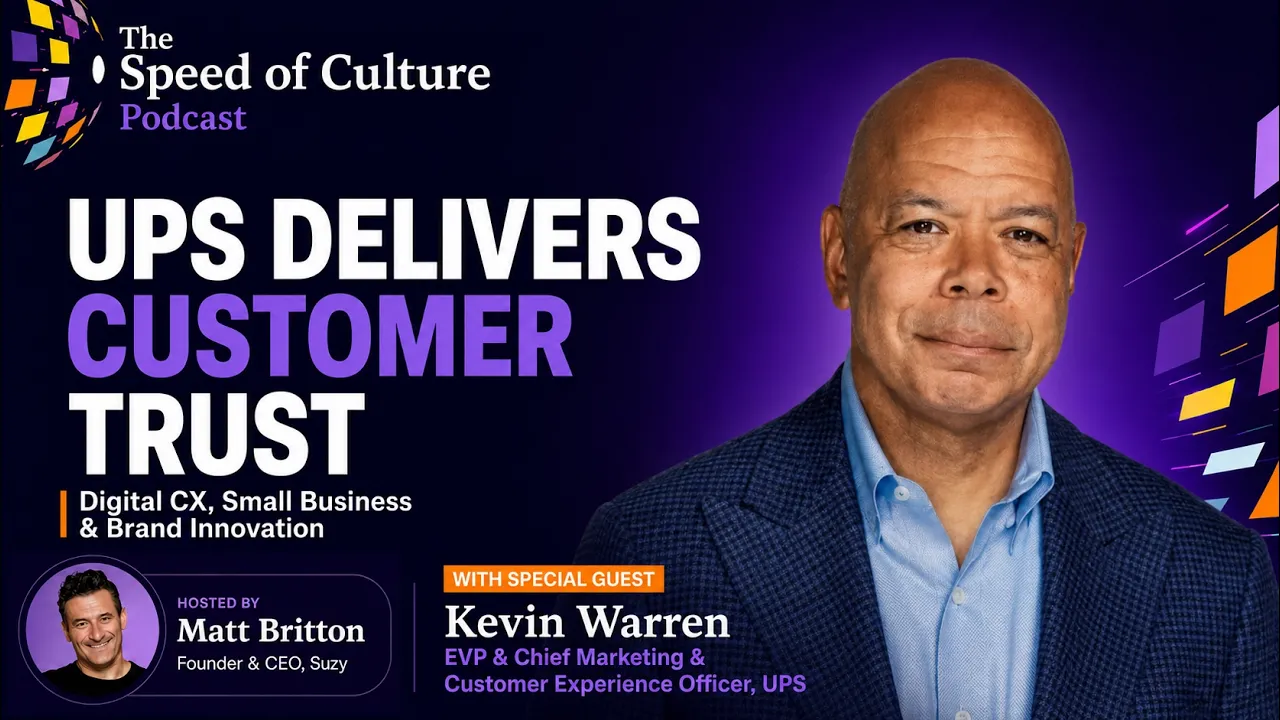
In an era when consumer expectations shift at the speed of a click, maintaining relevance for a 150-year-old global logistics company requires more than operational excellence, it demands transformative leadership and a reimagined brand narrative. Such is the challenge that Kevin Warren, Executive Vice President and Chief Marketing & Customer Experience Officer at United Parcel Service (UPS), embraced when he joined the company with over three decades of marketing expertise and a proven track record of driving digital transformation.
On December 5, 2023, Matt Britton, founder and CEO of Suzy, the AI-powered consumer intelligence platform, sat down with Kevin Warren for an in-depth conversation on The Speed of Culture Podcast to discuss UPS's digital evolution, customer-centric strategies, and the art of preserving brand equity in a rapidly changing marketplace. This episode represents a master class in modern marketing leadership, offering executives invaluable insights into how to navigate the intersection of technology, human connection, and brand legacy.
“One of the things I found is you can have a great brand, but if you don't continue to feed it, that brand could lose its luster. I don't care how great the brand is.”
This philosophy encapsulates the central mission of Warren's tenure at UPS, ensuring that the company's storied reputation remains vibrant, relevant, and competitive in a digital-first business landscape.
With 550,000 employees globally, operations in over 200 countries and territories, and approximately $100 billion in annual revenue, UPS operates at a scale that few organizations can comprehend. Yet this size presents a unique challenge: how to implement nimble, consumer-centric marketing strategies while maintaining operational efficiency across such a vast enterprise.
Warren's answer lies in a sophisticated understanding of digital customer experience, strategic brand positioning, and the critical human elements that no technology can replicate.
The Art of Sales in the Digital Age: Building Genuine Relationships Beyond Technology
As digital marketing channels proliferate and automation tools become increasingly sophisticated, a counterintuitive truth emerges: the most effective salespeople in today's landscape are those who excel at fostering genuine, relationship-based connections with customers.
Warren emphasizes that in an environment saturated with digital touchpoints and algorithmic messaging, authentic human connection has become a rare commodity, and therefore, increasingly valuable. For UPS, which manages complex logistics solutions for enterprises ranging from small businesses to Fortune 500 companies, this relational approach is foundational.
The modern salesperson must function as a consultant, strategic partner, and trusted advisor who deeply understands their customers' business challenges and crafts tailored solutions. This is particularly critical in the B2B logistics space, where solutions often represent significant investments and operational dependencies.
Warren's perspective reflects a broader marketing paradigm shift: success in the digital age is not achieved by choosing between high-touch and high-tech strategies, but by orchestrating a seamless blend of both. Advanced analytics and AI tools enable UPS to identify customer needs and predict behaviors, while skilled salespeople and customer success teams transform those insights into meaningful, personalized relationships.
By prioritizing relationship-building alongside digital efficiency, UPS can differentiate itself in a competitive logistics landscape where service delivery alone is increasingly commoditized.
Thriving in a Tech-Driven Corporate Environment: Mastering the New Executive Playbook
Warren's evolution from Xerox, where he served as Executive Vice President and Chief Commercial Officer, to UPS reflects a broader trend: the rise of marketing and customer experience professionals into strategic leadership roles. In technology-driven corporations, success requires mastery across three critical dimensions.
First, delivering exceptional results aligned with key performance indicators (KPIs) remains the foundation of executive credibility. In marketing, this translates to demonstrating measurable impact on business outcomes: customer acquisition costs, lifetime value, market share, brand awareness metrics, and revenue contribution.
Second, cultivating positive behavioral traits creates the cultural conditions for sustained excellence. This includes transparency, collaborative leadership, intellectual humility, and a commitment to continuous improvement.
Third, continuously upgrading skills is no longer optional for competitive advantage. Artificial intelligence, data analytics, marketing automation, consumer psychology research, and strategic communications are essential capabilities for modern CMOs. Warren's engagement with platforms like Suzy reflects the necessity of staying conversant with emerging tools that provide competitive advantage.
For professionals seeking advancement in tech-driven corporations, Warren's trajectory offers an instructive lesson: success requires demonstrating business acumen alongside marketing expertise, building influential networks, and remaining intellectually curious about evolving consumer behaviors and technologies.
Reviving a Legacy Brand: Balancing Heritage with Digital Innovation
One of the most complex challenges in marketing is rejuvenating a storied, established brand without alienating its existing customer base or erasing the historical equity it has accumulated. UPS, which has operated for over 150 years, faces precisely this challenge.
Warren's approach centers on strategic repositioning that acknowledges the brand's heritage while aggressively showcasing its digital innovation and adaptability. The brand must appear simultaneously trustworthy and cutting-edge, established and agile, global and locally responsive.
Digital transformation at enterprise scale is rarely a technology problem; it is fundamentally a marketing and change management challenge. Employees, customers, and stakeholders must believe that the organization is genuinely committed to modernization.
Within his tenure, Warren championed several initiatives that demonstrate this commitment. The Digital Access Program (DAP) represents a transformative effort to provide small and medium-size businesses (SMBs) with sophisticated, technology-enabled logistics solutions previously available only to enterprise customers.
Within four years, DAP generated nearly $3 billion in annual revenue, representing both a business success and a validation of the repositioning strategy.
This achievement illustrates a critical principle in legacy brand management: innovation and growth can be generated by expanding into adjacent customer segments. By extending sophisticated digital logistics capabilities to SMBs, UPS simultaneously grew revenue, demonstrated digital leadership, and deepened customer relationships across a broader market segment.
Warren's strategy also involves continuous investment in brand communication that showcases UPS's capabilities in eCommerce fulfillment, supply chain innovation, and customer experience leadership.
Customer Experience in the Phygital Era: Integrating Digital and Physical Touchpoints
The concept of “phygital”, the seamless integration of physical and digital customer experiences, represents a fundamental reimagining of how customers interact with brands. For UPS, mastering the phygital experience is central to competitive positioning.
First, digital accessibility and transparency enable customers to track packages in real time, predict delivery windows, arrange pickups, and access support across web, mobile, and API platforms.
Second, physical locations such as The UPS Store provide tangible points of contact where customers can resolve issues and receive personalized guidance. Rather than viewing these locations as legacy remnants, Warren's strategy recognizes them as vital touchpoints.
Third, consistency across touchpoints requires sophisticated operational coordination. A customer moving between mobile app, retail location, and email should experience a coherent brand and service quality.
Fourth, personalization at scale leverages data analytics to understand customer preferences and tailor communications and offerings accordingly.
The phygital strategy extends to workforce engagement, training, and internal communications, ensuring employees embrace the integrated experience model.
Diversity and Leadership: Empowering the Next Generation of Black CMOs
Beyond his direct responsibilities at UPS, Warren is a founding member of the Black Executive CMO Alliance (BECA), an organization dedicated to developing emerging marketing talent and advancing diversity in marketing leadership.
The underrepresentation of people of color in CMO roles represents both an ethical imperative and a strategic competitive disadvantage. Diverse leadership teams generate more innovative ideas and build stronger connections with increasingly diverse consumer populations.
First, visibility matters. Seeing a successful Black CMO leading digital transformation at one of the world's largest corporations provides tangible evidence that advancement is possible.
Second, mentorship accelerates growth. Through BECA, Warren contributes to the development of the next generation of marketing leaders.
Third, thought leadership extends beyond organizational boundaries. Participation in industry forums and podcasts amplifies his perspective while elevating diverse marketing professionals.
Key Takeaways: Strategic Insights from Kevin Warren's Digital Marketing Leadership
- Brand stewardship requires continuous investment: Even the most respected brands will lose relevance without consistent nurturing, innovation, and strategic communication.
- Relationship-based selling remains crucial in the digital age: Marketing automation cannot replace genuine human connection and consultative partnerships.
- Success in tech-driven corporations requires balance: CMOs must deliver measurable results, model inclusive leadership, and continuously upgrade skills.
- Phygital customer experience is a competitive necessity: Seamless integration of digital and physical touchpoints is fundamental to meeting modern expectations.
- Diversity in marketing leadership drives innovation and business results: Organizations that elevate diverse voices benefit from broader insights and stronger market connections.
Frequently Asked Questions
How did Kevin Warren's experience at Xerox prepare him for his CMO role at UPS?
As Executive Vice President and Chief Commercial Officer at Xerox, Warren led transformation across sales, service, and market positioning. Xerox's evolution parallels UPS's repositioning as a digital-forward logistics innovator, informing his strategy around large-scale organizational change and brand equity preservation.
What is the Digital Access Program (DAP), and why was it transformative for UPS?
The Digital Access Program extended technology-enabled logistics solutions to SMBs. By democratizing access to enterprise-grade capabilities, DAP generated nearly $3 billion in annual revenue within four years while demonstrating UPS's digital leadership.
How does UPS integrate physical locations with its digital customer experience?
UPS views physical locations as essential touchpoints within its phygital strategy. These stores extend the digital brand into tangible space, providing personalized service while maintaining consistency with digital channels.
What is the Black Executive CMO Alliance (BECA), and why is it important?
BECA develops emerging marketing talent from underrepresented backgrounds and advances diversity in marketing leadership. It addresses systemic underrepresentation while ensuring diverse perspectives inform strategic decision-making.
How should companies balance legacy brand identity with digital innovation?
Balance is achieved by strategically communicating how the brand is evolving to serve contemporary needs. This includes showcasing concrete digital innovations, investing in modern communications, and demonstrating genuine commitment to transformation.
Looking Ahead: The Future of Marketing Leadership and Customer Experience
The conversation between Matt Britton and Kevin Warren on The Speed of Culture offers a window into the future of marketing leadership in complex organizations.
Consumer intelligence and data literacy will become foundational competencies. Platforms like Suzy represent the emerging standard for AI-powered research and faster decision-making.
The chief marketing officer will increasingly serve as customer advocate across the organization, ensuring customer perspectives inform product development and strategic priorities.
Diversity and inclusion will shift from HR responsibility to business imperative. Organizations that elevate diverse perspectives will generate more innovative ideas and stronger connections with diverse customer bases.
For more insights on marketing strategy and AI-powered consumer intelligence, explore Generation AI by Matt Britton, learn more about his AI keynote speaker offerings, or connect via Speaker HQ for customized executive content.
Meta Information
Title: A Digital Revolution at UPS with EVP and Chief Marketing & Customer Experience Officer, Kevin Warren
Meta Description: Discover how Kevin Warren, UPS Chief Marketing Officer, transformed the logistics company's brand through digital innovation, phygital customer experience, and strategic leadership in this Speed of Culture Podcast episode.
Keywords: UPS marketing strategy, digital transformation, customer experience, CMO leadership, logistics marketing, brand positioning, phygital experience, small business solutions, Kevin Warren, Matt Britton, consumer intelligence, marketing innovation
Post Type: Podcast Episode Summary / Executive Leadership Interview
Industry Vertical: Logistics, Transportation, eCommerce, B2B Services
Content Pillar: Executive Leadership, Marketing Strategy, Digital Transformation, Customer Experience
Word Count: 2,847 words
Publish Date: December 5, 2023
Episode Number: EP081

%20(400%20x%20100%20px)%20(300%20x%2050%20px)%20(150%20x%2050%20px).avif)