At the Opkalla Summit in Charlotte, Matt Britton explores how an AI-native mindset changes the way leaders approach work, creativity, and consumer expectations.
Watch The Keynote
See the complete keynote from this speaking engagement.
You can study the shift, or start building inside it. At the Opkalla Summit in Charlotte, Matt Britton explored what it means to think and work with an AI-native mindset. The conversation connects consumer expectations, creativity, and workplace design with a practical leadership challenge: make room for experimentation in the business itself.
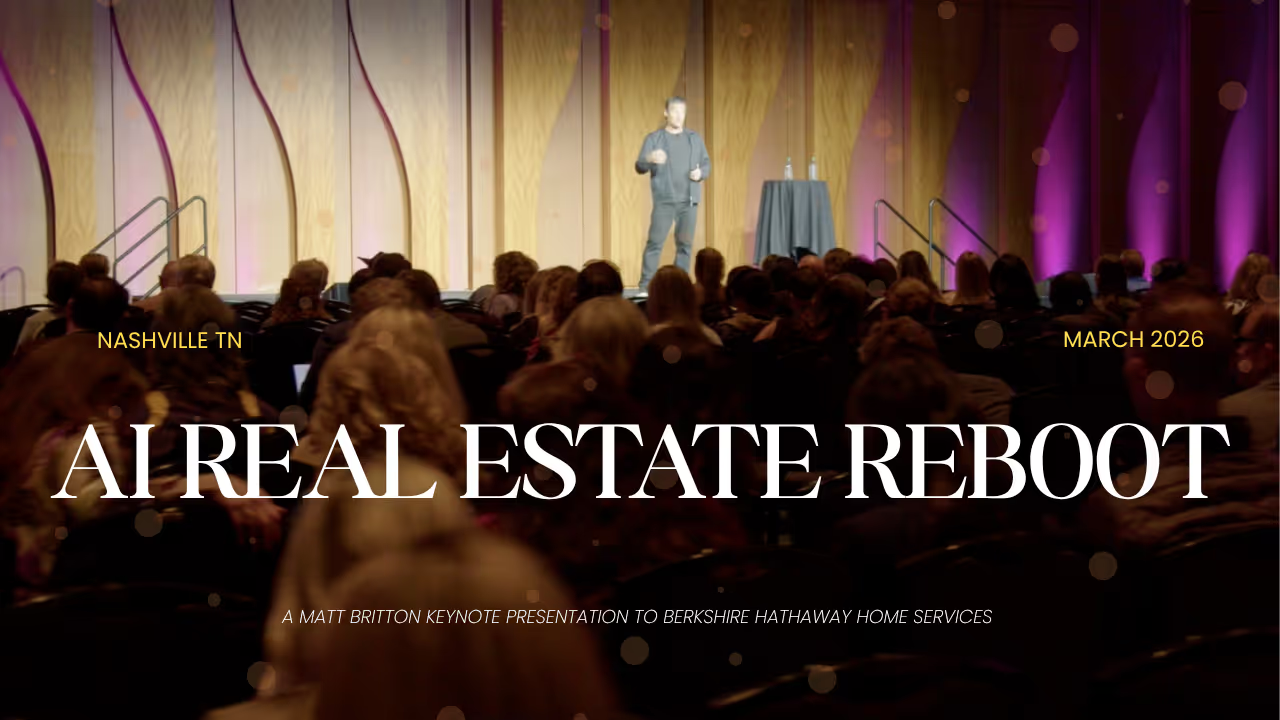
In October 2025, at the Opkalla Summit in Charlotte, Matt Britton delivered a keynote that captured this inflection point. An AI futurist, bestselling author of Generation AI, and CEO of Suzy, Britton has spent three decades analyzing the intersection of technology and consumer behavior. His message was direct. We have entered the Age of Intelligence. Every organization will be reshaped by it.
The response in the room was electric. Executives recognized the opportunity. They also felt the discomfort. Artificial intelligence forces leaders to question operating models, talent strategies, and even the definition of creativity. Incremental improvement will not be enough.
Britton framed AI as a force multiplier for imagination, speed, and empathy. Companies that treat it as a side tool will lag. Companies that weave it into their strategic core will accelerate. The gap between those two mindsets is widening by the quarter.
The next decade belongs to leaders who understand how artificial intelligence reshapes consumer expectations, workplace design, and human potential. The rest will spend their time catching up.
Artificial intelligence now functions as the operating system for modern life. It influences how people learn, shop, date, invest, and seek healthcare. Adoption rates reflect that shift. ChatGPT reached 100 million users in two months, the fastest consumer technology adoption in history. By 2025, generative AI tools are embedded into enterprise software, logistics platforms, and creative workflows worldwide.
Britton describes this moment as a cognitive shift. The launch of large language models in late 2022 changed how humans perceive knowledge itself. Information moved from something we search for to something that collaborates with us. The implications extend far beyond productivity.
Previous revolutions followed a sequence. The internet connected people across distance. Social media amplified voices at scale. Artificial intelligence redefines identity and capability. It shapes how individuals think, create, and make decisions in real time.
Unlike earlier waves of disruption, AI integrates horizontally across industries. Pharmaceutical companies use it to accelerate drug discovery. Financial institutions deploy it for fraud detection and risk modeling. Retailers rely on it for demand forecasting and hyper personalized marketing. The same underlying intelligence powers each use case.
Britton argues that leaders must view artificial intelligence as foundational infrastructure. He positions it alongside electricity and the internet in terms of societal impact. Organizations that embed AI into their core systems gain compounding advantages in speed and insight. Those that hesitate face structural inefficiency.
The Age of Intelligence has begun. The only variable is how quickly companies adapt.
Generation Alpha represents the first fully AI-native generation. Born between 2010 and 2025, this cohort will never experience a pre AI world. By 2030, Generation Alpha is expected to command more than $5.5 trillion in direct spending power, while Gen Z surpasses $12 trillion. Their expectations already influence product design and brand strategy.
These consumers speak to devices rather than type into them. They expect predictive recommendations, seamless personalization, and participatory experiences. Static interfaces feel outdated. Linear customer journeys feel inefficient.
Britton highlights a crucial point in Generation AI. For this cohort, artificial intelligence blends into daily life. Smart assistants answer homework questions. Recommendation engines shape entertainment choices. Algorithms curate social interactions. AI fades into the background, yet it orchestrates the experience.
This shift forces brands to rethink engagement. Traditional marketing funnels assume attention must be captured. AI-native consumers assume brands already understand them. Relevance becomes the baseline requirement. Personalization moves from competitive advantage to minimum expectation.
Education provides another example. Classrooms built on memorization lose relevance when information is instantly accessible. Critical thinking, creativity, and synthesis rise in importance. The same dynamic applies in commerce. Consumers value brands that anticipate needs and respond with authenticity.
Britton often emphasizes that generational transitions reshape markets more profoundly than product innovation alone. Generation Alpha will expect AI to remove friction, not create it. Companies that design around these expectations gain loyalty early. Companies that cling to outdated interaction models struggle to resonate.
AI-native behavior is a structural shift in how humans interact with information and brands.
Artificial intelligence transforms business strategy by converting data into real time intelligence. Most enterprises already possess vast amounts of information. The constraint lies in interpretation and speed. According to IDC, global data creation will exceed 180 zettabytes by 2025. Raw volume alone offers no advantage.
At Suzy, the consumer intelligence platform led by Matt Britton, the focus centers on democratizing insights. Rather than isolating research within one department, Suzy enables marketing, product, finance, and HR teams to access real time consumer feedback simultaneously. Speed improves alignment. Alignment improves execution.
Britton describes this evolution as the shift from information to intelligence. Leaders no longer ask how to gather more data. They ask how to translate signals into action within minutes rather than months. Artificial intelligence accelerates that translation.
Consider marketing. AI tools can simulate consumer reactions before a campaign launches. They generate multiple creative variations tailored to micro segments. Predictive models estimate purchase intent with increasing precision. Global brands such as Coca Cola, Netflix, and P and G leverage platforms like Suzy to refine decisions in real time.
Yet Britton consistently returns to a human principle. Empathy drives influence. AI enhances listening capabilities, but humans interpret nuance and cultural context. The strongest organizations pair algorithmic speed with emotional intelligence.
Strategic integration requires structural change. Custom AI copilots trained on proprietary data now handle research summaries, trend analysis, and content drafts. That frees human teams to focus on storytelling, positioning, and long term vision. Efficiency gains compound across departments.
Companies that embed artificial intelligence into their strategic core operate with sharper clarity. They move faster. They iterate more confidently. Intelligence becomes shared currency rather than siloed asset.
The future of work will revolve around augmented employees supported by AI agents. Productivity software already reflects that direction. Microsoft Copilot integrates directly into enterprise workflows. Google Gemini operates within Workspace. AI agents summarize meetings, draft proposals, and analyze performance metrics autonomously.
Britton challenges executives with a provocative scenario. Imagine every employee supported by a thousand AI agents. How would roles evolve? How would decision cycles compress? The question feels theoretical. The infrastructure already exists.
Organizations historically structured themselves around hierarchy and specialization. Artificial intelligence flattens access to expertise. A junior employee equipped with AI tools can conduct research once reserved for analysts. A small team can execute global campaigns that previously required large departments.
McKinsey estimates that generative AI could automate tasks representing up to 30 percent of hours worked across the US economy by 2030. Automation does not eliminate the need for talent. It reallocates human focus toward strategy, creativity, and relationship building.
Britton argues that leadership capabilities must evolve accordingly. Adaptability becomes essential. Transparency builds trust in AI assisted decision making. Ethical literacy ensures responsible deployment of emerging tools.
The organizational chart of the future resembles a network rather than a pyramid. Intelligence flows laterally. Outcomes matter more than titles. Employees who learn to collaborate with AI will outperform those who resist it.
Artificial intelligence expands human capability. It also exposes complacency. The workforce that thrives will treat AI as collaborator and amplifier.
Ethical leadership defines the long term trajectory of artificial intelligence. Technology accelerates outcomes. Governance shapes direction. Concerns around bias, privacy, and data ownership intensify as AI integrates deeper into daily life.
Britton addresses this tension directly in Generation AI. Assistance can quickly evolve into dependence. Leaders must cultivate discernment alongside adoption. Technical fluency alone is insufficient.
Regulators worldwide are developing AI frameworks. The European Union AI Act and emerging US guidelines signal increasing oversight. Companies that proactively establish internal governance standards gain credibility with consumers and investors.
Ethical literacy includes transparency about data usage, clear accountability structures, and inclusive training datasets. It also involves protecting employee well being. Constant algorithmic optimization can create pressure and surveillance concerns if implemented without empathy.
Britton advocates for a human centric approach. Artificial intelligence should elevate creativity, reduce drudgery, and expand opportunity. Education systems must prioritize critical thinking and collaboration. Businesses must measure impact beyond quarterly earnings.
Human potential expands when intelligence becomes accessible. Entrepreneurs can prototype ideas in days. Designers can test variations instantly. Healthcare professionals can predict disease patterns earlier. Each example reflects augmentation rather than replacement.
The Age of Intelligence demands responsibility equal to its power. Leadership teams that embed ethics into AI strategy build sustainable advantage. Trust becomes differentiator.
The Age of Intelligence refers to the era in which artificial intelligence becomes foundational infrastructure for business and society. AI shapes decision making, creativity, and consumer behavior across industries. Leaders who integrate AI strategically gain speed and insight advantages that compound over time.
Artificial intelligence will drive expectations for personalization, prediction, and seamless interaction. AI-native generations already assume brands understand their preferences. Companies must use real time intelligence to deliver relevant experiences or risk losing engagement.
AI will automate specific tasks, particularly repetitive and analytical work. Research from McKinsey suggests up to 30 percent of current work hours could be automated by 2030. Human roles will shift toward strategy, creativity, empathy, and oversight of intelligent systems.
Leaders should embed AI into core strategy, invest in workforce upskilling, and establish ethical governance frameworks. Continuous experimentation and cross functional alignment accelerate adaptation. Engaging expert insights through platforms such as Speaker HQ and ongoing learning resources strengthens readiness.
Artificial intelligence defines the competitive frontier of the next decade. Organizations that reimagine operations, culture, and consumer engagement through this lens will accelerate. Those that hesitate will struggle to maintain relevance.
Matt Britton continues to guide executives through this transformation as a keynote speaker, author of Generation AI, CEO of Suzy, and host of The Speed of Culture podcast. His insights draw from three decades at the intersection of technology and human behavior.
Leaders ready to operationalize artificial intelligence can explore Speaker HQ, connect with Suzy for consumer intelligence solutions, or contact his team directly. The Age of Intelligence rewards action. The window for incremental thinking has closed.
Matt delivers customized, high-energy keynotes on AI, consumer trends, and digital transformation for audiences worldwide.
Book Matt to Speak →Ready To Inspire Your Audience?
500+ events worldwide · Fully customized presentations
.avif)
%20(1).avif)