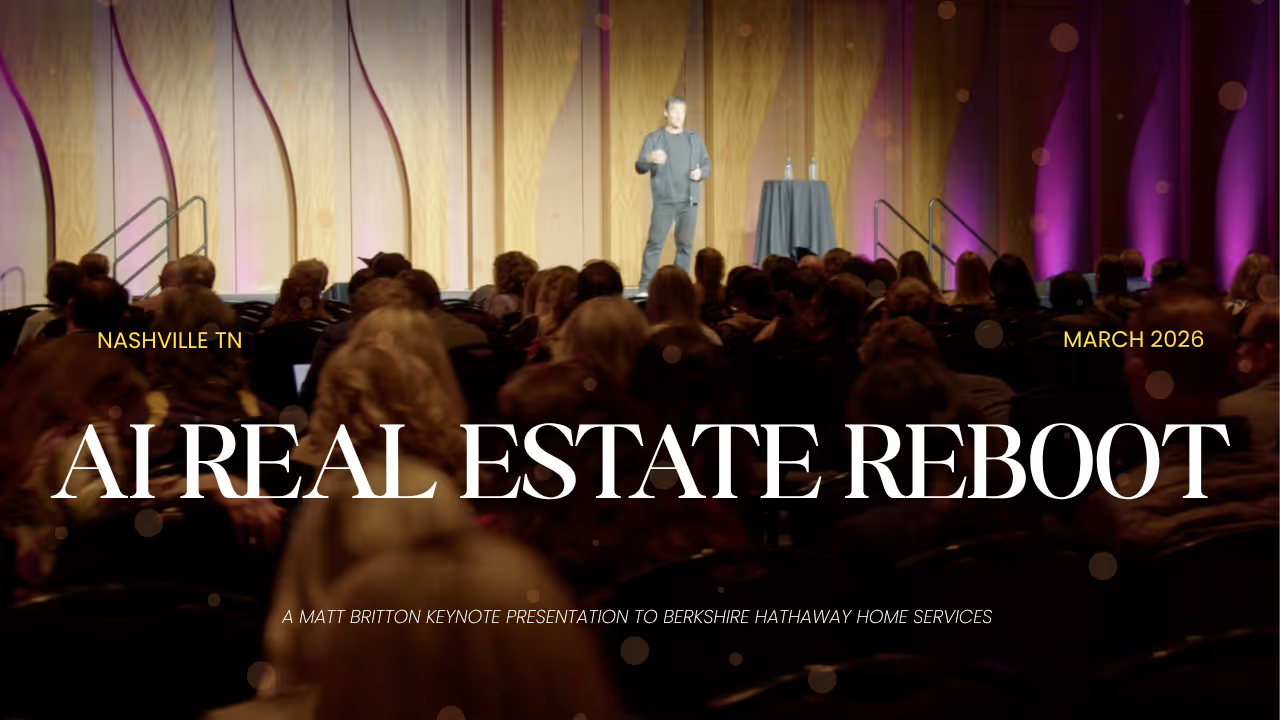
At NAR NXT, Matt Britton explores how real estate professionals can use AI to create, automate, and build around the changing expectations of buyers and sellers.
Watch The Keynote
See the complete keynote from this speaking engagement.
A home is personal. The technology helping people find it should make room for that. At NAR NXT, Matt Britton explored how real estate professionals can use AI to rethink creative work, everyday workflows, and customer relationships. His keynote opens a conversation about what agents can build when the tools become more accessible.
Britton made the creative opportunity tangible by opening with an AI-generated music video about housing. The band did not exist, and the video had been created the night before. The example set up his broader challenge to real estate professionals: experiment with the tools and explore what they make possible in your own work.
Britton, CEO of Suzy, bestselling author of Generation AI, and host of The Speed of Culture podcast, has delivered more than 500 keynotes globally. His work centers on understanding how emerging technology reshapes consumer behavior and competitive advantage. For real estate professionals, the stakes are unusually high. Housing is the largest asset class in the world, yet much of the industry still runs on fragmented data, manual workflows, and legacy systems.
The future has arrived unevenly. Where it has arrived, it is reshaping everything.
AI in real estate marks a structural shift, not a cyclical upgrade. The industry now faces the same fork in the road that retail confronted during e-commerce and media faced during mobile.
Britton framed the moment through a generational lens. Millennials entered adulthood as the first digital natives raised with home internet. Gen Z grew up with the iPhone as a permanent appendage. Two-thirds of global e-commerce now occurs on mobile devices, a behavioral shift that would have sounded implausible in 2007.
Gen Alpha will never know a world without AI. Children under 14 already interact with conversational systems that respond in natural language, generate images, compose music, and adapt to their preferences. Their cognitive baseline includes machine collaboration. That rewires expectations for speed, personalization, and service.
Technology adoption follows an S-curve. Early adopters experiment, the majority scales, laggards consolidate. AI’s S-curve is compressed. The first iPhone iteration cycle took 18 months. AI models now evolve meaningfully in months, sometimes weeks. Capabilities that seemed advanced in early 2024 feel rudimentary by early 2026.
For real estate professionals, the implication is direct. Clients will expect AI-enhanced experiences because every other industry will provide them. Mortgage underwriting, insurance pricing, consumer search, and financial planning are already embedding machine learning deeply into workflows. Housing cannot remain a manual island surrounded by automated oceans.
The work completed in the next 90 to 120 days will influence the next decade of competitiveness. Inflection points reward urgency.
AI adoption requires communication skills, not coding skills. That accessibility is why the shift is so disruptive.
Britton illustrated the point with a personal story. His mother, living alone in Florida, regularly texted him for passwords, streaming logins, and WiFi details. Instead of continuing as her tech support line, he built a custom chatbot trained on her appliance manuals and account credentials. He scanned documents, organized data, and created a tailored interface on her phone labeled “Mom GPT.”
The result was immediate. Fewer frantic texts. Faster answers. Greater independence.
The broader lesson extends beyond family convenience. Previous technological revolutions required technical fluency. Building a website required HTML. Launching an app required engineers. AI interfaces operate in plain language. Prompts replace programming. Context replaces code.
According to industry estimates, over 60 percent of knowledge workers have now experimented with generative AI tools. Adoption has outpaced early social media and smartphone uptake at comparable stages. The barrier to entry is minimal.
For real estate agents, this lowers the experimentation threshold dramatically. An agent can upload listing data and generate tailored property descriptions. A broker can analyze transaction history to forecast seasonal pricing patterns. A team leader can automate follow-up emails and lead nurturing flows.
No engineering degree required. Only curiosity.
Britton, who runs Suzy with more than 80 engineers on staff, did not delegate his AI learning journey entirely to technical teams. He built with it personally. That choice reflects a larger leadership mandate. Executives who treat AI as an IT initiative will lag behind those who treat it as a strategic capability.
AI delivers exponential value when paired with proprietary data. Generic prompts yield generic outputs. Customized systems produce insight.
After turning 50, Britton decided to test AI on a deeply personal challenge: longevity. He compiled 25 years of medical data, including MRIs, blood tests, X-rays, and physician notes. He digitized and organized the information, then trained a private large language model on that dataset. His base prompt instructed the system to act as a leading medical expert focused on one goal: extending his life.
Within days, he asked a blunt question. If death occurred within five years, what would be the most likely cause? The system cited biomarkers from more than a decade earlier and referenced peer-reviewed studies. A 10-year projection yielded a different risk profile.
The experience demonstrated how AI can synthesize longitudinal data faster than any individual specialist. It also highlighted a critical point for business leaders. The value lies in structured, relevant data paired with clear problem framing.
Real estate professionals sit on powerful proprietary datasets. Transaction histories. Neighborhood trends. Client preferences. Referral networks. Marketing performance metrics. Most of it remains under-leveraged.
Imagine a brokerage-level AI trained on five years of closed transactions, seasonal cycles, and buyer demographics. It could identify micro-trends in specific ZIP codes. It could forecast listing velocity under various pricing strategies. It could surface patterns invisible in spreadsheets.
The opportunity mirrors Britton’s health experiment. Define the problem. Organize the data. Build the system. Iterate.
Memorization is declining in value; creativity and critical thinking are compounding. That shift will redefine professional advantage.
In early 2025, China announced AI literacy programs beginning at age six. The move signaled national prioritization of machine collaboration skills. Trust in technology often begins with exposure. Cultural comfort accelerates innovation.
The American education system still emphasizes information recall and standardized testing. Britton often describes his own academic experience as optimized for cramming and short-term retention. That formula rewarded stamina and memory. AI commoditizes both.
Generative models already draft contracts, analyze financial statements, and produce tax scenarios. Britton tested AI on his own tax filings and uncovered a deduction worth $5,000 that his accountant overlooked. That anecdote underscores a larger trend. Knowledge work is becoming partially automated.
The World Economic Forum consistently ranks analytical thinking, creativity, resilience, and complex problem solving among the most in-demand skills. Those capabilities align closely with high-performing real estate professionals. Trust-building. Negotiation. Emotional intelligence. Adaptability under pressure.
A realtor’s core value lies in guiding clients through life-altering financial decisions. Buying or selling a home involves anxiety, aspiration, and identity. AI can support research, documentation, and communication workflows. It cannot replace human empathy and relational nuance.
The risk emerges when professionals spend most of their time on deterministic tasks. Email triage. Document formatting. Data entry. Appointment scheduling. AI excels in those domains.
Britton’s argument to the NAR audience was straightforward. Free your calendar for what only you can do. Delegate the rest to systems.
Real estate remains one of the most inefficient large asset classes globally. That inefficiency represents opportunity.
Housing transactions involve fragmented data, manual signatures, siloed platforms, and multi-party coordination. The consumer journey often feels opaque and time-consuming. Compare that with ordering a car through an app or transferring funds digitally within seconds.
Despite trillions of dollars in annual transaction volume, AI deployment across day-to-day real estate workflows remains limited. Many brokerages still rely on legacy CRMs, spreadsheet-driven tracking, and manual compliance checks.
The unlock is substantial. Intelligent lead scoring can prioritize high-intent buyers. Automated document review can flag contract inconsistencies. Predictive pricing models can incorporate macroeconomic indicators, local inventory shifts, and historical absorption rates.
Consider the productivity impact. If an agent reclaims five to ten hours per week through automation, that time can be reinvested into client meetings, referral cultivation, and strategic planning. Over a year, that compounds into dozens of additional touchpoints and potentially multiple incremental transactions.
Britton’s career, including his leadership at Suzy, centers on leveraging real-time consumer intelligence to guide decision-making. Housing decisions are deeply tied to consumer sentiment. AI-enhanced analytics can surface early indicators of demand shifts before they become obvious in headline data.
The professionals who integrate AI into listing strategy, marketing personalization, and operational efficiency will create differentiated client experiences. Speed. Transparency. Insight. Those attributes win trust.
AI will automate administrative, data-driven, and repetitive tasks while amplifying strategic and relational work. Agents who adopt AI can reduce time spent on paperwork and increase time spent advising clients, negotiating deals, and building referral networks.
AI tools are accessible to solo agents and small teams because most platforms operate through natural language interfaces. Cloud-based systems allow professionals of any size to implement automation, predictive analytics, and content generation without building internal engineering teams.
Creativity, analytical thinking, emotional intelligence, and adaptability will define competitive advantage. Technical fluency matters, but the highest value will come from interpreting AI outputs, asking better questions, and delivering trusted human guidance.
Adoption should begin immediately with pilot programs and workflow audits. AI capabilities evolve rapidly, and early experimentation builds institutional knowledge that compounds over time.
AI in real estate has moved from theoretical discussion to operational necessity. The professionals who treat it as a side project will struggle to keep pace with those who embed it into daily execution.
Matt Britton continues to advise global organizations through Speaker HQ, explore generational shifts in Generation AI, and unpack cultural acceleration on The Speed of Culture podcast. Through Suzy, he works with leading brands to harness real-time consumer intelligence in a world defined by rapid change.
The inflection point is here. Agents, brokers, and executives can contact his team to explore how AI strategy translates into tangible competitive advantage. The next decade of real estate leadership will be defined by those who build now.
Matt delivers customized, high-energy keynotes on AI, consumer trends, and digital transformation for audiences worldwide.
Book Matt to Speak →Ready To Inspire Your Audience?
500+ events worldwide · Fully customized presentations
.avif)
%20(1).avif)