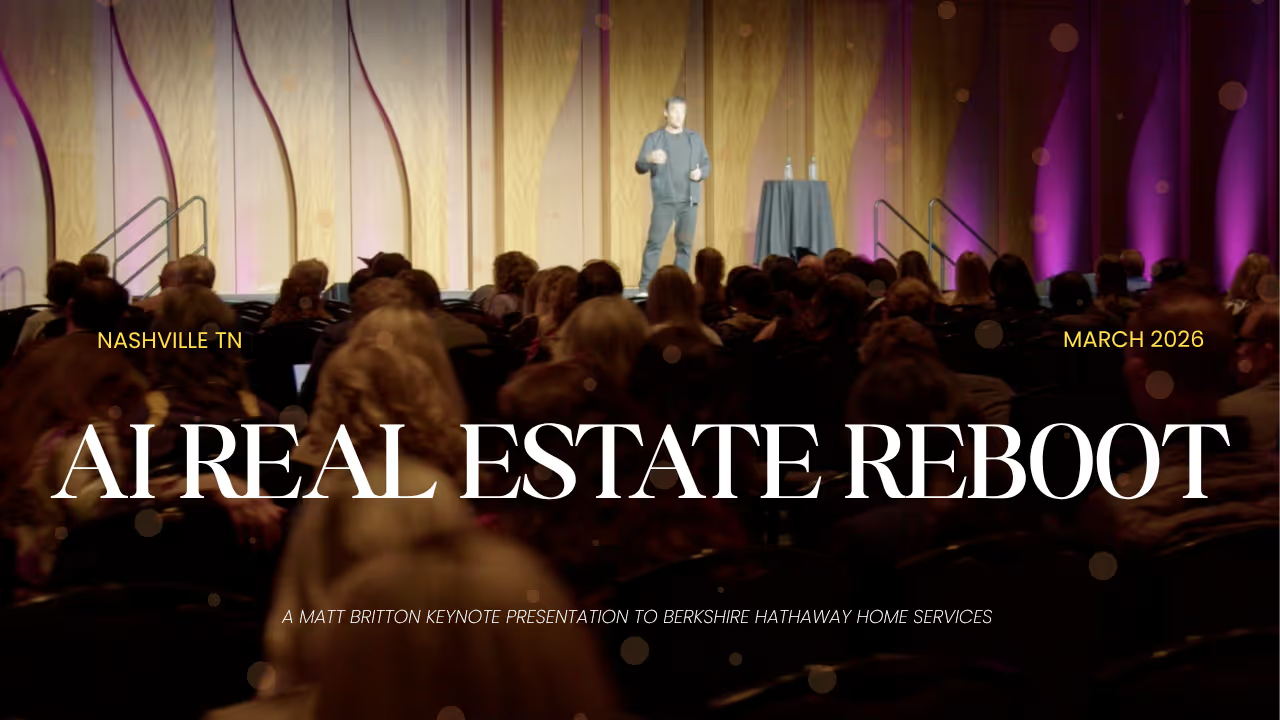
In his Brand Innovators keynote, Matt Britton connects the state of AI with culture, creativity, work, and the expectations taking shape for Generation Alpha.
Watch The Keynote
See the complete keynote from this speaking engagement.
The most useful AI update starts with people. In his State of AI 2025 keynote for Brand Innovators, Matt Britton explored how intelligent tools are changing culture, creativity, education, and work. Generation Alpha provides a view into the expectations taking shape when AI becomes part of everyday life.
During a recent keynote for Brand Innovators titled State of AI 2025, AI futurist and bestselling author Matt Britton delivered a message that cut through the hype. AI is driving a cultural revolution that will redefine business, education, creativity, and work itself. After 25 years studying generational behavior and helping brands navigate change, Britton argues that nothing compares to the velocity and depth of the AI era.
From the early internet to social media to mobile-first platforms, each shift redistributed power. AI does something deeper. It reshapes how knowledge is created, how decisions are made, and how humans interact with machines.
Gen Alpha, now ages 0 to 15, will grow up with AI as a default interface to the world. They will speak to machines before they type, rely on algorithms before advisors, and learn through adaptive systems that personalize knowledge in real time.
The State of AI 2025 demands a new mindset. Leaders who treat AI as a software upgrade will fall behind. Those who treat it as infrastructure for the future will pull ahead. The divide has already begun.
AI is the defining force shaping Gen Alpha’s worldview. Children entering kindergarten today interact with voice assistants and generative AI tools as casually as previous generations used search engines. That behavioral shift has long-term implications for brands, employers, and policymakers.
Gen Alpha represents more than 2 billion people globally. They will become the largest generation in history. Their baseline expectations are radically different from Millennials or Gen Z. They expect immediacy. They expect personalization. They expect machines to respond conversationally and intelligently.
Matt Britton has spent decades decoding generational shifts, and he sees AI as the backbone of Gen Alpha’s identity. This cohort does not perceive AI as innovation. They perceive it as environment. That distinction matters.
Brands that treat AI as a feature risk irrelevance with a generation that sees it as infrastructure.
Education systems reveal the tension. While countries such as China are introducing AI literacy in elementary school, many U.S. classrooms still emphasize memorization and standardized testing. In a world where large language models can generate essays, code, and research summaries in seconds, rote learning holds diminishing value.
Creativity, ethics, and problem definition become the scarce skills.
Parents face a similar reckoning. AI tutoring platforms, adaptive learning apps, and generative content engines offer immense upside. They also raise questions around dependency, bias, and critical thinking. Gen Alpha will need fluency in AI collaboration, not just AI consumption.
For business leaders, the takeaway is clear. Products and services must assume AI-native expectations. Personalization at scale will not be optional. Conversational interfaces will replace static ones. Trust and transparency will define brand equity in an algorithmic world.
The conversation around the State of AI 2025 has shifted from tools to agents. Early adoption centered on giving employees access to chat-based interfaces. Today’s frontier involves autonomous AI agents that execute workflows with minimal human oversight.
AI agents can draft proposals, summarize meetings, manage inboxes, analyze customer sentiment, and trigger follow-up actions across systems. Gartner projects that by 2028, a third of enterprise software interactions will involve agentic AI. That projection signals structural change, not incremental improvement.
Inside his company Suzy, a leading consumer intelligence platform, Matt Britton experimented with AI long before formal enterprise rollouts. He extracted sales call transcripts from Gong and fed them into large language models. The result: automated sentiment scoring, keyword strategy generation, and blog content creation rooted in real customer language.
No dedicated development team. No complex roadmap. A clear problem and available tools. That mindset turns AI from novelty into leverage.
Large organizations often face compliance and security constraints that slow adoption. Legal, IT, and risk teams demand governance. Those guardrails serve a purpose. Yet experimentation does not require enterprise-wide deployment.
Individuals can build prototypes, personal workflows, and side projects that translate into institutional advantage later.
The deeper shift involves intention. Early AI usage revolved around prompts. Users typed questions and received answers. Agentic systems begin with goals.
“Improve pipeline velocity.” “Reduce churn.” “Optimize creative performance.”
AI then determines the steps required to achieve those outcomes.
That evolution redefines work. Execution becomes automated. Judgment becomes premium.
AI is compressing the value of execution-based tasks. Companies across industries have reduced headcount while expanding AI integration. Technology firms, media companies, and financial institutions report measurable productivity gains from automation in areas such as coding, customer support, and content production.
The World Economic Forum estimates that AI will both displace and create millions of jobs by the end of the decade. The net impact depends on reskilling and adaptation. Roles centered on repetitive analysis, standardized reporting, and manual production face the greatest exposure.
Matt Britton frames the shift as a skills realignment. The next wave of opportunity belongs to critical thinkers, creative strategists, and problem definers. AI can generate ten campaign concepts in seconds.
It cannot determine which one aligns with brand positioning, cultural nuance, and long-term strategy without human guidance.
Education systems lag behind this reality. Many curricula still reward memorization over synthesis. In an environment where AI commoditizes access to knowledge, advantage flows to those who can ask better questions, contextualize outputs, and apply ethical judgment.
Professionals who treat AI as a co-pilot gain asymmetric advantage. A marketer using AI for rapid testing can iterate five times faster than a peer relying solely on manual workflows. A strategist leveraging AI-driven consumer insights can surface patterns buried in millions of data points. The productivity gap compounds over time.
The workforce of 2030 will not divide cleanly between technical and non-technical roles. AI fluency will become foundational across disciplines. Finance. HR. Creative. Operations.
Mastery involves understanding capabilities, limitations, and risk parameters.
The message from the State of AI 2025 is direct. Learn by building. Apply AI to personal projects. Experiment without waiting for corporate mandates. Skills compound through action.
The AI economy rests on four interconnected layers: infrastructure, models, data, and applications. Each layer captures value in distinct ways.
Infrastructure includes compute power and GPUs from companies such as Nvidia. Massive data centers enable training and inference at global scale. Capital investment in this layer runs into the hundreds of billions annually.
Models sit on top of infrastructure. Large language models such as GPT, Claude, and Gemini translate raw compute into usable intelligence. Model performance continues to improve in reasoning, multimodal capabilities, and contextual awareness.
Data forms the differentiation layer. If competitors share access to similar foundational models, proprietary data determines output quality. Customer interactions. CRM records. Product usage logs. Transaction histories.
These inputs fine-tune intelligence to specific business contexts.
Applications represent the interface between AI and users. Consumer apps, enterprise platforms, and embedded tools convert intelligence into utility.
Within this stack, data stands out as the long-term moat. Matt Britton emphasizes that enterprises must audit, structure, and activate proprietary data to extract advantage. A retailer feeding years of purchase behavior into AI can personalize recommendations with precision. A media company leveraging historical engagement patterns can predict content performance.
Suzy exemplifies application-level value built on proprietary consumer insights. By integrating AI with structured audience data, organizations can move from reactive research to predictive intelligence.
The State of AI 2025 underscores a strategic imperative. Own your data. Clean your data. Connect your data. Without that foundation, AI becomes generic.
AI-generated content now spans text, image, video, and voice. What once required specialized agencies and weeks of production can emerge in seconds from a single prompt. Platforms generate photorealistic visuals, cinematic video sequences, and synthetic voiceovers at scale.
Creative barriers have collapsed. The constraint shifts from production capability to conceptual clarity. Success depends on defining compelling ideas and guiding AI toward aligned outputs.
Matt Britton describes this moment as a transition from executors to curators. Technical mastery of tools like Photoshop or video editing software loses exclusivity. Strategic direction gains prominence.
The individual who can articulate vision, audience insight, and brand tone holds leverage.
Brand equity becomes critical in a world flooded with AI-generated sameness. Trust, authenticity, and emotional resonance separate signal from noise. Cultural icons such as Dwayne Johnson and Reese Witherspoon operate as brand systems. Their names signal quality, values, and narrative consistency.
Personal branding and intellectual property gain importance as AI scales content. Audiences gravitate toward recognizable voices amid algorithmic abundance. Organizations must clarify identity and invest in long-term storytelling.
The State of AI 2025 reframes creativity as collaborative intelligence. Humans set direction. AI accelerates execution. The partnership expands possibility rather than diminishing originality.
AI is shifting business strategy from efficiency gains to structural transformation. Organizations deploy AI agents to automate workflows, analyze proprietary data, and personalize customer experiences at scale. Competitive advantage increasingly depends on integrating AI across operations rather than treating it as a standalone tool.
Critical thinking, creativity, and problem definition rank among the most valuable skills in the AI era. As generative models handle execution tasks, professionals who can frame strategic questions, interpret outputs, and apply ethical judgment command premium value across industries.
Proprietary data differentiates AI performance. While many companies access similar foundational models, unique customer interactions, transaction histories, and operational data enable tailored outputs. Structured, high-quality data strengthens personalization, prediction, and strategic insight.
Leaders can begin with personal or small-scale experiments using publicly available AI tools. Building workflows around content creation, data analysis, or health tracking develops fluency. These skills translate into enterprise contexts once governance frameworks allow broader deployment.
The State of AI 2025 represents a hinge moment. Technology, culture, and commerce converge around intelligent systems that learn, adapt, and act. The opportunity gap between active experimenters and passive observers widens daily.
Matt Britton continues to explore these shifts through keynotes booked via Speaker HQ, his bestselling book Generation AI, and conversations with top executives on The Speed of Culture podcast. As CEO of Suzy, he works directly with brands translating AI potential into measurable growth.
AI functions as multiplier, co-pilot, and creative partner. Leaders who engage now shape the trajectory of their industries. Those who hesitate will inherit someone else’s blueprint.
To explore collaboration or bring these insights to your organization, contact his team and begin building for the AI era.
Matt delivers customized, high-energy keynotes on AI, consumer trends, and digital transformation for audiences worldwide.
Book Matt to Speak →Ready To Inspire Your Audience?
500+ events worldwide · Fully customized presentations
.avif)
%20(1).avif)