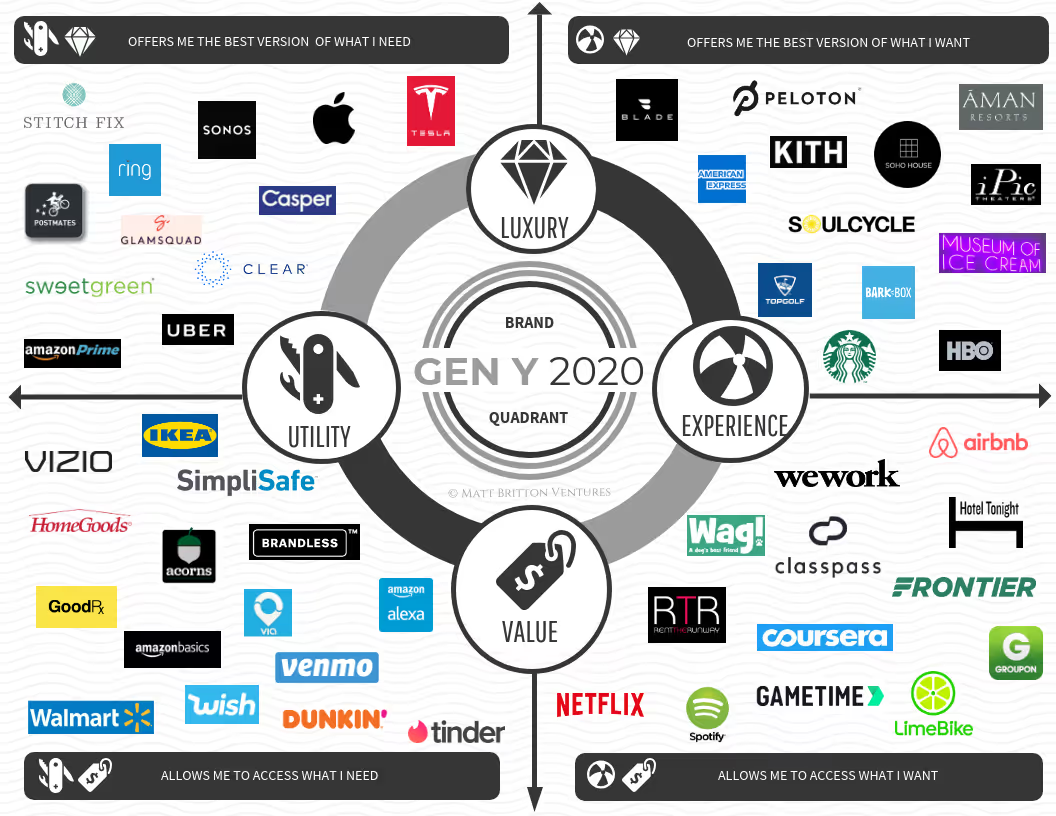
Millennials now control more than $2.5 trillion in annual spending in the United States. By 2030, they will make up 75 percent of the workforce and dominate both household purchasing decisions and the C-suite. The rules of brand growth are being rewritten in real time. The central question in the Gen Y Brand Quadrant is simple: are you value, or are you luxury?
Brands that fail to answer that question with precision risk drifting into irrelevance. Amazon has conditioned consumers to expect speed, efficiency, and low prices on almost everything. At the same time, experiential brands from Soho House to Peloton have built premium ecosystems that command loyalty far beyond transactional utility. The middle ground is evaporating.
Matt Britton, AI futurist and bestselling author of Generation AI, has spent two decades advising global brands on generational shifts. Across 500-plus keynotes and through his consumer intelligence platform Suzy, he has tracked the rise of the barbell economy and the growing divide between utility and experience. His message to executives is direct.
Pick a lane.
The Gen Y Brand Quadrant offers a strategic framework for the next decade. It challenges companies to define whether they are a time and money saving utility, or an experience so differentiated that consumers willingly look beyond Amazon. There are four quadrants to compete in. If a brand does not clearly occupy one, it faces a steep uphill battle in the years ahead.
Understanding the Gen Y Brand Quadrant Framework
The Gen Y Brand Quadrant defines how brands win in a Millennial-dominated economy. It maps two core dimensions: value versus luxury, and utility versus experience.
On one axis sits value and luxury. Value brands compete on efficiency, price transparency, and functional reliability. Luxury brands compete on status, design, and emotional resonance. On the other axis sits utility versus experience. Utilities solve friction. Experiences create memories.
This creates four strategic positions:
- Value Utility
- Luxury Utility
- Value Experience
- Luxury Experience
Value Utility brands are optimized for speed and cost savings. Think Walmart, Amazon Basics, Dollar General. These companies remove friction from everyday life. Walmart generated over $600 billion in revenue in 2025 by relentlessly focusing on supply chain efficiency and pricing power.
Luxury Experience brands sit at the opposite corner. They create aspirational environments that transcend product. LVMH surpassed $90 billion in annual revenue by turning fashion into culture and scarcity into demand. Consumers do not simply buy handbags. They buy identity.
The other two quadrants matter just as much. Luxury Utility brands such as Apple blend premium pricing with seamless integration into daily life. The iPhone functions as infrastructure. Value Experience brands such as Airbnb democratize access to memorable moments at accessible price points.
Matt Britton argues that brands drifting between these quadrants lose clarity in the mind of the Millennial consumer. The generation that came of age during the Great Recession developed a sharp value radar. They reward precision and punish ambiguity.
The Barbell Economy and Its Impact on American Business
The barbell economy explains why the middle is disappearing. Economic growth is concentrating at the high and low ends of the market, while mid-tier brands struggle to defend margin.
Data from McKinsey shows that over the past decade, premium and value segments have grown at nearly twice the rate of mid-market offerings across multiple categories. Department stores have contracted, while off-price retailers and luxury conglomerates expand globally.
Millennials accelerated this divide. Student debt surpassed $1.7 trillion in the United States, shaping early financial behaviors. As their incomes grew, spending polarized. Everyday purchases became hyper-optimized for price. Special purchases became vehicles for self-expression.
That polarization plays out across sectors. In travel, Spirit Airlines and Four Seasons thrive. Traditional carriers face margin compression. In food, fast casual and Michelin-starred restaurants command attention, while casual dining chains close locations.
The Gen Y Brand Quadrant sits squarely within this barbell context. Brands positioned in the middle without a clear value or luxury identity face margin pressure and declining relevance. Matt Britton frequently highlights this pattern on The Speed of Culture podcast, pointing to companies that cling to legacy positioning while consumer expectations fragment.
Executives must assess where their brand naturally belongs. For some, operational excellence and scale make value utility the logical path. For others, heritage and design DNA support a luxury experience strategy. Strategic honesty becomes a growth lever.
Why Experiences Are the New Social Currency
Experiences function as social currency for Millennials and Gen Z. They signal identity in a digital world where perception travels at algorithmic speed.
A 2024 Eventbrite study found that 78 percent of Millennials prioritize spending on experiences over physical goods. Social platforms amplify that preference. An Instagram post from a music festival, boutique hotel, or chef’s tasting menu carries cultural capital that a commodity purchase does not.
Luxury Experience brands understand this deeply. Soho House offers more than a membership. It offers belonging. Peloton sells community-driven motivation packaged in hardware and subscription software. Nike builds immersive flagship stores that merge retail with performance data and storytelling.
Even value-oriented companies tap into experience strategically. Starbucks transformed coffee from commodity to ritual, enabling a premium position for decades. Airbnb reframed travel around local immersion rather than standardized lodging.
Matt Britton explores this phenomenon extensively in Generation AI, arguing that digital natives curate their lives publicly. Brands that deliver shareable, story-driven moments capture disproportionate mindshare. Experiences become proof points of taste, ambition, and worldview.
Within the Gen Y Brand Quadrant, experience-driven brands must constantly justify their premium through innovation and storytelling. Stagnation erodes desirability quickly. Algorithms reward novelty. Consumers reward brands that evolve.
Why Winning Brands Are Becoming Utilities
Utility brands win by saving time, reducing cost, and integrating seamlessly into daily routines. In an era of cognitive overload, convenience equals value.
Amazon Prime surpassed 200 million global members by bundling speed, streaming, and reliability into one subscription. Uber transformed transportation into a tap-based habit. DoorDash turned food delivery into infrastructure.
Luxury Utility brands also thrive. Apple’s ecosystem generates over $80 billion annually in services revenue by embedding itself into communication, entertainment, and productivity. Consumers pay premium prices because the system works without friction.
The rise of AI accelerates this utility shift. Consumers expect predictive recommendations, real-time personalization, and automated workflows. Matt Britton, as CEO of Suzy, sees firsthand how brands use AI-driven consumer insights to refine products and messaging in near real time. Data becomes oxygen.
The Gen Y Brand Quadrant clarifies that utility requires relentless optimization. Margins depend on scale and efficiency. Experience brands can charge for emotion. Utility brands must earn loyalty through performance.
Brands attempting to be partially convenient and partially aspirational often dilute both advantages. Clear positioning guides investment. Technology budgets, marketing strategy, talent acquisition. All follow from the quadrant choice.
Applying the Gen Y Brand Quadrant in the AI Era
The Gen Y Brand Quadrant remains relevant as Generation AI comes of age. Digital natives raised on TikTok and ChatGPT expect brands to anticipate needs and deliver instantly.
AI enhances both value and luxury strategies. For value utility brands, automation reduces cost and improves speed. For luxury experience brands, AI personalizes storytelling and product design at scale. The differentiator is strategic intent.
Executives should conduct a quadrant audit. Where does the brand currently compete? Where do margins concentrate? What does consumer perception data reveal? Platforms like Suzy provide real-time feedback loops that replace static annual surveys.
Matt Britton often emphasizes in his keynotes, available through Speaker HQ, that generational shifts reward decisive brands. Ambiguity confuses algorithms and audiences alike. Precision compounds.
The next decade belongs to brands that understand their role in consumers’ lives. Save them time. Or give them stories worth sharing. Both paths offer growth. Drifting in between invites decline.
Key Takeaways for Business Leaders
- Define your quadrant with precision. Conduct consumer research to determine whether your brand is perceived as value or luxury, utility or experience. Align pricing, messaging, and operations accordingly.
- Invest where your strategy demands. Utility brands should prioritize supply chain, technology, and efficiency. Experience brands should prioritize design, storytelling, and community building.
- Leverage AI for clarity and speed. Use platforms such as Suzy to gather real-time insights and refine positioning. Data-driven iteration strengthens both value and luxury plays.
- Eliminate the ambiguous middle. Audit product lines and marketing campaigns that dilute your core identity. Focus resources on the quadrant where you can dominate.
- Align leadership around generational insight. Engage thought leaders like Matt Britton through Speaker HQ to ensure your executive team understands Millennial and Gen Z expectations.
Frequently Asked Questions
What is the Gen Y Brand Quadrant?
The Gen Y Brand Quadrant is a strategic framework that categorizes brands along two axes: value versus luxury and utility versus experience. It helps companies determine where they compete most effectively in a Millennial-driven economy and guides investment, pricing, and positioning decisions.
Why is the middle market struggling?
The middle market struggles due to the barbell economy, where growth concentrates in premium and value segments. Millennials optimize everyday purchases for price and splurge selectively on meaningful experiences, leaving undifferentiated mid-tier brands vulnerable to margin pressure.
How can brands compete with Amazon?
Brands compete with Amazon by choosing a clear position. Value utility brands match or exceed Amazon on efficiency and price. Experience-driven brands offer differentiated products, community, and storytelling compelling enough to justify purchasing outside Amazon’s ecosystem.
How does AI impact the Gen Y Brand Quadrant?
AI amplifies both utility and experience strategies. It enables operational efficiency for value brands and hyper-personalized storytelling for luxury brands. Companies that integrate AI thoughtfully strengthen their chosen quadrant and accelerate growth.
The Decade Demands a Choice
Millennials now shape the boardroom and the checkout line. Their expectations define the market. The Gen Y Brand Quadrant provides a blueprint for clarity in a polarized economy.
Matt Britton continues to challenge executives to confront hard truths about positioning, technology, and generational change. Through Generation AI, The Speed of Culture podcast, and his work at Suzy, he equips leaders to navigate what comes next. Organizations seeking deeper guidance can contact his team or explore keynote availability through Speaker HQ.
The next decade will reward brands that know exactly who they are. Value or luxury. Utility or experience. The choice defines the future.
Related Posts
AI Shopping Agents Trust: Why Banks Just Sounded the Alarm

Agentic Commerce Wars: What Amazon vs. Meta Muse Means for Brands

Financial Nihilism Goes Mainstream: Why Gen Z Is All-In on Prediction Markets