Only 36% of Fortune 500 companies still use the title Chief Marketing Officer, down from 49% a year earlier, according to Forrester's 2026 analysis. Average tenure at S&P 500 companies sits at 4.1 years, the shortest of any core C-suite seat. The headlines wrote the obituary: the CMO is dead. The data tells a more useful story, and it is not the one search firms have been selling for two decades.
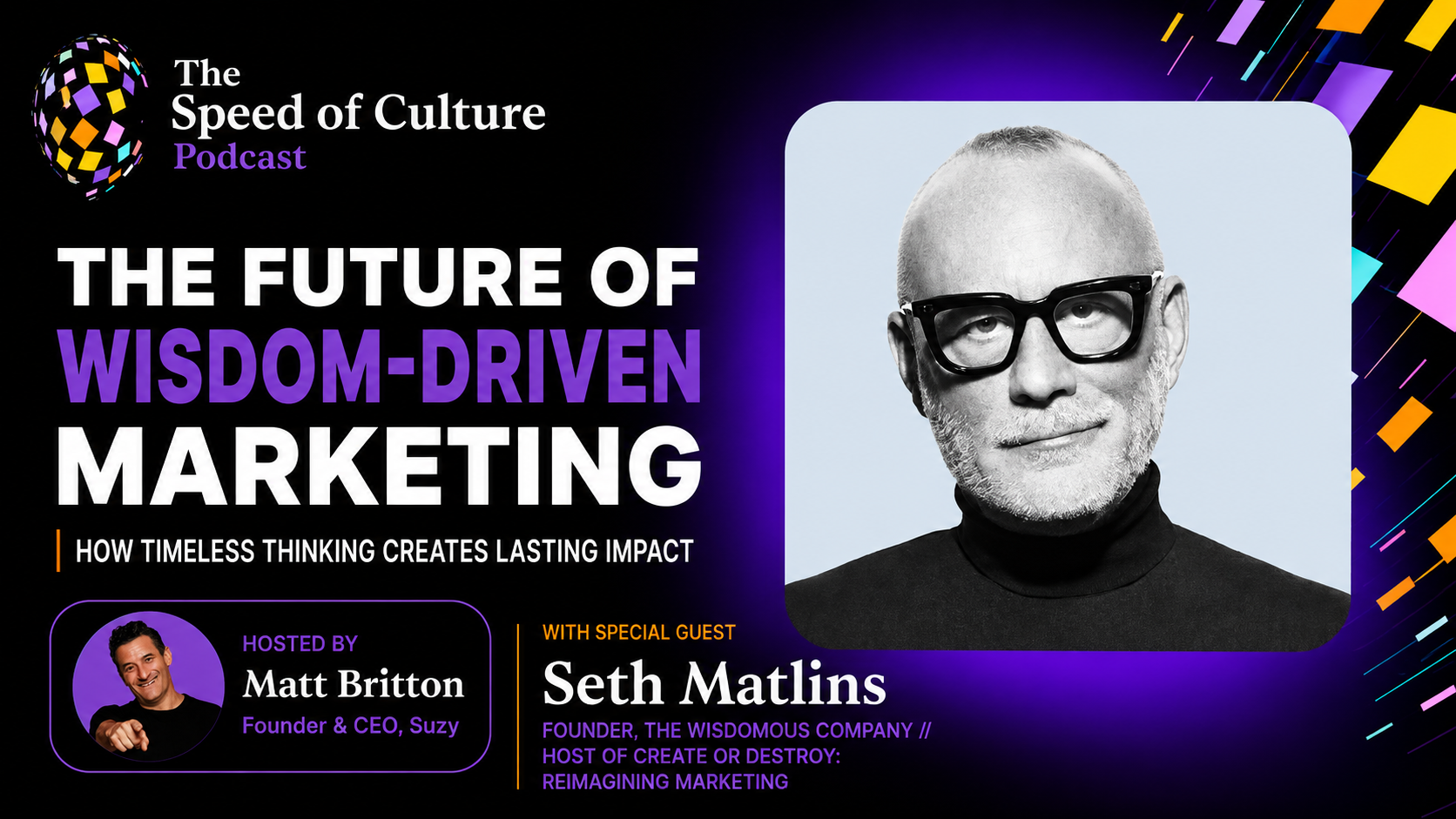
On the latest episode of The Speed of Culture podcast, Matt Britton sat down with Seth Matlins, founder of The Wisdomous Company, host of the Vox Media podcast Create or Destroy: Reimagining Marketing, former first global CMO of Live Nation, and former head of the Forbes CMO Network. Matlins has run marketing from nearly every angle, and his central argument reframes the entire conversation. The role of marketing has not changed. The job has changed dramatically. Confusing the two produces bad narratives, bad hires, and bad org charts.
For the Fortune 500 marketing and insights leaders who make up Britton's audience, this distinction is not academic. The pressure to drive AI transformation, prove commercial value, and survive a shrinking title is landing on marketers who were trained for a role that no longer exists the way boards picture it. Understanding what actually changed is the difference between being unbundled out of relevance and being reinvented into growth leadership.
The CMO Tenure Narrative Is Mostly Wrong
The most repeated statistic about marketing leadership is also the most misunderstood. Matlins does not dispute the 40-plus-month tenure figure. He disputes the story attached to it. The narrative, he argues, was shaped historically by search firms who were in the business of replacing CMOs, which means a negative narrative was commercially positive for the people spreading it. They were the only ones who benefited.
The data supports his skepticism. Of 218 CMO exits tracked between 2021 and 2025, 62% moved to an equivalent or larger role, 9% became CEO, and 13% stepped into divisional president or COO positions. Among those who left, 77% landed at a new organization within six months. Consumer brands post the shortest average tenure at 3.5 years precisely because those leaders are being actively developed as CEO candidates. The exit is frequently the promotion, not the pink slip.
Matlins offered Antonio Lucio as the case study. A short 24-month tenure reads like failure until you learn the person left for a bigger job. Strip the context of why someone moved, and you leave behind an implicit and damaging conclusion: they got fired, they couldn't make it work. Sometimes that is true. It is not, Matlins insists, the status quo circumstance. The perpetuation of the decline narrative is, in his words, wildly self-defeating for the entire profession.
Talent Is Not Enough: The Permission Problem
Britton pushed on the obvious counterpoint. Good talent jumps around and lands fine, so isn't the tenure conversation really just about mobility? Matlins refused the easy version. Good talent needs to be in a position where it can succeed, and there are situations where it structurally cannot.
He offered himself as evidence. He described his 14-month run as CMO of Live Nation as some of the best bottom-line work of his career, work that simply could not survive inside the construct of that organization at that moment. That failure of fit was not damning to the company, which he noted has performed like a rocket ship since, nor to the work itself. It was a mismatch of moment, fit, and organizational readiness. If only talent were enough to guarantee success, the org chart would be a much simpler place.
This is the permission problem, and it is the real constraint on marketing leadership in 2026. Many brilliant CMOs are not given the permission to do what they do best, at least not unfettered by the CEO whose 12-year-old hated the ad. The predictive factors for CMO survival bear this out: CEO alignment on marketing's role before accepting the position, board-level exposure in the first 90 days, and financial fluency all rank higher than raw marketing skill. When roughly 70% of Fortune 250 CEOs come from operations or finance and only about 4% have held a CMO-like role, the people deciding whether marketing gets permission often do not understand what it does.
Driving Change Versus Responding to Change
The AI mandate has become the ultimate test of the permission problem. CEOs pressured by Wall Street are pressuring CMOs to drive AI transformation the same way they once demanded digital and social transformation. Britton asked what actually determines whether a CMO can pull that off inside a large organization.
Matlins reframed the question itself. The mindset trap, he argued, is that CMOs believe they are being charged with responding to change when the real opportunity is to drive it. He quoted Bill Joy, the Sun Microsystems co-founder, from 25 years ago: the best way to predict the future is to invent it. That is the opportunity and the challenge facing brilliant marketers today.
But invention cannot become change for change's sake, and here Matlins drew a line that separates strategy from vanity. The bravest work a CMO can do is often to mine what has been done before and optimize it rather than reinvent the wheel to plant a flag. Britton named the pattern from his own agency years: clients who wanted a story of the week, who chased 3D printing or the newest shiny object the moment it launched so they could say they did it, moving the needle not at all. Being beholden to the status quo is as destructive as throwing it out simply because it existed before you arrived. The discipline is knowing which is which, and that requires asking why something needs to change before changing it.
The Skills That Actually Matter: Thinking Horizontally
When Britton asked what new skills marketing leaders need in 2026, Matlins gave an honest answer. The job has become so technical and tactical that even a veteran operator finds it hard to name a single skill. The data fluency, information fluency, and orchestration demands are, in his word, brutal. He cited Antonio Lucio's framing: today's CMO must be the CEO of the function, able to allocate resources, time, capital, and human talent to drive outcomes.
The one durable answer he offered is the ability to think horizontally. A generation of marketers has been trained in verticals and silos that typically do not connect. The result is a platform marketer optimizing for the platform rather than for outcomes that move the business, while believing the two are the same thing. That confusion is exactly what the current title consolidation is punishing.
The market is voting on this in real time. Chief growth officer and chief commercial officer appointments have risen nearly 40% over five years while standalone CMO placements at S&P 500 companies fell 22%, per Korn Ferry. Boards are combining marketing, sales, and customer success under single leaders accountable for growth across the full customer lifecycle. The horizontal, integrative, holistic view Matlins describes is no longer a nice-to-have leadership trait. It is the job description of the title replacing the CMO. Marketing is being unbundled and absorbed, and the marketers who think horizontally are the ones doing the absorbing rather than being absorbed.
Can New Brands Still Be Built, or Is It All Utility Now?
Britton raised a provocation that cuts to the future of brand itself. The most prolific American brands, the Nikes and Hersheys, were built in the TV industrial era when companies could write checks and force a message onto consumers. The dominant new brands, Airbnb and Instagram and Claude, are product utilities where the power lives in the product, not the advertising. So can a new Nike or Chanel ever be built again, or is it all utility now?
Matlins accepted the observation and rejected the binary. Separating product and brand, he argued, is a false split when the two are inextricably linked. He granted that Claude won the Super Bowl outright with a great spot and is a great product on its way to perhaps becoming a great brand, but he would not call it a great brand yet, because people are choosing it for what it does, not for what it means. That is product-led growth, not brand-led growth.
His deeper point is that building brands in new ways that forge genuine emotional connection is both possible and imperative. The what and the why of brand building have not changed. Only the how has, and the how is changing dramatically. Referencing Scott Galloway's observation that Bernard Arnault became the world's richest man by making things nobody needs, Matlins landed on the enduring truth: a luxury handbag meets no functional need, but it meets a profound human one, the communication of status, the expression of identity, the signaling of taste. That is Maslow's hierarchy, and the role brands play in it is essential and unchanging.
Britton countered with a thesis from his book Generation AI: it is status update over status symbol now, as people identify with experiences, tribes, and passion points more than possessions, empowered by their ability to express identity through content. Matlins agreed the shift is real, a rational reaction to a pandemic and a recession that taught people possessions are fleeting, but argued it does not erase the underlying need. The car in your driveway still says something about how you want to be seen. The ingredients of identity have been rearranged, not eliminated, and that is a fair parable for marketing itself: a set of ingredients with no single recipe that guarantees a delicious outcome every time.
Key Takeaways for Business Leaders
- Reject the CMO decline narrative at face value. A large share of short tenures are voluntary moves to bigger roles, and treating churn as failure leads to defensive, short-term leadership.
- Solve the permission problem before the talent problem. Secure CEO alignment on marketing's role, board exposure early, and financial fluency, because talent without organizational permission cannot succeed.
- Drive change instead of reacting to it, but never change for change's sake. Mine and optimize what works before reinventing, and always ask why something needs to change first.
- Build horizontal thinkers. The leaders absorbing marketing into growth and commercial mandates are the ones who see across silos rather than optimizing a single platform.
- Stop separating product and brand. Utility drives early growth, but durable emotional differentiation is still what commands premium and loyalty over decades.
Frequently Asked Questions
Is the CMO role disappearing in 2026?
The CMO role is being unbundled and reinvented, not eliminated. Only 36% of Fortune 500 companies still use the CMO title, down from 49% a year earlier, but marketing responsibilities are largely being absorbed into chief growth officer, chief commercial officer, and chief revenue officer roles. As Seth Matlins argues, the role of marketing is unchanged, while the job and its required skills have transformed dramatically.
Why is average CMO tenure so short?
Average CMO tenure at S&P 500 companies is 4.1 years, the shortest of any core C-suite role. But much of that churn is voluntary. Of tracked CMO exits, 62% moved to equal or larger roles and 9% became CEO. Marketing results are highly visible and expected quickly, and CEO turnover triggers CMO turnover, but short tenure often reflects promotion rather than failure.
What skills do marketing leaders need in 2026?
The most important skill is horizontal thinking, the ability to see how every function connects and to optimize for business outcomes rather than platform metrics. Modern marketing leaders also need deep data and information fluency, financial literacy to earn the CFO's trust, and the orchestration ability to act as CEO of the marketing function, allocating capital, time, and talent toward measurable growth.
Can strong new brands still be built in the AI era?
Yes, but the method has changed. Product-led utilities like Airbnb and Claude prove products can drive early growth without traditional advertising. Seth Matlins argues that building lasting brands still requires meaningful emotional differentiation, because human needs for status, identity, and belonging are unchanging. The what and why of brand building remain constant while the how evolves rapidly.
Leading Marketing Through the Age of Ambiguity
Seth Matlins closed with the mantra that has guided him for two decades, given to him by CAA's legendary general counsel Michael Rubel when he asked what it would take to succeed: a high tolerance for ambiguity. No words, Matlins argued, are better suited to this moment. As tech giants with tens of billions in profit cut staff and the future grows less certain by the day, the leaders who thrive will be the ones who arm themselves with the right skills and the agility to operate without assurances.
That is the throughline of the entire conversation. Marketing's role as the greatest strategic and financial engine in the enterprise has not changed. What has changed is the how, and the marketers who understand that difference will be the ones who invent the future rather than react to it.
Matt Britton has spent his career at the intersection of consumer behavior, technology, and brand building, first as an agency founder, now as CEO of Suzy and author of the national bestseller Generation AI. The marketing leaders who win the next decade will treat this era of unbundling not as a threat to their title but as a mandate to own growth.
To bring these insights to your next event, explore Matt Britton's speaking platform or contact his team directly. For more conversations with the leaders shaping the future of marketing, subscribe to The Speed of Culture podcast.

%20(400%20x%20100%20px)%20(300%20x%2050%20px)%20(150%20x%2050%20px).avif)