Non-alcoholic beer sales grew 22.1% in dollars across US retail in 2025, and the global category is projected to double from roughly $22 billion in 2026 to $44 billion within a decade. That growth is being driven by a generation that treats moderation as identity, socializes differently than its parents, and spends more on live experiences than any cohort before it, rather than by reformed drinkers reaching for a compromise. The brands winning this moment are the ones that move with culture while staying ruthlessly true to what they stand for, instead of chasing every trend.
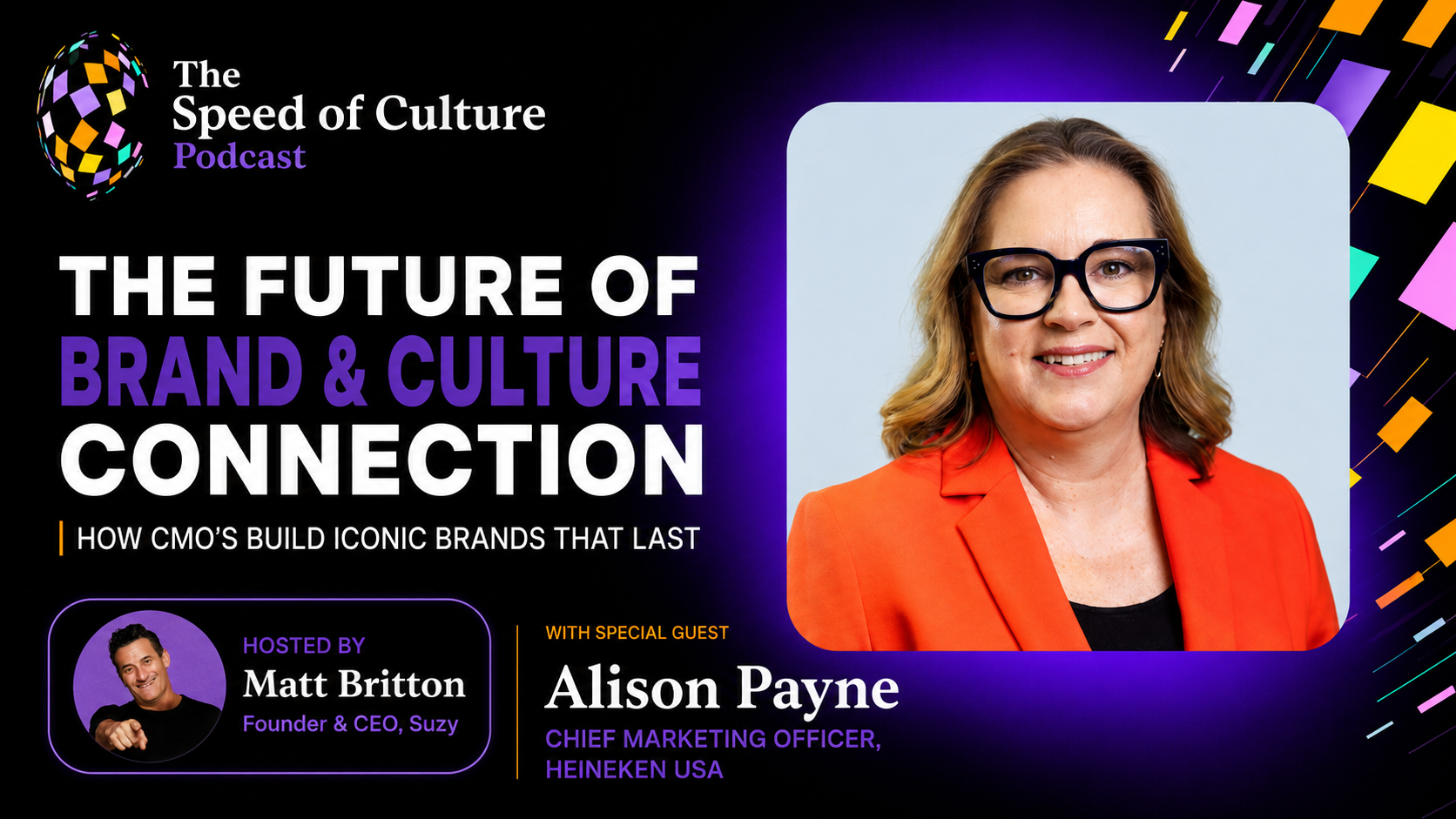
On the latest episode of The Speed of Culture podcast, Matt Britton sat down with Alison Payne, Chief Marketing Officer at Heineken USA. Payne has spent her career growing some of the world's most iconic brands, from Guinness and Smirnoff to Lay's, Doritos, and Special K, and now leads marketing for one of the largest beer companies on the planet. Her central discipline is a paradox every marketing leader is wrestling with in 2026: how do you evolve fast enough to stay culturally relevant without stretching the brand into places it has no right to be.
For the Fortune 500 marketing and insights leaders in Britton's audience, Payne's playbook is a masterclass in authentic evolution. She showed how Heineken rides the biggest waves in consumer behavior, fandom, nostalgia, moderation, and real-life experience, without ever letting the brand drift from its 150-year-old founding promise.
Authenticity Is the Guardrail: Knowing Where a Brand Should Not Play
Payne's first principle is the one most brands violate under pressure. Consumer trends are always changing, but the fastest way to destroy brand equity is to wade into a cultural conversation that sits beyond where the brand belongs. That, she argues, reads as inauthentic. The job is to move with the times while staying tethered to what the brand actually stands for.
For Heineken, that tether goes back to founder Freddy Heineken's line: we don't sell beer, we sell good times. Everything the brand does flows from a belief in a refreshing social life enhanced by a cheers over a Heineken. That clarity is what lets Payne evolve the execution without diluting the equity. When she decides whether to enter a new space, the test is whether the brand has permission to be there, regardless of how hot the trend is.
This is the discipline Britton has argued for across categories, the difference between riding a cultural wave and manufacturing relevance. Payne's version is sharper because it comes with a founding North Star that pre-decides most of the hard calls. The brand does not chase culture. It shows up where good times already happen.
Evolving the Brand by Following How People Socialize
Knowing when to evolve is the harder question, and Payne's answer is behavioral, not promotional. Heineken evolves when consumers change how they socialize. The way she socialized as a university student looks nothing like how her kids gather today, and the brand's job is to meet that shift rather than fight it.
That has taken Heineken into two moves that would have seemed off-brand a decade ago. The first is moderation, through the aggressive push behind Heineken 0.0. The second is gaming, through activations like Player 0.0 and its partnership with Formula One's Max Verstappen, meeting younger consumers where socializing increasingly happens. Crucially, neither move abandons the core. Heineken still champions socializing in real life. It has simply changed how it shows up based on where consumers have moved.
The timing is validated by the data. Gen Z now outspends millennials on live music, averaging $101 per month in early 2026, and 96% say the moments before and after an event matter as much as the event itself. Real life did not die during the pandemic. It came back stronger, and it came back as premium, high-intent, quality time that consumers want to make count.
The Fan Economy: Why Fandom Became Heineken's Marketing Engine
The most strategically rich part of the conversation centered on fandom, and Heineken's Fans Have More Friends platform. The campaign is built on a genuine consumer insight: people who are fans of something statistically do have more friends, because a shared passion is an instant social bridge. Payne illustrated it through her husband, a lifelong Arsenal supporter who can walk into any bar in any country, find another Arsenal fan, and leave with a new friend. Getting together over a common interest and a beer is the entire thesis.
Heineken activated this during the World Cup across major US cities, not as the official sponsor but as the brand backing the fans, even delivering emergency kegs to Boston after the Scottish Tartan Army reportedly drank the city dry. This is the superfan economy in practice, a space where fans now spend across live events, merchandise, collectibles, and digital communities simultaneously, and where the fan has become the infrastructure rather than the audience.
The US Open ties it all together. Heineken has sponsored the event for nearly 30 years, anchored in New York, the brand's American heartland and the first port for imported beer after Prohibition. The Second Serve Tickets campaign, fronted by six-time champion and brand ambassador Serena Williams, invites fans who saved iconic ticket stubs to enter for a VIP experience. It is a single idea that captures three of the most powerful drivers in the current consumer zeitgeist at once: nostalgia, collectibles, and fandom. With 87% of Gen Z now collecting physical event mementos and preserving them to relive and share, Payne is not guessing at the trend. She is building on documented behavior.
Moderation and the Non-Alcoholic Revolution: The Zebra Striping Effect
Heineken's non-alcoholic bet is the clearest proof of Payne's evolve-but-stay-true philosophy paying off commercially. When the brand stood up at its sell-in meeting and told distributors it was putting a major bet behind Heineken 0.0, some thought it was crazy. The category at the time was dusty bottom-shelf product, niche, old-fashioned, and by Payne's own account, terrible tasting. Heineken saw the moderation trend coming and revolutionized the category rather than dabbling in it.
The unlock was the product itself, returning to the fundamentals. Years of formulation technology produced a beer that tastes like Heineken without the alcohol, in packaging that looks, smells, and behaves like a beer. That last point is the social unlock. A drinker can stand at a barbecue and cheers with everyone else, avoiding the conversational detour that comes with ordering water. Payne noted the cultural shift underneath it: Gen Z increasingly finds it completely acceptable to say they do not drink, removing the social friction that once suppressed the category.
Two behaviors are driving the growth. Zebra striping is the practice of alternating between alcoholic and non-alcoholic drinks, which Heineken directly enables by offering both Heineken and Heineken 0.0. Social marathoning is the desire to stay in control across a long day, from a festival that starts at 3pm and runs to 3am. The numbers confirm the scale of the shift. NA beer grew 32% year over year in 2025, outpacing every other alcohol category, and 78% of Gen Z already zebra stripe. Innovation continues to expand the runway, from cold-pressed lime and nectarine-juniper flavors to Heineken 0.0 Ultimate, a triple-zero option with zero alcohol, zero sugar, and zero calories that answers the consumer who does not want to drink calories when not drinking alcohol.
AI, Creators, and the Skills Marketing Leaders Need Now
On AI, Payne drew a line that maps directly to Heineken's authenticity guardrail. Because the brand promotes real-life moments, it will not manufacture people cheersing over a beer through AI, because the audience must believe it is real. Where AI earns its place is upstream, in speed to creative idea. Heineken uses it to simulate what content might look like, put it in front of consumers for quick reads, and decide faster where to invest real production money. It also absorbs the busywork, the reporting, budgeting, and performance summaries that consume marketers' time, freeing the team to sweat the things that actually matter.
That efficiency reshapes what Payne looks for in the next generation of marketing leaders. The essential traits are agility, a willingness to take calculated risks, and comfort with experimentation, because the landscape shifts constantly. She pointed to Reddit's rising importance as consumers lean on peer-to-peer reviews, a platform many brands underweighted, and warned there will always be a next platform beyond TikTok and Instagram to master. But agility sits on top of fundamentals, not in place of them. Payne still swears by the four P's, insisting positioning and product quality never stop mattering. Her media mix reflects the balance, having swung meaningfully toward creators and loyal influencers who represent the brand authentically, while live sports remains one of the few places to still command mass attention on TV.
She extended the four P's to a fifth that her category has made non-negotiable: packaging. The pack on shelf is often the only brand touchpoint a consumer sees, the first moment of truth in a bodega on the walk home. If it does not look premium or shout the brand's icons, it does not get picked up. Payne is watching format shifts closely, from smaller pack sizes and mini bottles that answer squeezed wallets to slimline cans that have brought in female consumers with cues of freshness and fewer calories.
Key Takeaways for Business Leaders
- Anchor evolution to a founding truth. Heineken's good times promise pre-decides which cultural spaces the brand can authentically enter, preventing costly, inauthentic stretches.
- Follow behavior, not trends. Evolve the brand when consumers change how they socialize, whether that means moderation options, gaming, or new formats, rather than chasing hype.
- Build on documented consumer insight. Fans Have More Friends works because the insight is real, and it maps to a measurable rise in fandom, collectibles, and experience spending.
- Treat moderation as identity, not compromise. Zebra striping and social marathoning reflect a structural generational shift, and product quality is what converts the trend into loyalty.
- Use AI to protect creativity, not replace it. Deploy AI for speed-to-idea and busywork, and reinvest the freed capacity into the human creative work that differentiates the brand.
Frequently Asked Questions
Why is non-alcoholic beer growing so fast in 2026?
Non-alcoholic beer sales grew 22.1% in US retail dollars in 2025 and the global market is projected to roughly double by 2036, driven by a structural generational shift rather than a passing trend. Gen Z drinks about 20% less alcohol per capita than millennials did at the same age, and 78% already practice zebra striping. Dramatically improved product quality and beer-like packaging removed the taste and social barriers that once limited the category.
What is zebra striping and social marathoning?
Zebra striping is alternating between alcoholic and non-alcoholic drinks within the same occasion, which brands like Heineken enable by offering both a full-strength beer and its 0.0 counterpart. Social marathoning is pacing consumption to stay in control across a long event, such as a festival running from afternoon to early morning. Both behaviors let consumers participate socially while moderating alcohol intake.
How should brands use fandom in marketing?
Brands should build on a genuine consumer insight rather than slapping a logo on an event. Heineken's Fans Have More Friends platform works because fans of something statistically have more friends, giving the brand an authentic role in social connection. Effective fandom marketing rides the full journey before, during, and after an event, tapping nostalgia, collectibles, and shared passion.
What skills do marketing leaders need in the AI era?
According to Alison Payne, marketing leaders need agility, comfort with calculated risk, and a willingness to experiment as platforms and tools shift rapidly. Those traits must sit on top of enduring fundamentals like positioning and product quality, the classic four P's. AI is best used to accelerate creative ideation and eliminate reporting busywork, freeing teams to focus on high-value creative work.
Building Brands That Move With Culture and Stay True to Themselves
Alison Payne closed with the mantra that has guided her rise to the CMO seat, learned from an early boss: strategy and marketing are more about what you are not going to do than what you are. The discipline of a clear North Star, of killing pet projects early, and of protecting a creative idea from death by committee is what separates brands that evolve with intention from those that chase every trend into irrelevance.
That is the throughline of the entire conversation. In an experience economy defined by fandom, moderation, and the return of real life, the brands that win are the ones agile enough to move with culture and disciplined enough to stay true to what they stand for.
Matt Britton has spent his career at the intersection of consumer behavior, generational change, and brand building, first as an agency founder, now as CEO of Suzy and author of the national bestseller Generation AI. The marketing leaders who thrive in the next decade will treat authenticity not as a constraint but as the guardrail that makes bold evolution possible.
To bring these insights to your next event, explore Matt Britton's speaking platform or contact his team directly. For more conversations with the leaders shaping consumer culture, subscribe to The Speed of Culture podcast.
.png)
%20(400%20x%20100%20px)%20(300%20x%2050%20px)%20(150%20x%2050%20px).avif)