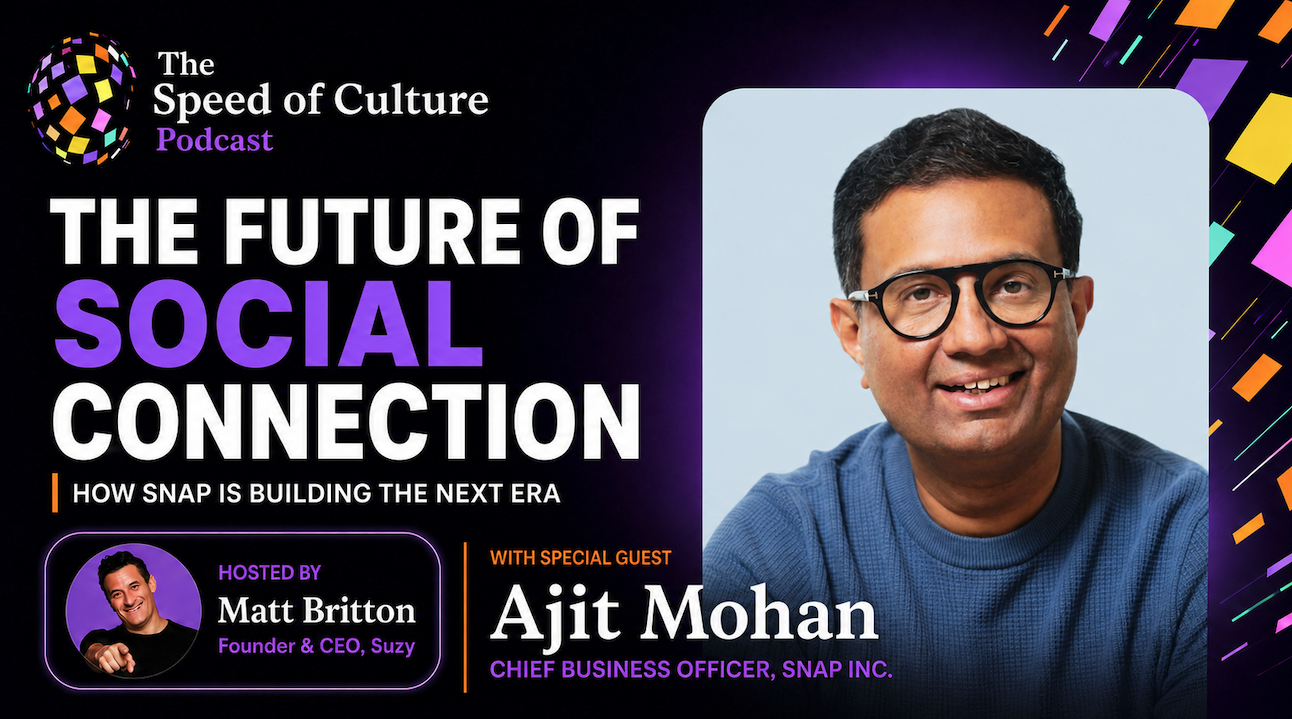
Roughly 85 percent of the people who open Snapchat go there to message someone. Until last year, Snap did not allow a single ad in that surface. That one data point explains a company with nearly a billion monthly users and a revenue line that never matched its scale, and it also explains where the entire attention market is heading next.
Ajit Mohan, Chief Business Officer at Snap, laid out the case on a recent episode of The Speed of Culture with Matt Britton. His framing borrows an old line about how nothing happens in some industries for decades, then decades happen in a few weeks. Mohan has now watched that pattern three times: mobile telephony in Southeast Asia, the broadcast-to-streaming shift he lived through while building Hotstar for a legacy media incumbent in India, and the transition happening right now. His read on the current moment is direct. The industry is in the final stages of the age of performance that has defined social media for fifteen years.
Two shifts are running at the same time. Attention is moving from the feed to private conversation. And user behavior is moving from performative posting to authenticity. Layer generative AI on top, where nearly every consumer interaction is already conversational by default, and the marketing systems built around the scroll start looking like assets with a decay curve rather than a growth curve.
For any AI keynote speaker tracking where enterprise marketing budgets go next, this is the structural story of the next five years. Britton, founder of Suzy and bestselling author of Generation AI, has spent two decades advising Fortune 500 marketers through exactly these transitions. The pattern he describes is consistent: the incumbent behavior does not die, it decays slowly enough that most organizations mistake the decay for stability. Then the window to build a new capability closes while everyone is still optimizing the old one.
Why the Age of Performance Is Ending
Mohan is careful not to overstate it. A former Instagram colleague told him the scroll is dead. His correction: the scroll is still alive, but it is dying.
The distinction matters for planning. Feed-based media will carry real volume for years. But the energy is shifting, and energy is what determines where the next decade of product investment and consumer habit formation goes.
Two forces are driving it. The first is a documented backlash against performative social media, the fifteen-year stretch where the core user behavior was publishing a highlight reel. Britton and Mohan agree on the shorthand: look at my Lamborghini. That posture has an expiration date because the audience learned to read it.
The second force is more interesting because it is not a backlash at all. Users are simply recognizing where their real conversations already live. The exchange you have with the people you actually care about happens in private messaging, not in a public comment thread. Snap did not have to manufacture that behavior. It has been the platform's center of gravity since ephemeral messaging launched.
The commercial implication is significant. If authenticity and privacy are where engagement concentrates, then the advertising model built on public performance is monetizing a declining surface. Britton makes a parallel point in his keynotes on consumer behavior: brands consistently over-invest in the channel where measurement is easiest rather than the channel where attention is strongest, and the gap between those two things is widening.
Discovery Is Moving Into Conversation
The strongest objection to the end of the feed is discovery, and Britton raises it directly. The feed is how people found the restaurant, the trip, the sneakers. It gave brands and creators an introduction to audiences that earlier media forms could not deliver. If the feed decays, where does discovery go?
Mohan's answer reframes the question. Feed-based discovery has been a large part of the marketing story for a decade, but recommendation from friends and family predates all of it and never stopped. Conversations on Snapchat cover far more than shared experiences. They are about which movie to see and which shoe to buy. Discovery has been happening inside conversation the entire time. It was just not instrumented, so marketers could not see it or buy against it.
What changes now is the second layer. Consumers are no longer limited to asking friends and family. They are asking agents. And that adds a variable most marketing organizations have not modeled: the answer that comes back differs by person, based on context. There is no single ranked result set to optimize toward.
This is where answer engine optimization becomes a board-level concern rather than a search team's side project. Britton has been building against this shift directly through FutureProof's AEO work, tracking how brands surface inside AI-generated answers. The upside Mohan identifies is real and underdiscussed. Products, categories, and brands that never had a path to surface in a feed governed by engagement ranking may finally get surfaced in conversation, because relevance in a conversation is contextual rather than competitive. A small brand with a precise fit for a specific prompt can win a moment that no media budget would have bought it in the feed era.
The risk sits on the other side of the same coin. Algorithmic gatekeeping does not disappear in a conversational world. It moves upstream and becomes harder to see. When the model is the intermediary, brand visibility becomes a function of how the model represents your category, and most brands currently have no measurement of that at all.
The Default Economy Is Why Marketers Are Late
Mohan's explanation for why Snap has trailed Meta and Google in advertising revenue despite platform scale is the sharpest business observation in the conversation. Meta and Google are the new broadcast television. They built strong platforms, marketers got used to spending on them, and that behavior has been sticky for fifteen years. As he puts it, no marketer is going to get fired for spending more money on Meta and Google.
That is the default economy operating exactly as designed. Defaults do not win on merit once they are established. They win on the absence of career risk in choosing them. The spend allocation stops being a decision and becomes a habit, and habits survive long after the conditions that justified them.
Mohan is candid that this is now the core of his job. The product exists. The task is helping CMOs recognize that they need to be solving for the next ten to fifteen years rather than defending systems built for the last ten. He notes that smaller companies tend to move faster here because they are always hunting the marginal dollar. Large enterprises have entrenched process, agency relationships, measurement frameworks, and internal incentive structures all built around the feed. Inertia is an operating system problem rather than a mindset problem.
Britton's framing for this is decision compression. When an organization has genuine clarity on where it is going, new options resolve to a fast yes or a fast no. When it does not, every new channel becomes a two-quarter evaluation cycle, and by the time the test concludes the opportunity has repriced. The brands that will move first on conversational advertising are the ones with the shortest distance between insight and budget reallocation, whatever the innovation credentials of their CMOs.
What Brand Agents Signal About the Next Ad Format
Snap's answer to all of this is a product progression worth studying regardless of whether Snap is in your media plan.
Sponsored Snaps put advertising into the messaging surface for the first time. Mohan is clear that Snap withheld that for years for defensible reasons. Private messaging is a sacred space, and the qualities that make the platform work, being authentic and in the moment, are the same qualities that ads can degrade. When the company finally shipped it, the community response was positive, and the second half of the year went to scaling it.
The next version, announced at Possible, is AI Sponsored Snaps. The original format was a full-screen brand message you opened and closed. The new one turns it into a two-way conversation with an agent the brand owns.
Britton's immediate read on it: if Delta runs one, you can ask about routes, pricing, or a promotion, and the brand can bring a persona into the exchange. Two design choices make the format more interesting than a chatbot in an ad slot. The first is that Snap is not building its own frontier model, which makes it a neutral distribution layer. Marketers bring whatever agent and whatever model they have chosen. The second is that the conversation is genuinely open-ended. Advertisers can seed prompts, but responses are shaped by what the individual user actually asks.
Mohan's line about why placement beats destination is the one worth writing down. Most companies are experimenting with putting an agent on their own website. But consumers do not need more places to go and find AI. They need AI to come to where they already are. A billion people are already having conversations on the platform, and many of those conversations already mention brands.
Britton adds the gap he expects to close quickly. Companies have verified profile pages on every major platform. Almost none have a verified consumer agent, a canonical brand-owned endpoint stocked with the data the company wants surfaced and carrying the brand's voice. His prediction is that this arrives sooner than most marketing organizations are planning for, and the brands that establish it early will own the default answer in their category.
There is a counterpoint worth holding. Conversational ad formats have a fragile trust profile. An agent that hallucinates a return policy or a fare creates liability that a static creative asset never could, and the sacred-space dynamic Mohan describes cuts both ways. The upside is high. So is the cost of getting the governance wrong.
Glasses, and the Next Canvas After the Phone
The longer arc of Snap's strategy sits in hardware. Evan Spiegel has held a consistent view on wearables for over a decade, and Mohan says the company has invested twelve years toward a consumer version of Spectacles launching this year. Snap designs the hardware and the software in-house rather than licensing technology to an eyewear partner.
The reasoning connects back to the same behavioral thesis. Mohan describes walking the beach in Miami and noticing that roughly 80 percent of the people walking are looking down at a phone. Britton adds the comparison that makes it land: watch footage of high school students on the last day of school in 1994 and the way they interact reads like a different species.
The bet is that the appetite driving that behavior, staying connected to people and to what is happening, is durable, while the form factor delivering it is not. Package the smartphone's capability into something worn on the face and you keep the connection while restoring presence in the physical world.
Mohan is measured on timing. New products do not eliminate old ones. The smartphone will have a role, and its decay curve may run long. But he frames glasses as the next canvas in computing, and he expects that within a decade or sooner the value of a device that augments the physical world rather than replacing it will be intuitive to consumers.
For brands, the strategic point goes beyond whether to build for glasses in 2026: a shift in canvas resets creative and measurement conventions entirely, the way mobile did to desktop. Organizations that were slow through the last canvas transition spent years buying their way back to parity.
Key Takeaways for Business Leaders
- Audit how much of your media plan assumes the feed. If the majority of your creative, measurement, and agency structure is built for scroll-based placement, you have concentration risk in a decaying surface.
- Stand up AEO measurement now. You cannot manage brand visibility inside AI-generated answers without first measuring how models currently represent your category and your competitors.
- Build a canonical brand agent before a platform builds one for you. Decide what data, voice, and guardrails your agent carries while you still control the specification.
- Name your default spend explicitly. Identify the portion of budget allocated to Meta and Google because it carries no career risk rather than because it produces the best marginal return, then test against it.
- Treat governance as part of the format. Conversational advertising creates real liability on accuracy and tone. Legal and brand review need to be designed into the agent, not bolted on after launch.
- Shorten the distance between insight and reallocation. The advantage in this transition goes to organizations that can move budget in weeks rather than validate for quarters.
Frequently Asked Questions
Is the social media feed actually dying?
Not immediately, but the trend is directional. Snap's Chief Business Officer Ajit Mohan describes the scroll as dying rather than dead, with user energy shifting toward private messaging and conversational interfaces. Feed-based media will carry meaningful volume for years. The strategic risk is not a sudden collapse but a slow decay that organizations mistake for stability while the window to build conversational capability narrows.
What is a brand agent and why does it matter for marketers?
A brand agent is a company-owned conversational AI endpoint that consumers interact with directly, carrying the brand's data, voice, and guardrails. It matters because discovery is moving into conversation, and in that environment the answer a consumer receives differs by context rather than resolving to a single ranked result. Brands without a canonical agent cede control of how they are represented to whichever model is intermediating.
How is AI changing product discovery for consumers?
Discovery is shifting from algorithmic feed exposure to conversational recommendation. Consumers have always relied on friends and family for recommendations, and AI adds a second conversational layer through agents. This changes the competitive dynamic, because relevance in a conversation is contextual rather than auction-based. Products and categories that could not win feed placement may surface for a well-matched prompt.
Why do marketers keep over-allocating to Meta and Google?
Because default allocation carries no career risk. As Mohan puts it, no marketer gets fired for spending more money on Meta and Google. Fifteen years of habit, agency structure, and measurement convention have made that spend a default rather than a decision. The behavior persists after the conditions justifying it change, which is what creates the opening for platforms with different surfaces.
What This Means Going Forward
Mohan's closing advice to people early in their careers applies equally to enterprises. Be ready to reinvent almost weekly, and accept that the answer you held with conviction two weeks ago may need to change. He pairs that with two constants: leaders will always pay a premium for people willing to walk up a mountain rather than drive down an expressway, and in a period of intense change, kindness becomes a genuine differentiator. His personal mantra, build for legacy but stay rooted, is a reasonable operating principle for any leadership team navigating a canvas shift.
Britton has spent his career at the intersection of AI, consumer behavior, and brand strategy, advising Fortune 500 leaders on how to convert structural change into commercial advantage rather than watching it arrive as disruption. Hear the full conversation with Ajit Mohan on The Speed of Culture podcast, and to bring these frameworks to your next leadership event, explore Matt Britton's speaking platform.
The feed took fifteen years to become the default. Conversation will not take that long, and the organizations building for it now will set the terms everyone else has to buy their way into later.

%20(400%20x%20100%20px)%20(300%20x%2050%20px)%20(150%20x%2050%20px).avif)