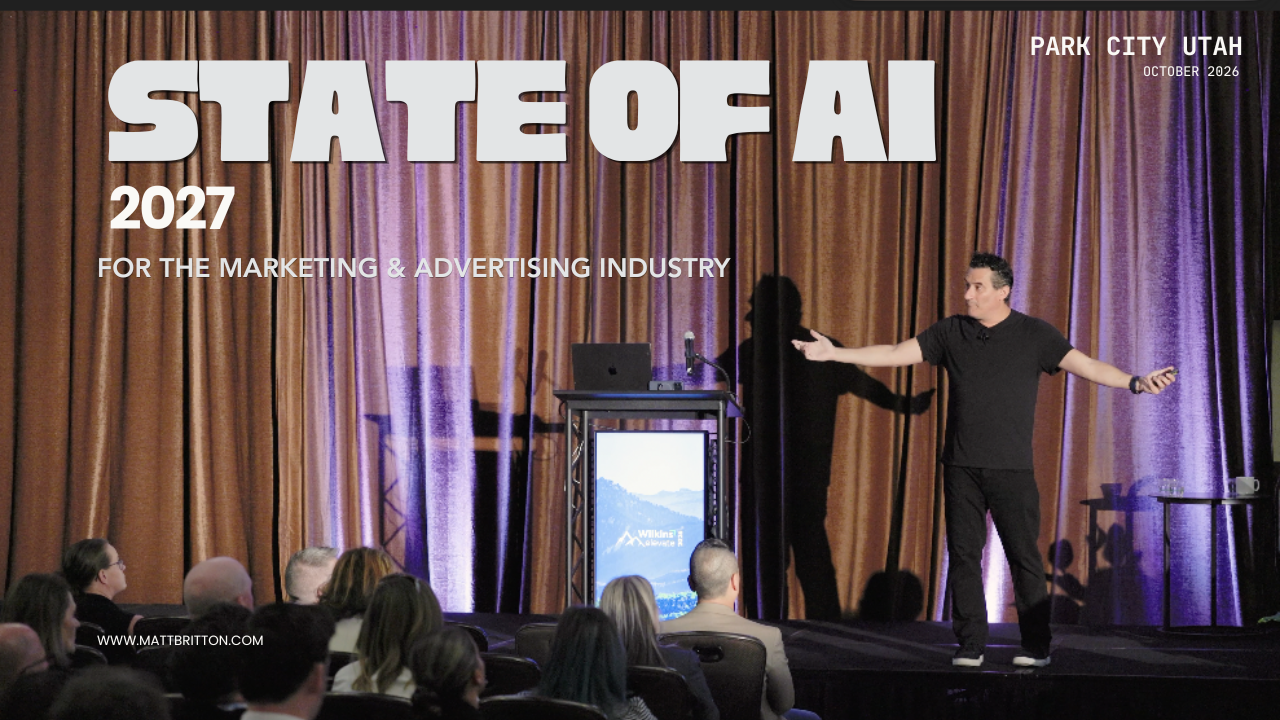
At Recom’s Agentic Commerce Summit in Boca Raton, Florida, Matt Britton made the case that AI will change not only how brands create and market products, but how customers discover, evaluate and buy them.
At Recom’s Agentic Commerce Summit in Boca Raton, Florida, Matt Britton made the case that AI will change not only how brands create and market products, but how customers discover, evaluate and buy them.
Britton opened his keynote with a music video about Recom. The song, graphics and animation had been created on his laptop the previous evening. It was a playful introduction, but it carried his central point: work that recently required a team of specialists can now begin with one person, an idea and AI tools. For businesses, the question is no longer whether AI can produce something impressive. It is how to use that capability to solve a meaningful problem.
At the summit, that problem was commerce. Britton argued that shopping is moving toward AI systems that can understand a customer’s circumstances, recommend a product and eventually complete a purchase within the same conversation. Recom’s leadership connected that possibility to familiar commercial work: content, advertising, fulfillment, pricing, brand protection and customer relationships. The technology may be new, but brands will still have to earn consideration, deliver reliably and give customers a reason to trust them.
The most consequential shift Britton described was a change in where shopping begins. A customer looking for a product may once have typed a few words into Google, compared links, visited a retailer and then purchased on Amazon. Increasingly, Britton said, that customer can begin by describing what they need to an AI chatbot. In the room, he asked who had used a tool such as ChatGPT or Claude to find or research a product they might previously have searched for on Google. Most hands went up. He presented that show of hands as evidence of a behavior worth watching—not as a formal consumer survey.
A conventional product search often starts with sparse information: “pickleball racket” or “wedding guest dress.” An AI conversation can carry more context. Depending on what a customer has shared and connected, an assistant might know the age of the person receiving the racket, or the location and timing of the wedding. A recommendation can then respond to a more specific need than a broad keyword ever captured. That specificity, Britton argued, will influence which brands get considered before a customer clicks anything.
This creates a demanding new test for product information. A listing that describes a moisturizer only as “hydrating” may be less useful in a conversation about a particular skin concern, routine or season. Britton urged brands to think beyond broad search terms and publish more contextual information about who a product is for, when it should be used and how it fits a customer’s needs. During the discussion, Recom said its upcoming sessions would examine those questions within Amazon’s own ecosystem as well.
Britton cited an August study indicating that AI-referred e-commerce traffic converted at a higher rate than non-AI referrals. His explanation was context: a recommendation shaped by a fuller understanding of the request should be more relevant. The broader point does not depend on any single conversion figure. If an AI system helps narrow the options before a shopper reaches a product page, brands must compete to be present and accurately represented in that earlier decision.
That is why “visibility” in AI shopping cannot mean only appearing somewhere in an answer. In the summit Q&A, participants distinguished between whether an AI system understands a product correctly and whether it recommends that product over competitors. Those are different questions. A brand could appear frequently but with the wrong positioning, or be described accurately without making the shortlist. Recom discussed an answer engine optimization tracker intended to follow brand visibility across recurring questions and multiple language models over time.
Britton predicted that purchasing inside AI chatbots would become a practical reality in 2027. He noted that ChatGPT had tested chat-based checkout and pulled back, leaving important questions about the eventual experience and the companies behind fulfillment. His prediction was about direction, not a claim that the end-to-end shopping experience had already been settled.
Today, a shopper can ask an AI tool for advice, copy the name of a recommended product and buy it elsewhere. Britton asked what happens when that extra step disappears. If payment details are stored and the product can arrive at the right price, why leave the conversation? The customer gains convenience. The brand, meanwhile, faces a new set of choices about how its product information reaches the assistant, where it advertises and who owns the resulting customer relationship.
Recom’s leadership brought the discussion back to three things shoppers consider when deciding how to buy: price, speed and trust. Trust may mean confidence in delivery, returns, product condition or the seller itself. Amazon has built a powerful experience around those expectations. An AI interface would not make them irrelevant; it would need a way to meet them. A persuasive recommendation is only part of commerce. The product still has to be paid for, fulfilled and supported.
This is also why agentic commerce is more than a new search box. Britton described AI agents as systems that can remain active on a customer’s behalf rather than answering a single prompt and stopping. He gave the example of an agent watching for a flight price to fall below a chosen amount. Applied to shopping, an agent could help research options, compare prices or wait for a condition to be met. The purchase journey becomes less dependent on the moment a shopper happens to sit down and search.
For brands, there is a potential prize beyond the individual transaction: first-party customer data. In the summit discussion, Recom’s leadership emphasized that when a brand can take part in a sale more directly, it may gain a better understanding of who purchased and what that customer needs. That information can inform product development, content and advertising. But the opportunity depends on the eventual commerce infrastructure, which participants acknowledged is still taking shape.
Britton’s opening video was one example of AI-assisted creative work. He shared others throughout the keynote, including a promotional music video made from a real-estate listing and an illustrated story based on a dream described by his young daughter. Neither example was presented as a reason to stop caring about creative quality. Both illustrated how quickly an idea can become something people can see, hear and respond to.
For marketers, that speed changes the economics of experimentation. Britton argued that AI can make it less expensive to create many variations of an image, video or message, then learn which ones work. Asked whether AI-generated creative converts better than human-made creative, he did not claim to have universal evidence that it does. His narrower point was that brands can produce more creative for the same budget and that the tools are improving rapidly. Performance still has to be tested.
The distinction matters. “Made with AI” is not itself a customer benefit, and producing a thousand variations does not guarantee that any one of them is useful. The value comes from starting with a clear audience and idea, making something relevant, and using results to improve it. Britton’s real-estate example captured that sequence: he chose a listing, considered the audience at a conference of agents, and used AI to turn the property into an unexpected country-music promotion. He said many attendees asked how he had done it, but only a few went on to try it themselves. Access to a tool and action were not the same thing.
Britton also raised the prospect of AI-generated influencers: fictional people depicted in social content and brand campaigns. He saw creative potential, while stressing that brands should disclose when a person is not real. That is a useful boundary for a rapidly expanding creative toolkit. An audience may enjoy an invented character; it should not have to guess whether it is being shown a real person.
His deeper creative argument was about the changing value of technical execution. Britton does not write music, he told the room, yet he could make a song for the summit. In his view, knowing what to make, why it matters and whom it serves becomes more important as the mechanics of making it become more accessible. AI expands what an individual can attempt. It does not supply the purpose behind the attempt.
If creativity supplied the keynote’s most visible demonstrations, data supplied its organizing principle. Britton described an AI value chain running from computing infrastructure and language models through data to applications people use. The model alone, he argued, is not the main differentiator between two businesses using AI. What matters is the context each business can give it and the decisions that context enables.
He illustrated the point with projects from his personal life. For one, he organized years of medical records into a personal health bot he could question about his history. For another, he gathered household information so his mother could find answers about appliances and accounts. The examples differed in complexity, but followed the same pattern: identify a problem, collect the relevant information and build an interface that makes it useful.
For a commerce business, the relevant data may include product details, advertising results, inventory, pricing, customer interactions and fulfillment performance. Having those records somewhere is not enough. Teams need to know where they live, whether they refer to the same products and customers consistently, and which rules govern their use. Otherwise, an AI assistant may be fluent without being dependable.
Britton said Recom had completed a first version of an internal connection to data covering areas such as advertising, inventory and customer work. The team had been consolidating information in Snowflake, establishing common naming conventions and adding business logic. His example of the intended benefit was a question such as what Recom had learned about a brand over the past year and which first steps might help it. Recom was also working toward allowing partners to ask questions about their data from tools such as Claude or ChatGPT; Britton described that rollout as forthcoming, rather than already available to partners.
Good data infrastructure can also reduce the work of coordinating a business. Recom speakers described using an AI layer over project-management information to surface status and blockers across teams. They also discussed the value of having recorded meetings that could become a searchable knowledge source. The aim was not simply to generate more summaries. It was to make information that already exists easier to find when someone needs to act on it.
Data brings responsibilities alongside opportunities. In response to a question about protecting intellectual capital, Britton cautioned companies to consider what they put into externally hosted AI models. He described the trade-off between the benefit of using data and the risk of exposing it, and pointed to locally run, open-source models as one approach for organizations that want greater control. The right decision, his answer suggested, depends on both the value of the use case and the sensitivity of the information.
Questions from the audience revealed a familiar tension: leaders want teams to adopt AI, while employees may be restricted to approved systems that cannot connect to the information they need. Britton said he had encountered that problem while training large organizations. He encouraged people to experiment with personal projects when workplace restrictions prevent hands-on learning, while arguing that company-wide transformation needs senior support, clear ownership and work on the underlying data.
He did not present change management as easy. Existing processes, protective teams, privacy concerns and legacy systems can all slow progress. Britton described his own preference for demonstrating a working example—“show, don’t tell”—so colleagues can see the benefit before being asked to support a wider shift. Another suggestion in the discussion was to pilot AI against a single data source, such as sales data, and use that result to build a case for broader adoption.
His closing framework was deliberately practical: find a problem worth solving, identify the data that could help, build something and keep going when the first attempt does not work. That framework applies as readily to a personal project as it does to a brand’s commerce strategy. It also gives organizations a more useful starting point than asking which AI product they should buy first.
Britton’s keynote was full of ambitious forecasts. He expects AI agents to become central to shopping, creative production to accelerate and businesses to reorganize around data they can actually use. Those outcomes are not all here today, and their timing and eventual winners remain uncertain. What the summit made clear is the preparation brands can do now: make product information more useful, learn how customers are being represented in AI answers, test creative rather than assume it works, and connect trustworthy data to problems that matter.
The next storefront may well be a conversation. If it is, success will still rest on recognizable foundations: understanding the customer, describing the product accurately, earning trust and delivering what was promised. AI changes how quickly those foundations can be put to work—and how visible their absence may become.
Matt delivers customized, high-energy keynotes on AI, consumer trends, and digital transformation for audiences worldwide.
Book Matt to Speak →Ready To Inspire Your Audience?
500+ events worldwide · Fully customized presentations