Contact →
Generation AI · Official Briefing Document

The complete guide to
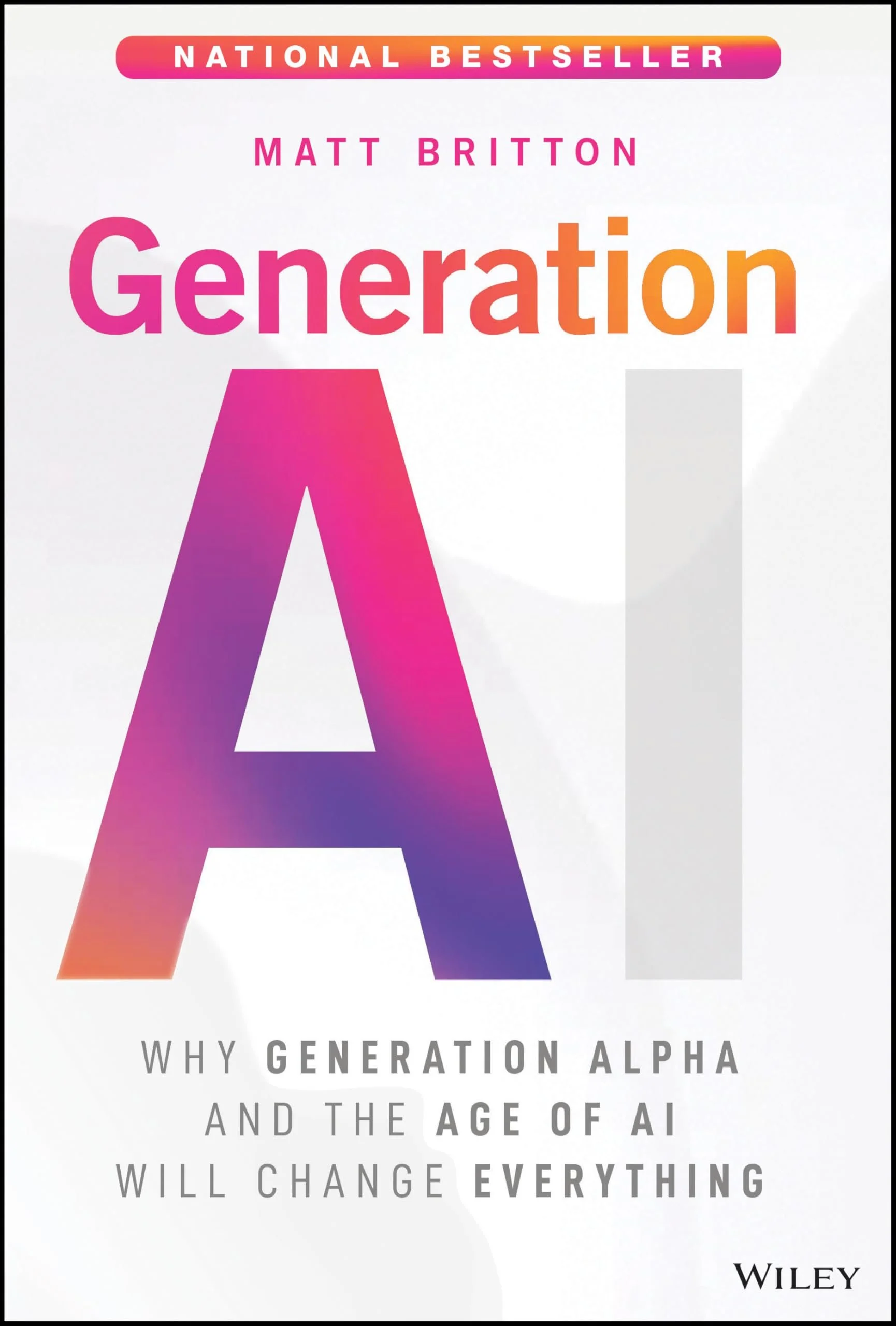
Generation AI

A comprehensive briefing on the profound societal shifts driven by AI and the emergence of Generation Alpha — the first true AI natives.

Buy the Book →
Executive Summary

"Generation AI" by Matt Britton explores the profound societal shifts driven by the rapid evolution of artificial intelligence and the emergence of Generation Alpha (born 2010–2025). The book argues that AI is not just another technological advancement but a fundamental force that will reshape every aspect of human life — from education and healthcare to commerce, relationships, and the nature of work. While acknowledging AI's immense potential, the author critically examines the challenges and ethical dilemmas it presents, advocating for a balanced approach that ensures AI enhances, rather than diminishes, human potential and connection.

01

The Dawn of the AI Era and its Unprecedented Impact

  • AI as a Defining Technology: Just as personal computers defined Gen X, the internet defined Millennials, and the iPhone defined Gen Z, AI will be the defining technology of Generation Alpha — and likely the most impactful of them all.
  • ChatGPT as a Catalyst: The launch of OpenAI's ChatGPT on November 30, 2022, ushered society into a new technological era. Its rapid adoption — 1 million users in 5 days, 100 million in a month — signals its groundbreaking nature and ease of use.
  • Historical Context: Successful technologies seamlessly enhance what we already do, unlike those demanding significant behavioral change (early VR, Metaverse, NFTs). ChatGPT's success is attributed to low barriers to entry and broad applicability.

The Four Layers of Generative AI

  • Infrastructure (GPUs): Companies like Nvidia are central, with GPUs being incredibly effective at powering AI applications. Demand for AI computing power remains in record demand while in limited supply.
  • Large Language Models (LLMs): The "brains" of generative AI, capable of interpreting and producing human-like outputs by training on large datasets. Examples include OpenAI's GPT-4, Meta's LLAMA, Anthropic's Claude, and Google's Gemini.
  • Training Data: The secret sauce differentiating LLMs. Both publicly available (Wikipedia, Common Crawl) and premium data (exclusive, copyrighted content) drive licensing deals and legal battles.
  • Applications: These transform complex AI into user-friendly products — chatbots, text-to-image tools (MidJourney, DALL-E), text-to-video (Runway, Sora), and text-to-music (Suno, AIVA).
02

Generation Alpha: The First AI Natives

  • Demographics: Born 2010–2025, comprising approximately 45.5 million citizens in the United States by end of 2025 — about 13.5% of the population.
  • Digitally Native Households: The first generation born into a fully digital household with Millennial parents. Over 90% will have a digital footprint by age two.
  • Decreased Attention Spans: Early smartphone exposure leads to average human attention spans dropping from 12 to 8 seconds between 2000–2013, with earlier exposure to information requiring more maturity.
  • Mental Health Challenges: Significant increases in anxiety and depression among children aged 3–17 between 2016–2020, linked to early and frequent technology exposure.
  • Unprecedented Diversity: The most diverse generation in history, with nearly 50% identifying as non-white. Products of dizzying media fragmentation across countless sources.
  • Increased Life Expectancy: Will live longer than any prior generation — 73.3 years globally in 2024, 20% longer than Millennials — driven by biotech advancements.
  • Political Immersion: Exposed to politics earlier, creating a recipe for history's most politically active generation.
03

AI's Reshaping of Key Sectors

Home The Jetsons Arrive

  • Smart Homes: AI will enable appliances that anticipate needs — refrigerators that order food, cleaning devices that learn and adapt. Talking to devices will be as natural as talking to humans.
  • Family Chatbot: AI tools trained on household information (schedules, finances, medical records) will become central to how families manage daily life — grocery orders, travel bookings, schoolwork monitoring.

Media Entertainment & Information

  • Creator Economy: Projected to reach $480 billion by 2027, democratizing media and allowing individuals to steer culture from the ground up.
  • AI Influencers: AI-generated personas that mimic human behaviors. Social media posts by AI influencers outperform posts by real humans (2.84% vs. 1.72% engagement).
  • AI in Hollywood: Text-to-video tools like Sora and Veo 2 deliver mind-blowing results. Opportunity for A-listers but a looming threat for most other actors.
  • Deepfakes & Misinformation: AI enables convincing deepfakes blurring reality and fabrication, posing risks for elections, fraud, and widespread misinformation.
  • AI Search: ChatGPT and Perplexity challenge Google's dominance, shifting from blue links to conversational summaries.

Health Healthcare Revolution

  • AI-Powered Diagnoses: AI chatbots can sort through millions of medical texts to distill symptoms into likely causes — with documented cases outperforming 17 human specialists.
  • The Quantified Self: Wearables (Apple Watch, Oura Ring, Whoop) combined with AI provide personalized health insights at reduced costs.
  • AI-Powered Surgery: Robotic assistants perform procedures with unprecedented precision, learning from millions of procedures.
  • Personal Health Bots: Custom GPTs trained on personal health data enable individuals to take control of their health in compelling new ways.

Work The Workplace Transformed

  • White-Collar Impact: AI disproportionately affects educated workers making up to $80,000. Employers believe 42% of workforce tasks will be fully automated by 2027.
  • Affected Roles: Customer service, legal/accounting, creative professionals, and software engineering all face significant disruption.
  • Solopreneurship: AI agents empower individuals to build billion-dollar companies with 10-person teams, without traditional capital or large organizations.
"AI isn't going to take your job; it's somebody that is using AI that will take your job."

Commerce Reinventing How We Buy

  • Creator Store: Social shopping enables influencers to directly sell products to engaged audiences, creating massive scalable opportunities.
  • The Buying Agent: AI agents revolutionize purchasing — detecting when products run low, arranging trips, finding best prices. Perplexity's "Buy with Pro" is an early example.
  • Membership Economy: Growing demand for exclusive, community-driven experiences indicates a shift toward closed communities with unique access.

Finance Money & Wealth

  • YOLO Spending: Gen Z's "You Only Live Once" mentality prioritizes instant gratification, contributing to record credit card debt.
  • AI Wealth Management: Gen Alpha will prefer AI-based platforms (Betterment, Wealthfront) over traditional wealth managers.
  • Cryptocurrency: Approximately 20% of digital natives own cryptocurrencies, and over half of US Gen Z prefers crypto over traditional banks.
  • Great Wealth Transfer: Over $50 trillion in inheritances will transfer from baby boomers to younger consumers by 2045.
04

Parenting in the Age of AI

  • Developing Critical Thinking: Parents must balance AI's power and productivity with ensuring children retain abilities to ideate, plan, collaborate, write, and think — skills that will be uniquely human and valued.
  • Prioritizing Social Skills: COVID-19 exacerbated social disconnection. AI platforms like Character AI offer alluring emotional connection with non-human entities, raising concerns about relationship atrophy.
  • AI as a "New Religion": As AI becomes capable of deep, meaningful conversations, there's a distinct possibility Gen Alpha will turn to AI chatbots as a form of religion, potentially replacing traditional affiliations.
  • The Parental Pivot: Parents must embrace AI's benefits while ensuring it doesn't eclipse critical parts of the human experience — real-world relationships, independent thinking, and guiding values.
05

Risks & Ethical Concerns of AI

  • Inherent Bias: LLMs can be biased due to skewed training data, lack of developer diversity, or censorship — threatening user trust and influencing worldviews.
  • Deepfakes & Misinformation: AI's ability to clone voices and appearances enables bad actors to wreak havoc through highly convincing deepfakes.
  • Sustainability: AI models may consume up to 4% of all global power demand by 2030. ChatGPT queries consume nearly 10x more electricity than Google searches.
  • Job Loss: AI will lead to structural job loss, potentially eliminating millions of jobs worldwide — initially disproportionately affecting white-collar workers.
  • Data & Privacy: Companies train AI on user data without explicit consent, raising concerns about personal control and identity fraud risk.
  • Economic Disparity: The "Magnificent Seven" tech companies are positioned to control AI's future, potentially concentrating wealth even further.
  • AGI & Control: The fear of AI reaching self-awareness and the risk of bad actors using advanced AI for harmful purposes remains a serious long-term concern.
06

Author's Journey & Use of AI

Matt Britton — a Generation Xer (b. 1975) — grew up without digital technology, witnessing the transformative impact of the internet, social media, and mobile on Millennials and Gen Z through his marketing agencies. In 2018, he founded Suzy, a consumer research software company focused on helping businesses remain consumer-centric.

AI Tools Used to Write the Book

  • Claude AI (Anthropic): Used to write the foreword and polish writing for fluency and comprehension.
  • Perplexity AI: Used for the majority of research and fact-finding, enabling rapid access to validated data.
  • Grammarly: Used for proofreading, correcting grammatical errors and restructuring sentences.
  • Futureproof AI: Built a chatbot for readers based on the book's content for interactive engagement.
  • Suno AI: Created the book's theme song in the style of The Beatles.

AI for Business: "The Growth Engine"

Britton personally built "The Growth Engine," an internal chatbot at Suzy trained on 20,000 hours of sales call transcripts. This tool acts as a 24/7 assistant for customer communications, case study retrieval, proposal generation, and pitch prep — designed and launched in two weeks with almost $0 in marginal cost.

The key traits for success in the AI era: taking initiative, technical sufficiency, determination, and collaboration.
07

Call to Action

The core message is clear: AI's effects will be more profound and immediate than any innovation in human history. Your future success depends on understanding and deploying AI in your life and career.

"This train will stop for nobody." Society must harness this elevation in human potential to create opportunity and security — and ensure AI amplifies rather than diminishes what makes us innately human.

Generation Alpha will be the first true AI natives — not merely users of this technology but also its natural orchestrators, uniquely positioned to reshape AI for a more prosperous future.

Matt in the media

From CNN and Fox Business to CNBC and Bloomberg — watch Matt break down AI trends and generational shifts for national audiences.

Generation AI

Ready to explore the AI future?

Get the book that Fortune 500 leaders are calling essential reading for the AI era.