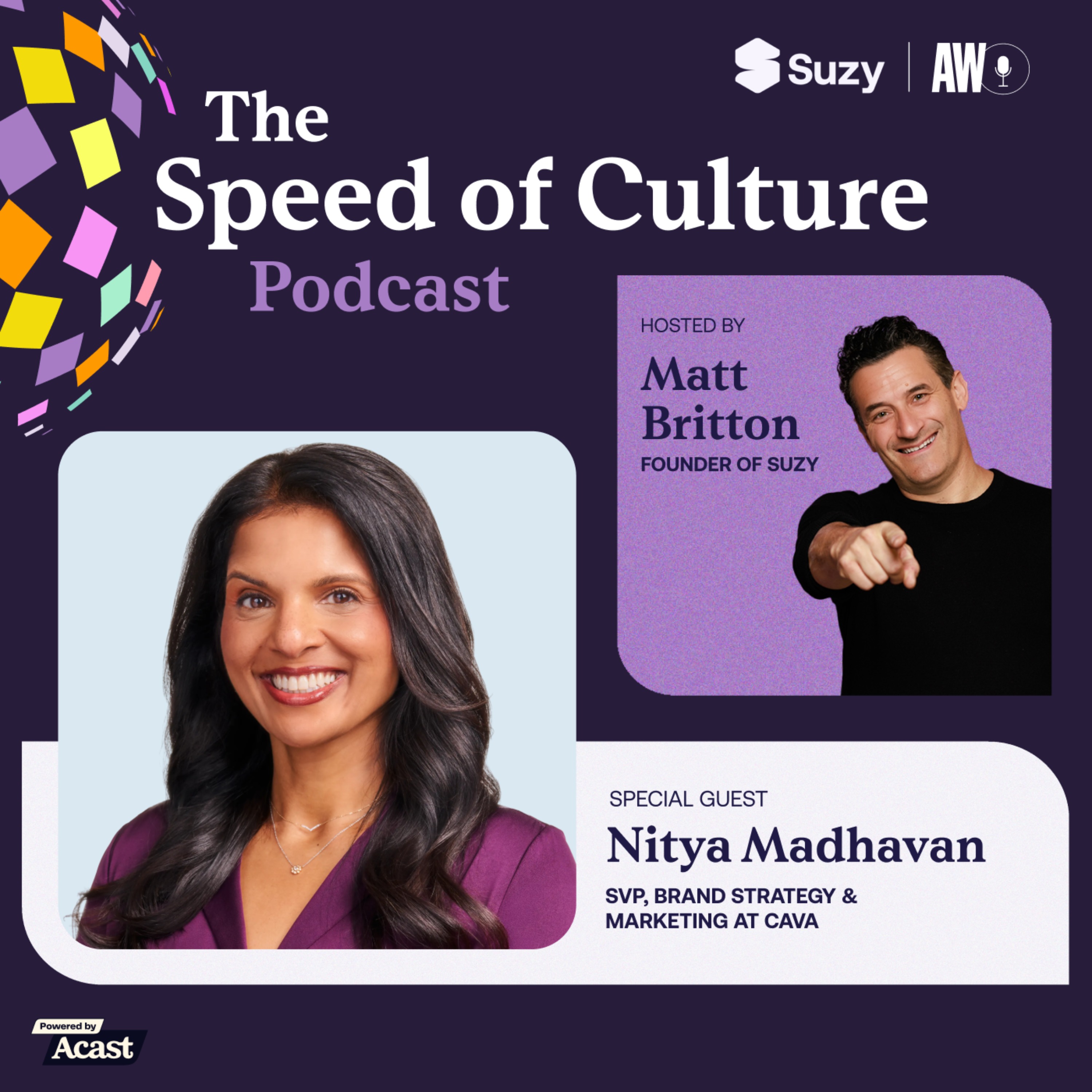
In Episode 265 of The Speed of Culture podcast, Matt Britton sits down with Nitya Madhavan, Senior Vice President of Brand Strategy and Marketing at CAVA, for a candid conversation about what it actually takes to scale a beloved regional brand into a national powerhouse without sacrificing the warmth that made it worth scaling in the first place. The discussion is as relevant for CMOs in packaged goods and retail as it is for anyone in food service — because the tension CAVA is navigating is the defining brand challenge of this decade.
The fast-casual restaurant segment has become one of the most fiercely competitive arenas in consumer spending. Industry data shows fast-casual dining now commands more than a third of all restaurant visits in the United States, with consumers demonstrating a clear preference for brands that deliver quality and speed without the transactional coldness of traditional quick service. Mediterranean cuisine in particular has emerged as a breakout category, riding sustained consumer interest in healthful, ingredient-forward eating. CAVA sits at the center of that wave — a publicly traded, rapidly expanding brand with more than 350 locations and an aggressive footprint growth plan in motion.
But scale is a stress test. Every new market entered, every new franchisee onboarded, every new social platform embraced carries the risk of diluting the hospitality and human connection that originally differentiated the brand. Matt Britton, one of the foremost authorities on consumer culture and brand strategy in the AI era, brings that lens to this conversation. As the bestselling author of Generation AI and a keynote speaker who has addressed executive audiences across the Fortune 500, Britton consistently challenges leaders to think about growth not as a force that works against brand identity, but as a vehicle for deepening it. Madhavan's approach at CAVA offers a compelling case study in doing exactly that.
What follows are the core strategic themes from their conversation — and the implications every brand marketer should carry back to their organization.
How CAVA Is Scaling Mediterranean Culture Without Losing Its Soul
One of the central tensions in brand growth is the relationship between consistency and authenticity. Standardization is what makes a brand scalable; but over-standardization is what makes a brand feel corporate. CAVA has made an explicit choice to resolve that tension in favor of the human element, even when doing so requires more operational complexity.
Madhavan describes CAVA's approach as rooted in a simple but demanding principle: the brand is not a restaurant concept, it is a carrier of Mediterranean hospitality. That philosophy has roots in the culinary traditions of the Mediterranean world itself — a culture where sharing food is a primary form of relationship-building, where the act of eating together carries meaning beyond sustenance. Translating that ethos into a fast-casual format operating at national scale requires more than a well-designed menu. It requires a training culture, a hiring philosophy, and a marketing posture that all reinforce the same human warmth.
The implication for CMOs is straightforward but underappreciated: brand voice is not just a communications asset. It is an operational discipline. The brands that maintain authenticity at scale treat their culture as infrastructure, not decoration. CAVA's investment in how team members interact with guests — the eye contact, the genuine product enthusiasm, the willingness to slow down and explain an ingredient — is as central to the brand strategy as any campaign the marketing team produces.
Britton, who has spent more than two decades studying how consumer expectations evolve, argues that this kind of embedded hospitality will only become more competitively significant as AI takes over more of the surface-level customer interaction. When automation handles the transactional, the brands that have cultivated genuine human warmth will hold a structural advantage that technology cannot replicate. CAVA appears to understand this intuitively.
Experiential Marketing as a Competitive Growth Strategy for Restaurant Brands
Madhavan is emphatic that traditional advertising alone cannot build the kind of brand equity CAVA is after. In a landscape where consumers are simultaneously overexposed to digital advertising and deeply hungry for meaningful experiences, CAVA has invested heavily in experiential marketing as a primary growth driver — not a supplemental tactic.
The reasoning is grounded in consumer psychology that Britton explores frequently in his keynote presentations: experiences create memories in a way that impressions do not. A consumer who attends a CAVA-hosted community event, who participates in a Mediterranean cooking activation, or who encounters the brand in an unexpected and delightful context is far more likely to become a loyal advocate than one who has seen thirty digital ads. The experience is the campaign. The memory is the asset.
This approach also plays well against the fragmentation of the media environment. As attention continues to atomize across platforms, channels, and formats, any single advertising placement has a diminishing probability of breaking through. Experiential touchpoints, by contrast, are inherently high-attention environments — people are present, engaged, and emotionally open in a way they rarely are when scrolling a feed. CAVA's investment in these moments reflects a sophisticated understanding of where durable brand impressions actually form.
For restaurant marketers and CMOs in adjacent consumer categories, the lesson is to treat experiential not as a line item to be cut when budgets tighten, but as a core mechanism for generating the memories and associations that no amount of digital spend can efficiently replicate. The brands gaining share in this environment are investing in moments, not just messages.
Social Micro-Communities and Creator Partnerships in Modern Brand Marketing
One of the most tactically instructive parts of Madhavan's conversation with Britton is her discussion of how CAVA thinks about social media — not as a broadcast channel, but as a network of micro-communities that need to be engaged on their own terms.
The conventional brand social playbook — produce polished content, publish on schedule, optimize for reach — is increasingly insufficient. Consumer trust has migrated away from brands and toward peers, creators, and community voices. This is particularly pronounced among the younger consumer cohorts that represent CAVA's long-term growth opportunity. Research consistently shows that consumers under 35 are more influenced by creator recommendations than by traditional advertising, and that authenticity of voice matters more to them than production quality.
CAVA's response is to engage with creators not as distribution vehicles, but as genuine partners in storytelling. Rather than briefing creators with scripts and brand talking points, the approach emphasizes finding voices that have an organic relationship with food, health, culture, or Mediterranean cuisine — and then giving them enough creative latitude to produce content that feels native to their community. The result is brand content that doesn't feel like brand content, which is precisely the point.
The micro-community dimension matters here. CAVA isn't chasing the biggest creators in the largest categories. The brand is identifying specific community pockets — fitness and nutrition communities, Mediterranean diaspora communities, food discovery communities — where there is natural alignment between audience values and what CAVA represents. This targeted approach generates less reach in raw numbers but far higher relevance, engagement, and conversion intent than broadcast-scale creator campaigns. It is the kind of nuanced social strategy that Britton regularly sees separating the brands building genuine communities from those simply accumulating followers.
Loyalty Data and AI as Tools for Deepening Customer Relationships
CAVA's loyalty program represents one of the brand's most strategically valuable assets — not because of the discounts it delivers, but because of the data and relationship signals it generates. Madhavan discusses loyalty with an orientation that is notably different from the transactional loyalty programs that have defined the restaurant industry for decades. The goal is not to incent repeat visits through points mechanics. The goal is to understand guests well enough to make every interaction feel more personal, more relevant, and more like the brand actually knows them.
This is where AI enters the picture. The convergence of rich loyalty data and increasingly capable AI tools creates an opportunity to deliver personalization at a scale that was previously impossible. Consumer intelligence platforms like Suzy have demonstrated how real-time data and AI-powered analysis can help brands move from aggregate demographic assumptions to nuanced understanding of what individual consumers actually want — and when, and why. For CAVA, applying that kind of intelligence to loyalty data means being able to identify which guests are most likely to try a new menu item, which markets are showing signs of brand affinity growth, and which touchpoints are most effective at converting occasional visitors into regulars.
Madhavan's framing of AI as a relationship-deepening tool rather than a cost-reduction mechanism is worth noting. The brands most at risk from AI disruption in the consumer space are those using it primarily to automate away human interaction. The brands that will use AI to create competitive advantage are those, like CAVA appears to be, that use it to understand their customers more precisely and serve them more thoughtfully. That distinction has profound implications for how marketing leaders should be framing AI investments to their boards and executive teams.
Why the Strongest Brands Use Growth to Deepen Relationships, Not Dilute Them
The organizing philosophy that runs through Madhavan's conversation with Britton is one that challenges a deeply ingrained assumption in brand strategy: that scale and authenticity are inherently in tension. The conventional wisdom holds that growth requires standardization, that standardization requires compromise, and that compromise erodes the distinctive qualities that made the brand worth scaling. CAVA's trajectory suggests a different model is possible.
The key insight is that growth can be deliberately designed to reinforce brand identity rather than dilute it — but only if brand identity is treated as a strategic input to growth decisions, not a constraint on them. Every market CAVA enters, every partnership the brand forms, every channel it activates is evaluated not just for its commercial potential but for whether it reinforces or weakens the warmth and hospitality at the brand's core. This disciplined filtering is what allows the brand to grow aggressively while maintaining the cultural coherence that makes it feel like CAVA everywhere it operates.
For Britton, this is a model that extends well beyond the restaurant industry. In his work advising enterprise leaders on navigating accelerating change, he consistently observes that the companies that sustain competitive advantage through periods of rapid growth are those that treat their culture and values as load-bearing elements of the business model, not aspirational language in an annual report. CAVA's approach to scaling with soul offers a replicable framework: define what is non-negotiable about the brand experience, build operational systems that protect those elements at scale, and then grow as aggressively as the market allows within those guardrails.
That framework becomes even more important in an era when AI is compressing the timeline between strategic decisions and competitive consequences. The brands that have built genuine, values-aligned cultures will be more resilient, more differentiated, and more difficult to replicate — by competitors and by algorithms alike.
Key Takeaways for Business Leaders
- Embed hospitality as an operational discipline, not a marketing message. CAVA's ability to maintain warmth at scale comes from treating human connection as an infrastructure investment — built into hiring, training, and incentive systems — rather than a campaign theme. CMOs should audit whether their brand's stated values are actually engineered into the customer experience or merely asserted in communications.
- Invest in experiential marketing as a primary growth driver, not a supplemental tactic. In an environment of fragmented attention and declining advertising trust, memories formed through direct brand experiences generate loyalty and advocacy that no digital campaign can efficiently replicate. Allocate budget accordingly.
- Build creator partnerships around authentic community alignment, not reach metrics alone. Micro-community engagement with genuinely aligned creators consistently outperforms broadcast-scale influencer campaigns on the metrics that actually drive purchase behavior: trust, relevance, and intent. Evaluate creator partnerships by audience fit, not follower count.
- Reframe loyalty programs as relationship intelligence systems. The most valuable output of a loyalty program is not repeat-purchase behavior — it is the behavioral and preference data that enables increasingly personalized engagement. Design loyalty architecture around data quality, not discount mechanics.
- Use AI to deepen customer understanding, not just automate customer interactions. The competitive advantage in AI lies in using it to serve customers more thoughtfully — surfacing the right offer, message, or experience at the right moment — not in using it to reduce human contact. Brands that invest AI in understanding rather than automation will build durable differentiation.
Frequently Asked Questions
How is CAVA scaling its restaurant brand while maintaining brand authenticity?
CAVA treats Mediterranean hospitality not as a restaurant format but as a cultural philosophy embedded in operations. The brand maintains authenticity at scale by making human warmth an operational discipline — built into team training, hiring criteria, and the physical design of every location. Rather than standardizing away individuality, CAVA uses its core values as a filter for every growth decision, ensuring that expansion reinforces rather than dilutes what makes the brand distinctive.
What role does experiential marketing play in fast-casual restaurant growth strategies?
Experiential marketing is increasingly central to building the kind of durable brand equity that drives long-term loyalty in the fast-casual segment. Unlike digital advertising, which generates impressions, experiences create memories — and memories drive advocacy. For brands operating in a fragmented media environment, investment in high-quality direct experiences with consumers delivers a return on brand affinity that mass-reach advertising cannot efficiently replicate. CAVA has made experiential a core growth mechanism, not a supplemental budget item.
How are restaurant brands using AI and loyalty data to improve customer relationships?
Leading restaurant brands are combining loyalty program data with AI-powered analysis to move beyond aggregate consumer profiles toward genuine individual personalization. Rather than using AI primarily to automate transactions, the most effective applications use it to surface insights that make each customer interaction more relevant — identifying which guests are most likely to try new items, which offers will resonate with specific segments, and which moments in the customer journey represent the highest opportunity for deepening the relationship.
What is the best strategy for building a restaurant brand community on social media?
The most effective restaurant brand social strategies move away from broadcast thinking — polished content pushed to large audiences — toward community engagement thinking. This means identifying micro-communities where natural alignment with the brand's values and cuisine already exists, then partnering with creators who have authentic relationships within those communities. Giving creators genuine creative latitude produces content that feels native and trustworthy, driving higher engagement and conversion intent than scripted influencer campaigns with larger reach but lower relevance.
The Future of Brand Scaling: Culture as Competitive Advantage
The conversation between Matt Britton and Nitya Madhavan offers more than a case study in restaurant marketing. It offers a model for how brands in any category can approach the fundamental tension between growth and identity — and resolve it in favor of both. In an era defined by accelerating change, AI disruption, and consumer demand for authenticity, the brands that will lead are those that have built genuine cultures strong enough to survive scale.
Britton has spent two decades at the intersection of consumer behavior, technology, and business strategy, and the theme that runs through his work — from his research for Generation AI to his keynotes for Fortune 500 leadership teams — is that the organizations winning the future are those investing in what makes them irreducibly human. CAVA's story, as told by Madhavan, is a vivid illustration of that principle in action.
Hear more conversations like this one — with the executives, strategists, and innovators shaping the future of consumer culture — on The Speed of Culture podcast with Matt Britton. New episodes publish weekly.
Related Posts
Playing the Long Game: CarMax on Turning Fandom Into Brand Loyalty

Offline by Design: How Pinterest Turned Disconnection Into Earned Media

Kitchen Table Finances: Intuit on AI and Everyday Money Management