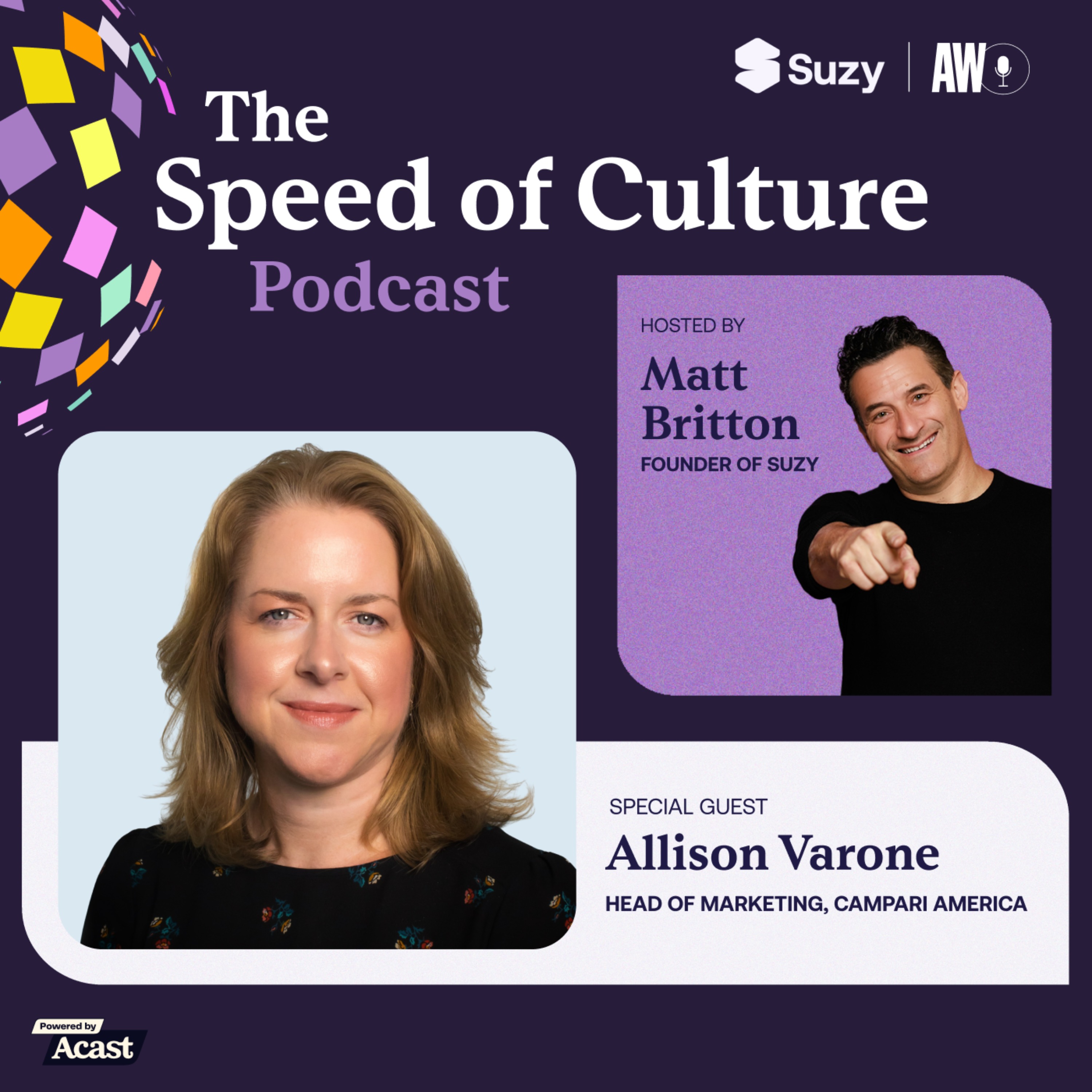
Allison Varone, Head of Marketing at Campari America, on How Heritage Spirits Brands Stay Culturally Relevant
The global spirits market is expected to surpass $700 billion by 2030, yet the brands most likely to capture that growth are not necessarily the ones with the longest histories — they are the ones with the sharpest cultural radar. For marketing leaders at heritage portfolio houses, the central question is no longer whether to evolve, but how to evolve without erasing the rituals, emotional associations, and category authority that took generations to build. That tension — between preservation and progress — sits at the heart of one of the most important strategic conversations in consumer marketing today.
On Episode 266 of The Speed of Culture, Matt Britton sat down with Allison Varone, Head of Marketing at Campari America, to examine exactly that challenge. Varone leads marketing strategy for one of the most storied portfolios in beverage alcohol, a house that includes Campari, Aperol, Wild Turkey, Grand Marnier, SKYY Vodka, and more than fifty other brands. Her vantage point is uniquely instructive for any chief marketing officer navigating the collision of consumer behavior change, cultural fragmentation, and the relentless pressure to drive commercial results without sacrificing brand equity.
Matt Britton is the Chairman of Suzy, the AI-powered consumer intelligence platform used by Fortune 500 marketing teams to decode shifting consumer behavior in real time. He is also the bestselling author of Generation AI and YouthNation, a leading AI futurist and keynote speaker, and the host of The Speed of Culture podcast on the Adweek Podcast Network. Each episode of the show brings together the executives and innovators who are defining what brand relevance looks like in a culture moving faster than any prior generation of marketers was trained to handle.
The conversation with Varone covers four high-stakes areas that belong on every CMO's agenda: the mechanics of growing a category rather than just a brand, the rise of mindful drinking as a structural consumer shift, the compounding return on experiential marketing, and the often undervalued strategic role of bartender education. Together, these themes form a masterclass in what it means to lead marketing at a heritage brand in a culture that rewards curiosity and punishes complacency.
How Heritage Spirits Brands Can Evolve Without Losing Their Identity
Campari was founded in Milan in 1860. Aperol, another jewel in the Campari Group portfolio, dates to 1919. These are not brands that arrived in the attention economy last year with a TikTok-first strategy and a DTC funnel. They are brands with deep roots, ritualized consumption occasions, and the kind of cultural symbolism that most modern brands would pay any premium to acquire. The challenge Varone and her team face is one that any steward of a legacy brand knows intimately: how do you honor the brand's foundational promise while making it feel urgent and alive to a consumer cohort that did not grow up with it?
Varone's framework begins with a fundamental distinction between brand identity and brand expression. The identity — the flavor profile, the occasion, the emotional territory — is non-negotiable. What can and must evolve is the expression: the channels through which a brand shows up, the language it uses, the cultural conversations it enters, and the communities it serves. A brand like Campari does not need to reinvent itself to be relevant to a younger consumer. It needs to make its existing relevance legible in a new cultural vocabulary.
This requires what Varone describes as institutional curiosity — a genuine organizational commitment to understanding how consumer behavior is changing, not just in the abstract, but in the specific rituals, social contexts, and occasions that govern how people choose and consume spirits. For heritage brands, the risk is not irrelevance on its own; it is the slow calcification that happens when marketing teams stop asking why consumers behaved a certain way in the past and start assuming those behaviors are fixed. The brands that age well are the ones whose marketing organizations learn as fast as the culture moves.
The Spritz Category's Explosive Growth and What It Teaches CMOs About Occasion Marketing
Few category stories in beverage alcohol over the past decade are as instructive as the rise of the spritz. What began as a hyper-regional Italian aperitivo ritual — Aperol or Campari, prosecco, a splash of soda water, an orange slice, a wide-brimmed glass — has become a genuinely global phenomenon, one that has reshaped how an entire generation thinks about the pre-dinner drinking occasion. Understanding the mechanics of that growth is essential for any CMO trying to build occasion-based brand strategy.
Varone breaks down the spritz's trajectory with the precision of someone who has lived it from the inside. The category did not grow because Campari Group simply spent more money amplifying an existing product. It grew because the brand invested in defining and expanding an occasion. The aperitivo hour — that transitional moment between the workday and the evening, designed for light, low-ABV drinks paired with small bites and good conversation — was not a widely recognized consumer ritual in the United States a decade ago. It is now. That shift did not happen organically. It was the result of sustained, intentional marketing work that used cultural fluency, influencer relationships, travel media, and experiential activations to transplant a centuries-old European ritual into American social life.
The lesson for CMOs is not specific to spirits. It is a masterclass in occasion creation as a growth lever. Rather than fighting for share within an established occasion — a zero-sum game that produces incremental gains at best — Campari's team asked a more expansive question: what new occasions can we own? By building the aperitivo moment from near-zero in the U.S. market, the brand was not competing for a slice of an existing pie; it was baking an entirely new one. For marketing executives at brands operating in mature or commoditized categories, this kind of occasion-first thinking represents one of the highest-leverage strategic moves available.
The spritz's growth also illustrates the power of visual culture as a brand-building medium. The drink is architecturally beautiful — the burnt orange hue of Aperol against the golden bubbles of prosecco, served in a globe glass over ice, garnished with citrus. It was made for a camera long before smartphones existed. In the Instagram era, that visual identity became an organic distribution engine. The lesson: in a camera-forward culture, a product's visual distinctiveness is not a cosmetic detail. It is a marketing channel.
Mindful Drinking as a Structural Consumer Shift, Not a Trend
One of the most consequential shifts Varone identifies is the mainstreaming of mindful drinking — the move by a growing segment of consumers, particularly younger ones, to drink less alcohol, drink differently, or abstain entirely for extended periods. For spirits brands, this could read as an existential threat. Varone reads it differently, and that reframe is worth examining closely.
Mindful drinking is not anti-alcohol sentiment. It is a recalibration of the relationship consumers have with alcohol, one that prioritizes intentionality, quality, and occasion over volume and habit. For premium spirits brands with strong occasion associations, this shift is not a headwind — it is a tailwind. When consumers are drinking less but drinking more deliberately, they are exactly the audience that reaches for a brand with a story, a ritual, and a distinct flavor profile rather than a commodity product purchased primarily on price.
The strategic implication for CMOs is significant. Brands that have historically marketed on volume occasions — the party, the nightclub, the weekend binge — need to develop fluency in a new kind of occasion marketing: the considered, quality-forward drinking moment that mindful consumers are increasingly gravitating toward. This means investing in education content that explains what a brand tastes like and why, building digital and social presences that speak to appreciation rather than excess, and developing partnerships and channels that reinforce premium quality signals.
Varone also notes that the mindful drinking wave has been commercially generative for the non-alcoholic and low-ABV segments, and that heritage brands are well-positioned to participate in this space. The flavor complexity and ritual associations that make a brand like Campari distinctive in the traditional spirits context translate directly to compelling non-alcoholic expressions. For CMOs evaluating whether to extend into the no/low space, the question is not whether the consumer demand is real — the data says it is — but whether the brand's identity can travel credibly into that territory. Brands with strong flavor stories and deep occasion associations are better positioned than those whose equity rests primarily on ABV or intoxicant appeal.
Experiential Marketing as a Long-Term Brand Equity Investment
Campari's approach to experiential marketing is one of the clearest illustrations in the industry of how to use live experiences not as a promotional tactic but as a brand-building infrastructure. Varone's team invests meaningfully in activations that range from intimate bartender-focused events to large-scale cultural moments tied to festivals, art, and food. In each case, the goal is the same: create a physical, sensory encounter with the brand that imprints on consumers in a way that no digital media can replicate.
The economics of experiential marketing have always been difficult to defend in a short-term ROI conversation. Events are expensive. They reach fewer people than a digital campaign for the same budget. They are hard to measure with the kind of attribution precision that performance marketing teams demand. And yet the brands that have invested consistently in experiential over the past decade have built consumer relationships that are measurably deeper, more loyal, and more resistant to competitive pressure than those built on digital reach alone.
Varone's perspective on this is grounded in what she describes as the difference between awareness and affinity. Digital media builds awareness at scale. Experiences build affinity at depth. Both matter, but in a culture where consumer attention is fragmenting and ad avoidance is structural, the brands that win long-term are the ones that have invested in the kind of direct, physical brand encounters that create genuine emotional connection. For CMOs under pressure to cut budgets, experiential marketing is often the first line item under threat. Varone's track record at Campari argues for protecting it as a strategic essential.
The experiential strategy also serves a multiplier function in an age of social media. A well-designed, visually compelling brand activation does not reach only the people who attend it. It reaches the social networks of every person who posts about it — which, for the right audience in the right format, can represent a significant amplification of the original investment. The key is designing experiences that are inherently shareable: visually distinctive, emotionally resonant, and tied to cultural moments that consumers already want to participate in and document.
Bartender Education as a Strategic Brand-Building Channel
Among the marketing levers that consumer-facing CMOs most consistently undervalue, trade education — specifically bartender education — stands out as one of the most powerful and most overlooked. Varone discusses Campari's investment in bartender training and relationship-building with the kind of conviction that comes from watching it drive measurable commercial outcomes over a sustained period.
The logic is straightforward but its implications are profound. In a world where the on-premise channel — bars, restaurants, hotels — remains the primary discovery occasion for premium spirits, the bartender is not just a distribution point. The bartender is a brand ambassador, a curator, a trusted advisor who influences the drink decision of every customer they serve. A bartender who loves a brand, understands its flavor story, and knows how to make it shine in a cocktail is worth more to that brand's long-term health than most media placements.
Campari's investment in bartender education goes beyond simple product training. It encompasses cocktail culture, flavor education, the history and heritage of the brands in the portfolio, and the kind of aspirational craft experience that turns bartenders into genuine advocates. The result is a distributed network of experts who recommend Campari Group brands not because they have been paid to do so, but because they genuinely believe in the products and know how to present them at their best.
For CMOs at brands that sell through on-premise channels, this model has clear and immediate applications. The question is not whether to invest in trade education but how to structure it for maximum impact — who to prioritize, what knowledge to transfer, and how to create the kind of ongoing relationship that sustains advocacy over time rather than generating a one-time product trial. Varone's approach offers a working model worth studying carefully.
The bartender education strategy also reflects a broader principle that runs through Campari's marketing philosophy: the belief that building genuine expertise and authentic advocacy in the trade ecosystem produces more durable brand equity than any amount of consumer-facing media spending. This does not mean deprioritizing consumer marketing. It means recognizing that the most credible brand endorsement a consumer can receive comes not from an ad but from the person making their drink.
Key Takeaways for Business Leaders
- Invest in occasion creation, not just occasion capture. Campari's spritz growth demonstrates that the highest-leverage brand strategy is often to define and own a new consumption occasion rather than compete for share within an established one. CMOs should audit their category for underserved or underdefined moments where their brand could establish genuine authority.
- Reframe mindful drinking as a premium opportunity. The structural shift toward intentional, quality-forward consumption favors brands with strong flavor stories, heritage, and ritual associations. Rather than treating reduced alcohol consumption as a threat, position your brand's distinctiveness as the reason consumers choose it when they do choose to drink.
- Protect experiential marketing budgets as long-term equity investments. Experiences build the kind of emotional affinity that digital reach cannot replicate. In a culture where consumer attention is scarce and ad avoidance is structural, the brands that have maintained consistent experiential investment will have deeper, more loyal consumer relationships than those that abandoned it for short-term efficiency.
- Build commercial awareness into marketing culture from the beginning. Varone identifies commercial awareness as a critical skill gap in modern marketing organizations. Marketing teams that understand the business mechanics behind their investments — margin, velocity, channel economics — make better creative decisions and earn more organizational trust.
- Cultivate bartender and trade educator networks as a long-term brand asset. For any brand that moves through on-premise channels, investing in the expertise and advocacy of the people who serve the product is one of the highest-return brand-building moves available. Design trade education programs that build genuine knowledge and enthusiasm, not just transactional compliance.
Frequently Asked Questions
How do heritage spirits brands like Campari stay relevant with younger consumers without alienating their existing base?
The key is distinguishing brand identity from brand expression. A brand's core identity — its flavor, its occasion, its emotional territory — does not need to change to reach a new consumer cohort. What can evolve is how that identity is expressed: the channels, the language, the cultural contexts, and the communities the brand engages. Campari's approach centers on making existing brand relevance legible in the cultural vocabulary of each new generation, rather than reinventing what the brand fundamentally stands for.
What is driving the growth of the spritz category, and how can other beverage brands replicate it?
The spritz category grew because Campari Group invested in defining and owning a new occasion — the aperitivo hour — rather than simply amplifying an existing product. The brand used experiential marketing, cultural partnerships, travel media, and visual distinctiveness to transplant a European ritual into U.S. consumer culture. Brands looking to replicate this model should identify underserved consumption occasions in their category and build a sustained, multi-channel narrative around why their product belongs there.
How should CMOs think about the mindful drinking trend from a brand strategy perspective?
Mindful drinking is not declining consumer interest in alcohol — it is a shift toward more intentional, quality-forward consumption. For premium brands with strong occasion associations and flavor stories, this is a tailwind: when consumers are drinking less but more deliberately, they gravitate toward brands with genuine distinction and heritage. CMOs should respond by investing in education content, quality signals, and occasion marketing that speaks to the considered consumer rather than the volume occasion.
What makes bartender education an effective brand-building investment for spirits companies?
Bartenders are the most credible brand advocates in the on-premise channel because their recommendations come from genuine expertise rather than paid promotion. Campari's investment in deep product education, cocktail craft, and ongoing bartender relationships has created a distributed network of authentic advocates who understand the brand's story and know how to present it at its best. For spirits brands, this long-term investment in trade relationships consistently outperforms transactional trade incentives in building durable brand equity.
The Bottom Line on Brand Longevity in a Fast-Moving Culture
What Allison Varone's work at Campari America makes clear is that brand longevity is not a passive achievement. It is the result of active, intelligent, culturally fluent marketing leadership — the kind that honors a brand's heritage while staying genuinely curious about where the culture is heading next. The brands that endure are not the ones that resist change. They are the ones that learn to distinguish what must be preserved from what must evolve, and then execute on that distinction with commercial discipline and creative ambition.
For CMOs navigating the same terrain — leading established brands through a cultural moment defined by attention fragmentation, behavioral shift, and accelerating change — Varone's framework offers both strategic clarity and practical instruction. The spritz growth model, the mindful drinking reframe, the experiential investment thesis, and the trade education multiplier are each applicable well beyond the spirits category.
Hear more conversations like this one on The Speed of Culture podcast with Matt Britton, available on all major podcast platforms through the Adweek Podcast Network. Each episode delivers the strategic intelligence that marketing leaders need to build brands that move as fast as the culture around them.
Related Posts
Playing the Long Game: CarMax on Turning Fandom Into Brand Loyalty

Offline by Design: How Pinterest Turned Disconnection Into Earned Media
Kitchen Table Finances: Intuit on AI and Everyday Money Management