The U.S. Census Bureau just put a number on what every operator has felt in their gut for the last 18 months. American business is split into two economies. One is moving at the speed of AI. The other is still treating it as a future agenda item.
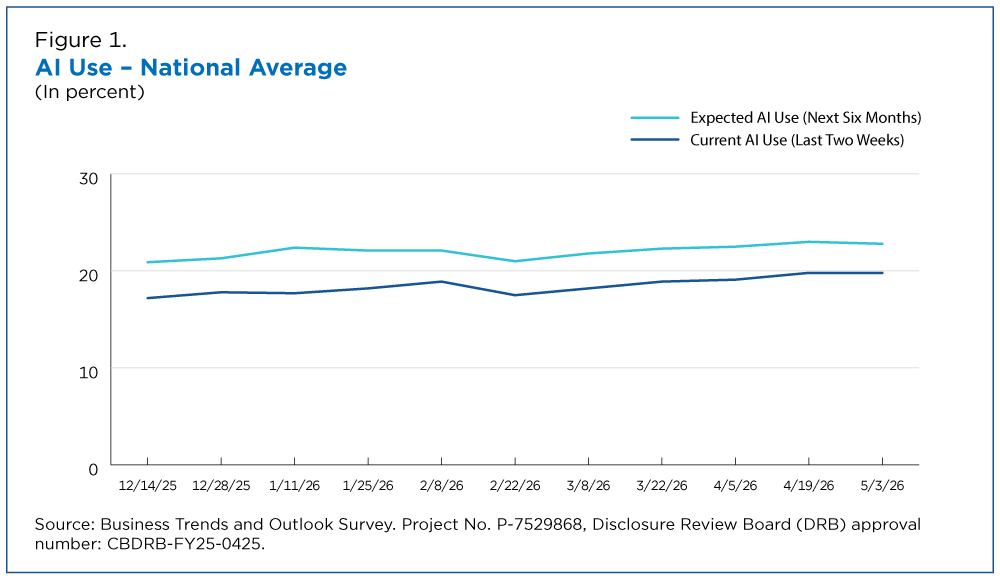
On May 26, 2026, the Census Bureau published its latest Business Trends and Outlook Survey (BTOS) analysis covering AI usage from December 2025 through May 2026. Overall AI usage hovered between 17% and 20%, and between 20% and 23% of businesses expected to be using it in the next six months. The headline number sounds modest. The detail underneath it is the story.
Thirty-seven percent of firms with at least 250 employees reported using AI in their operations. Less than 20% of firms with four or fewer employees reported using AI. That is a structural reordering of who can compete, who can scale, and who gets left holding analog cost structures while their largest competitors compound efficiency every quarter.
For Fortune 500 marketing leaders, board members, and growth-stage CEOs, the BTOS data lands as a wake-up call dressed up as a routine statistical release. Matt Britton, founder and CEO of Suzy and bestselling author of Generation AI, has spent the last two years arguing that AI adoption would bifurcate the U.S. economy faster than any technology shift in modern memory. The May 2026 Census numbers are the receipt.
What the Census BTOS Data Actually Says About U.S. Business AI Use
The Business Trends and Outlook Survey is the most comprehensive ongoing measurement of how American employers are using artificial intelligence. The BTOS sample consists of approximately 1.2 million businesses with biweekly data collection. No other dataset in the country sees AI adoption with the same frequency or breadth. U.S. Census Bureau
The May 26 release covered the six most recent months of data. The Census Bureau measures two things: whether the business used AI in the past two weeks, and whether the business expects to use AI in the next six months. Both metrics tell the same story. The trendline is real, but it is concentrated at the top of the size distribution.
In the data collection period ending May 3, 2026, 32% of firms with 100 to 249 employees said they used AI. Firms with at least 250 employees came in at 37%. Firms with four or fewer employees, which represent the vast majority of American businesses by count, stayed below 20%.
The Census Bureau also flagged a notable methodology shift. Originally framed around AI use "in producing goods or services," rather than to carry out simple tasks like drafting emails, the Census Bureau revised the wording last November to ask businesses whether they were using AI "in any business function." Even with the broader definition, the small-business number barely moved. That is the signal worth paying attention to.
The Sector Story: Information and Finance Lap the Field
The sector breakdown maps almost perfectly to where capital, data infrastructure, and digital-native workflows already exist.
As of May 3, 2026, the AI use rates in the Information (39.7%) and Finance and Insurance (33.9%) sectors were both higher than the national rate (19.8%) but neither reported significant shifts since December. Translation: the leading sectors built their advantage early and are now sitting on a steady plateau while everyone else tries to catch up.
The expected-use numbers reinforce the gap. About 42% of businesses in the Information sector and roughly 39% in Finance and Insurance expected to use AI in their business functions over the next six months.
Retail Trade is the cautionary tale. Businesses in the Retail Trade sector reported current and expected usage lower than the national average: around 14% of businesses currently use AI, and about 17% expect to in the next six months. A category that lives or dies by personalization, inventory intelligence, and demand forecasting is adopting the most important productivity technology of this decade at a rate three times slower than Information.
Britton's argument in his keynotes to enterprise audiences has been blunt on this point. Retail is being algorithmically gatekept out of its own future. The brands that own the consumer relationship in 2030 will be the ones investing in AI infrastructure today, not the ones running another margin-protection drill.
The Firm Size Divide Is the Real Headline
The most strategically important finding in the May 26 release is the divergence by firm size rather than the national average.
Between December 2025 and May 2026, AI use increased among firms with at least 20 employees but didn't change significantly among firms with fewer than 20 employees. Six months. No movement at the bottom of the size distribution. Steady growth at the top.
This contradicts a popular narrative that small businesses are out-innovating enterprise on AI. By mid-2025, the Federal Reserve found that small businesses were adopting AI faster than large firms, a reversal that hadn't happened before in the monitoring data. That reversal appears to have either reversed itself or stalled. The Census data is the most representative dataset in the country, and it shows large firms re-accelerating. Stealth Agents
This matters for three reasons.
First, capital. Large firms can afford the talent, the infrastructure, and the failure rate that AI deployment still demands. 95% of generative AI pilots fail to move beyond the experimental phase, according to MIT's GenAI Divide report. Small businesses cannot absorb that failure cost. Large enterprises can. Larridin
Second, data. AI gets better with proprietary signal. Large firms have it. Small firms do not. The companies that founded their AI strategy on internal datasets are pulling away from the ones renting capability from generic foundation models.
Third, distribution. The default economy now routes consumer attention through algorithmic interfaces that reward scale. AI lets large firms compress decisions, automate creative, and optimize media buying in ways that small operators cannot match without burning their margin.
What Enterprise Leaders Should Take From the May 2026 Numbers
If you sit in a CMO chair, a CIO chair, or a board seat at a company with more than 250 employees, the Census data is a leading indicator. Your peer set is at 37% adoption and climbing. Your competitive set is investing in scaled deployment, not pilots.
McKinsey's parallel data confirms the depth problem behind the breadth number. McKinsey's 2025 State of AI report found that 88% of organizations are using AI in at least one business function, up from 78% the previous year. But only 1% of organizations consider their AI strategies mature. Not 10%. Not 5%. One percent. LarridinLarridin
That gap between adoption and maturity is where competitive advantage will be earned over the next 24 months. Organizations that redesign work processes with AI are twice as likely to exceed revenue goals, according to Gartner's 2025 survey of 1,973 managers. The leverage is not in buying licenses. The leverage is in redesigning the work. Larridin
Britton, who has delivered over 500 keynotes to Fortune 500 audiences and now advises enterprise leaders on AI transformation through FutureProof, frames this as the central operating question of 2026. The companies winning are the ones with the fewest pilots that have scaled, rather than the ones with the most pilots.
The Geographic Picture Adds a Final Layer
State-level data from earlier 2026 BTOS releases shows AI adoption is also geographically concentrated. Colorado tops the country with 23.2% of businesses adopting AI on average in 2026. It's followed closely by Arizona (22.9%) and Washington, D.C. (22.5%), with Oregon and Utah tied for fourth at 21.1%. Visual Capitalist
Colorado, Arizona, and Washington, D.C. lead U.S. business AI adoption, each over double West Virginia's 10.8%, the lowest in the country. Visual Capitalist
The geography of AI maps almost exactly to the geography of venture capital, technical talent, and university research density. This is a feedback loop. States with AI-native workforces attract AI-native employers, which attract more talent, which deepens the moat.
For boards making location decisions over the next decade, the BTOS state data is now a serious input. Sitting in a low-adoption state with a workforce that has not encountered AI in daily work is a real recruiting and execution penalty.
Why the New BTOS Supplement Will Matter More Than the Headline Number
Buried in the May 26 release is a methodology note that deserves more attention than it received.
On November 17, 2025, BTOS began collecting data for its second AI supplement and revised the core AI use questions. This updated supplement expands on the original content by measuring AI use across 15 different business functions, including finance, human resources, customer service, marketing, information technology and research and development.
In addition, the supplement asks about AI-related operational changes, such as training, workflow adjustments and new technology investments. The supplemental data also ask why a business is not using AI.
The next 12 months of BTOS releases will give the C-suite the closest thing the country has ever had to a real-time, sector-by-sector view of which business functions are being transformed by AI and which are being skipped. That data will tell board directors where to push their CEOs, and it will tell CEOs which functional leaders are quietly falling behind.
Britton's view, consistent across his keynotes and his work building Suzy into a $67M ARR consumer intelligence platform, is that marketing and customer experience will be the first functions to see AI maturity at scale, followed by finance and operations. The BTOS supplement will let us test that thesis with hard data through the back half of 2026.
Frequently Asked Questions
What percentage of U.S. businesses are using AI in 2026?
According to the U.S. Census Bureau's May 26, 2026 release of Business Trends and Outlook Survey data, overall AI usage among U.S. businesses ranged between 17% and 20% over the December 2025 to May 2026 period. Between 20% and 23% of businesses expected to be using AI in the next six months. The numbers are significantly higher for large firms and lower for businesses with fewer than 20 employees.
Which industries are adopting AI the fastest?
The Information sector leads at 39.7% AI usage as of May 3, 2026, followed by Finance and Insurance at 33.9%. Both sectors are well above the 19.8% national average. Retail Trade lags at around 14% current use and 17% expected use over the next six months. Sector adoption tracks closely with existing digital infrastructure, data maturity, and capital intensity.
Why is large enterprise AI adoption outpacing small business?
Census BTOS data through May 2026 shows that AI use increased among firms with at least 20 employees but did not change significantly among firms with fewer than 20 employees. Large enterprises have the capital to absorb pilot failure rates, the proprietary data assets that make AI more accurate, and the technical talent to deploy at scale. Small businesses face a steeper integration cost despite cheaper underlying tools.
How can business leaders use Census BTOS data for AI strategy?
The BTOS provides biweekly, nationally representative AI adoption data by sector, firm size, state, and metropolitan area. Leaders should benchmark internal AI deployment against the relevant size and sector cohort, not the national average. Boards should add BTOS data to quarterly review cycles, particularly the new 15-function supplement that tracks adoption inside specific business areas like marketing, HR, finance, and customer service.
The Bottom Line for Operators
The Census Bureau's May 2026 data is the clearest evidence yet that the AI adoption gap is widening, not closing. Enterprise leaders who frame AI as a 2027 strategic priority are already a year behind their peer set. The companies expanding their AI footprint right now are doing it because the cost of waiting is starting to show up in productivity metrics, talent retention, and competitive positioning.
The next BTOS releases will sharpen the picture further. The 15-function supplement will reveal which corners of the business are quietly accelerating and which are falling behind. For Fortune 500 boards and C-suites, that data should become a standing input to strategic planning conversations, not a research artifact.
Matt Britton's keynotes on AI transformation translate this kind of data into operating decisions leadership teams can act on the next morning. To bring these insights to your next leadership offsite, board meeting, or industry conference, explore Matt Britton's speaking platform or connect with his team directly.
Related Posts
AI Product Discovery: Why 55% of Shoppers Trust AI Over Ads

How AI Product Discovery Is Reshaping Consumer Behavior in 2027

ChatGPT Advertising Hits $1B: The New AI Discovery Channel


