The Intention Economy: How Pinterest Is Winning by Telling Users to Put Down Their Phones
Every major social platform on earth is locked in a zero-sum war for one resource: attention. They build algorithms to maximize time-on-screen, engineer dopamine loops to keep users scrolling, and measure success in minutes consumed. In 2026, the global social media advertising market surpasses $300 billion, and the predominant currency powering it is captured attention. Against this backdrop, one platform has made a radical bet — that telling users to get off their phones is actually the smartest marketing strategy in the industry.
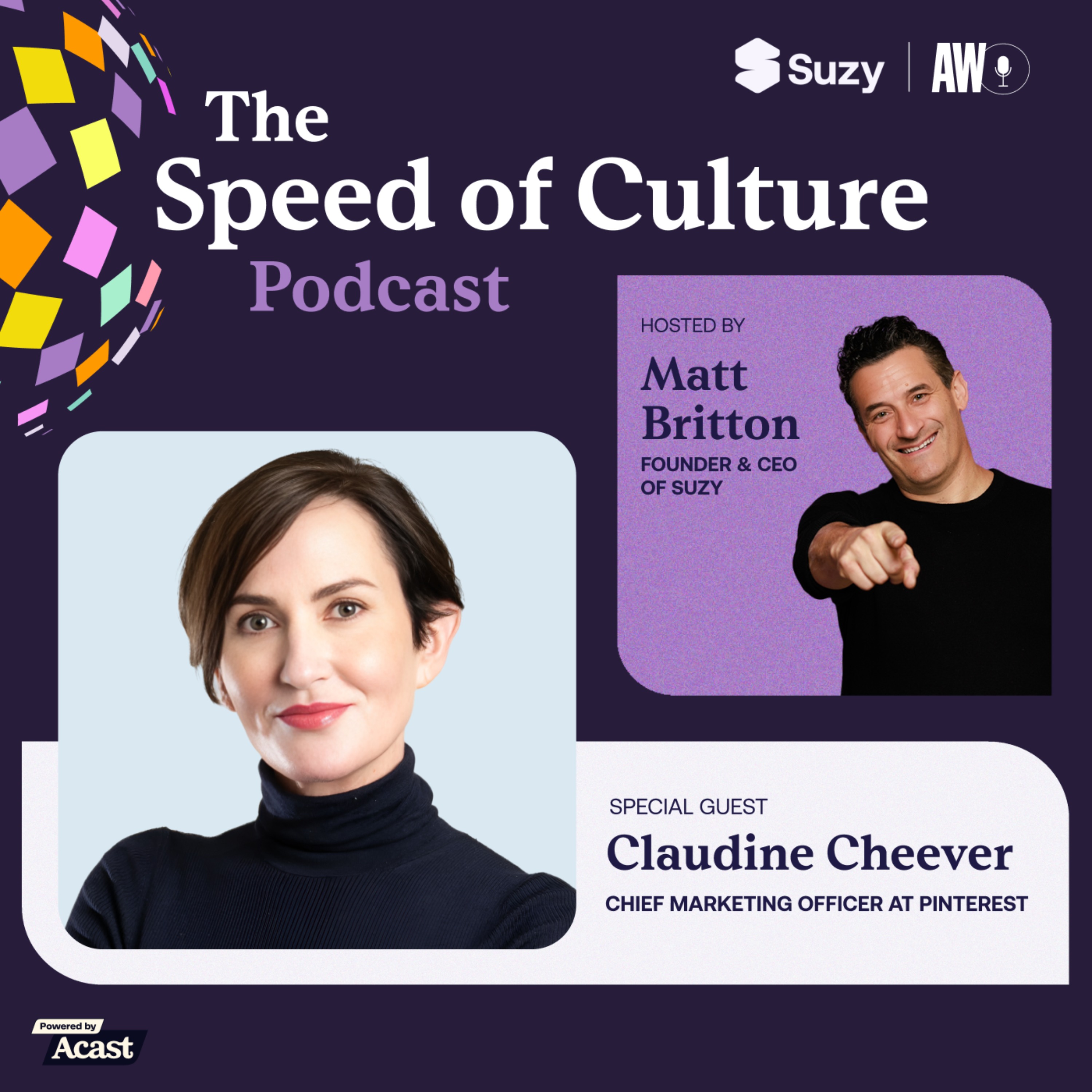
That platform is Pinterest. And the architect of this counterintuitive pivot is Claudine Cheever, its Chief Marketing Officer. In Episode 264 of The Speed of Culture podcast, Matt Britton sits down with Cheever to unpack how Pinterest is redefining the rules of digital engagement, what the "intention economy" means for CMOs, and why a platform that celebrates screen-free living now boasts 631 million monthly active users and record-breaking ad revenue of $3.73 billion.
For business leaders navigating an era of fragmented attention and consumer skepticism, the Pinterest model offers a template that goes well beyond social media strategy. It is a case study in brand differentiation, earned media generation, and the power of aligning a platform's purpose with the actual desires of its users. Matt Britton, CEO of the consumer intelligence platform Suzy and bestselling author of Generation AI, has long argued that the brands winning the next decade will be those that serve consumer intent rather than manufacture it. The Pinterest story proves that thesis in real time.
From Vision Board to Daily Companion: Pinterest's Platform Evolution
Pinterest was built on aspiration. For years, it served as the digital equivalent of a mood board — a place users returned to when planning a wedding, decorating a home, or dreaming about a future kitchen renovation. It was powerful but episodic, associated with major life milestones rather than daily habits. Claudine Cheever joined as CMO with a mandate to change that identity without abandoning what made Pinterest distinct.
The transformation she describes is not cosmetic. Pinterest has repositioned itself as a daily companion for shopping discovery and creative inspiration, deepening its utility across every phase of the consumer journey. Where the platform once captured peak-aspiration moments, it now intercepts users at the earliest stage of intent formation — before they know what they want to buy, and sometimes before they know they want to buy at all. That is a fundamentally different value proposition than any other major platform offers.
The data validates the shift. Approximately 97% of all searches on Pinterest are unbranded. Users arrive curious, not committed. They are not searching for "Nike running shoes" — they are searching for "fall trail running outfit ideas." This open-minded discovery posture gives brands an extraordinary window. The brand that shows up when intent is forming, rather than when it has already crystallized elsewhere, earns a disproportionate share of eventual purchases. Some 87% of Pinterest users report buying something they discovered on the platform, a conversion pipeline that most performance marketers would consider exceptional.
Britton has consistently emphasized in his keynotes that the future of brand building belongs to platforms and companies that meet consumers at the point of curiosity rather than at the point of transaction. Pinterest's platform evolution is a direct expression of that principle — and Cheever's leadership has made it operational.
The Intention Economy: Why Pinterest Is Playing a Different Game Than Every Other Platform
The attention economy runs on a simple and ruthless logic: keep the user engaged as long as possible, monetize that engagement through advertising, and optimize every product decision toward maximizing time-on-platform. TikTok, Instagram, YouTube, and X all compete on these terms. The attention economy has produced remarkable scale, but it has also produced an arms race that increasingly alienates the very users it depends on.
Cheever draws a sharp distinction between attention and intention. In her framing, Pinterest users do not arrive to be entertained or distracted — they arrive with a mission. They are in a state of active curiosity, exploring ideas, building taste, and making plans. This mental posture, which she calls the intention economy, creates an advertising environment that is categorically different from passive-scroll contexts. A user who is actively searching for "modern farmhouse bathroom remodel" is exponentially more receptive to relevant brand messaging than one who encounters an ad mid-scroll through a friend's vacation photos.
The commercial implications are significant. Pinterest generates $4.30 in sales for every $1 spent on advertising, and delivers 2.3 times more cost-efficient conversions than Facebook and Instagram. Its average cost-per-click sits below a dollar — a remarkable figure for a platform with 631 million monthly active users. These metrics are not accidents of targeting technology. They are the structural output of an intention-first platform architecture that positions brands in front of consumers who are already primed to act.
For CMOs under pressure to demonstrate measurable ROI, this distinction matters enormously. Britton's research through Suzy, the AI-powered consumer intelligence platform he founded, consistently surfaces a core insight: consumers in an active discovery mindset are more open to brand influence, more likely to engage meaningfully, and more likely to convert than those reached through interruptive advertising formats. Pinterest has built a business on that behavioral reality.
Visual Search as a Human Behavior — Not Just a Feature
Pinterest Lens processes more than 1.5 billion visual search queries per month — a 40% increase year over year. The scale of that number is striking, but Cheever's perspective on what it represents is more interesting than the metric itself. She frames visual search not as a technological capability but as an expression of innate human curiosity. People have always made sense of the world by seeing it. Visual search simply gives that impulse a digital channel.
When a user photographs a coffee table they admired at a friend's apartment and searches for "where can I find this," they are not executing a transaction — they are beginning an exploration. Pinterest's visual search infrastructure meets that moment with inspiration, related ideas, and purchase pathways that feel like discovery rather than advertising. The experience mirrors the serendipity of a well-curated physical retail environment, but with the personalization and scale that only a digital platform can deliver.
For brands, the visual search behavior creates a set of opportunities that text-based search cannot replicate. Products that are difficult to describe in words but easy to recognize visually — furniture, fashion, home decor, food — become highly discoverable in ways that Google cannot match. The category skew of Pinterest's user base, which over-indexes heavily on home, beauty, fashion, and food, aligns precisely with the product categories that benefit most from visual discovery.
The implications extend beyond media planning. Visual search is reshaping how product teams think about photography, packaging, and the visual vocabulary of brands. If a product appears in organic Pinterest searches and inspires users who did not know they were looking for it, the distinction between marketing and product design begins to dissolve. In his keynotes on AI transformation, Britton regularly highlights this convergence — the idea that the most powerful future marketing will be embedded in the product experience itself, not layered on top of it.
Offline by Design: The Counterintuitive Earned Media Strategy That Delivered Outsize Returns
In May 2026, Pinterest launched a campaign built around a tagline that would be baffling coming from any other platform: "The best thing you can find online is a reason to go offline." Outdoor executions carried messages like "Less URL. More IRL" and "It's about life, not likes." Cinema pre-rolls asked audiences to silence their phones. The campaign featured home movies and family photographs submitted by Pinterest employees — images of life lived away from screens.
It became one of the most-discussed marketing moments of the year. The earned media value generated by coverage in major outlets — journalists and marketing commentators who found the self-aware irony irresistible — far exceeded what a comparable paid media investment would have produced. And the core message was not performative contradiction. It was a precise expression of Pinterest's genuine product philosophy: the platform exists to give users the inspiration they need to go do things in the real world.
This approach reflects a broader strategic insight that Cheever articulates clearly: authenticity at scale requires a platform to be honest about its relationship with users. Pinterest does not want to maximize time-on-screen. It wants to maximize the quality of the inspiration it delivers, which is a fundamentally different optimization target. When a user finds a recipe, saves it, and then makes it for their family, Pinterest has succeeded — regardless of how many minutes that interaction required.
For CMOs evaluating their own brand campaigns, the Pinterest model surfaces a powerful strategic question: what is your platform or product actually for? Organizations willing to answer that question honestly, and to build their messaging around the true value they deliver rather than the metrics they optimize, consistently generate the kind of earned media attention that paid campaigns cannot buy. Britton makes this point explicitly in his work with enterprise clients — differentiation built on genuine purpose converts to brand equity; differentiation built on positioning alone does not hold.
Radical Ownership as a Leadership Superpower in Marketing Organizations
Beyond the strategic content of her work at Pinterest, Cheever's reflections on her career in advertising and her leadership philosophy offer direct value for executives building marketing organizations in a period of accelerating change. The concept she returns to repeatedly is what she calls radical ownership — a disposition toward problems that refuses to locate accountability anywhere other than in oneself.
Radical ownership, in Cheever's definition, is not about accepting blame. It is about maintaining the agency to shape outcomes rather than becoming a passive observer of circumstances. In marketing organizations under pressure from shrinking budgets, proliferating channels, and AI-driven disruption, the temptation to attribute poor results to external conditions — a noisy media landscape, shifting consumer behavior, inadequate technology — is constant. Leaders who resist that temptation and instead ask what they can control, change, or build differently are the ones who find paths forward that others miss.
This disposition is directly relevant to the challenges facing CMOs in 2026. AI is fundamentally altering creative production, media buying, consumer research, and personalization — simultaneously creating new opportunities and eliminating established competencies. Leaders who approach this disruption with radical ownership, treating it as a field of possibility to be navigated rather than a threat to be managed, are positioned to move faster and with more clarity than those who wait for the landscape to stabilize.
Britton's own career trajectory — from agency executive to entrepreneur, from consumer research pioneer to AI thought leader — reflects a similar disposition. His national bestseller Generation AI is, at its core, an argument for proactive engagement with transformative forces rather than reactive adaptation to them. The leaders Britton profiles throughout the book share Cheever's instinct for ownership: they do not wait to understand AI; they engage with it, experiment with it, and build organizational capability around it before the window of advantage closes.
Key Takeaways for Business Leaders
- Compete on intention, not attention. The most durable commercial advantage on digital platforms comes from reaching consumers in an active discovery mindset, not an interruptive one. Audit where your brand shows up in the consumer journey and prioritize channels and formats that intercept early-stage intent.
- Build campaigns around honest purpose. Pinterest's "get offline" campaign generated outsize earned media because it expressed a genuine product philosophy, not a contrived positioning. Campaigns grounded in what your product actually does for consumers — not what you wish they believed about it — produce more credible and more shareable results.
- Invest in visual search discoverability now. With Pinterest Lens processing 1.5 billion visual queries per month, the question for product and marketing teams is not whether visual search matters but whether their products are optimized for it. Photography, product design, and content strategy all need to reflect a visual-first discovery environment.
- Reframe unbranded search as opportunity, not threat. The fact that 97% of Pinterest searches are unbranded means the platform is a market of genuine consideration — consumers who have not yet decided. Brands that show up intelligently in unbranded search contexts are not competing for existing demand; they are creating it.
- Cultivate radical ownership throughout the marketing organization. In a period of platform disruption, AI-driven change, and budget pressure, marketing leaders who locate accountability in themselves rather than in circumstances consistently outperform those who do not. Model this disposition explicitly and hire for it at every level.
Frequently Asked Questions
What is the intention economy and how does it differ from the attention economy?
The intention economy describes a digital environment where users arrive with a specific purpose, curiosity, or goal in mind — actively seeking inspiration, information, or products rather than passively consuming content. The attention economy, by contrast, optimizes for time-on-screen and engagement volume regardless of user intent. Pinterest CMO Claudine Cheever positions the intention economy as a fundamentally higher-quality advertising environment, because users in an active discovery mindset are more receptive to relevant brand messaging and significantly more likely to convert.
How is Pinterest using visual search to drive consumer behavior in 2026?
Pinterest processes more than 1.5 billion visual search queries per month through its Lens technology — a 40% year-over-year increase. Users photograph objects, spaces, and products in the real world and use visual search to find similar items and inspirational ideas on the platform. This behavior is especially powerful for categories like home decor, fashion, and beauty, where visual identity is core to purchase decisions and text-based search struggles to capture the nuance of what a consumer is actually looking for.
Why did Pinterest build a campaign encouraging users to spend less time on social media?
Pinterest's "offline by design" campaign — anchored by the tagline "The best thing you can find online is a reason to go offline" — reflects the platform's genuine product philosophy: its purpose is to inspire real-world action, not maximize screen time. This authentic differentiation from attention-maximizing competitors generated significant earned media coverage and reinforced the brand's distinctive positioning. It works because it is true — Pinterest succeeds when a user finds an idea and then goes live it, regardless of how long the platform interaction took.
What does Pinterest's marketing strategy mean for CMOs evaluating their channel mix?
Pinterest's commercial performance — $4.30 in sales per $1 of advertising spend and 2.3 times more cost-efficient conversions than Facebook and Instagram — makes a strong case for intention-based channels in any CMO's media mix. For brands selling visually distinctive products with a consideration phase, Pinterest offers a high-intent discovery environment at a cost-per-click below most competing platforms. CMOs should evaluate whether their current channel allocation reflects where consumers are forming preferences, not just where they are spending time.
The Future of Marketing Belongs to Brands That Serve Intent
The conversation between Matt Britton and Claudine Cheever surfaces something that goes well beyond Pinterest's specific strategy. It reveals a broader shift in what effective marketing looks like when consumers are overwhelmed, skeptical, and increasingly in control of their own discovery journeys. The brands and platforms that win will be those that align with what consumers actually want — not those that manipulate attention, manufacture urgency, or optimize for metrics that serve the platform more than the user.
Matt Britton has spent two decades studying how consumer behavior evolves at the intersection of culture, technology, and generational change. His work through Suzy and his keynote platform consistently points toward the same conclusion: the future belongs to organizations willing to build genuine value for consumers first, and to trust that commercial results will follow. Pinterest's story, as told by Claudine Cheever, is a compelling proof point for that thesis.
Hear more on The Speed of Culture podcast with Matt Britton — new episodes every week featuring the executives and innovators reshaping how brands connect with consumers in an accelerating world. The brands that understand these shifts today will lead the markets of tomorrow.
Related Posts
Playing the Long Game: CarMax on Turning Fandom Into Brand Loyalty

Kitchen Table Finances: Intuit on AI and Everyday Money Management
From Heritage to Happy Hour: How Campari Keeps Iconic Brands Moving With Culture