How AI Is Transforming Everyday Money Management: Lessons From Intuit
More than 75% of American households earn under $100,000 a year, and 57% of active Credit Karma members carry revolving debt. Those numbers tell a story that no financial brand can afford to ignore: the majority of consumers in this country are navigating genuinely difficult financial terrain—and they are increasingly turning to artificial intelligence to find their footing. Between 2024 and 2026, active AI use within personal finance more than doubled, climbing from 30% to 75% of users on platforms like Intuit's. That kind of acceleration does not happen by accident. It happens when technology finally meets people where they actually live.
For CMOs and brand strategists operating in financial services, insurance, fintech, or any sector that touches household spending, the implications are immediate. The consumer is no longer waiting for an annual tax appointment or a call with a financial advisor. They want real-time guidance, personalized to their specific debt load, credit profile, and life stage—delivered on demand. The brands that build infrastructure for that expectation will win. Those that cling to legacy engagement models risk becoming irrelevant to a population that has discovered AI can answer their money questions at midnight, without judgment.
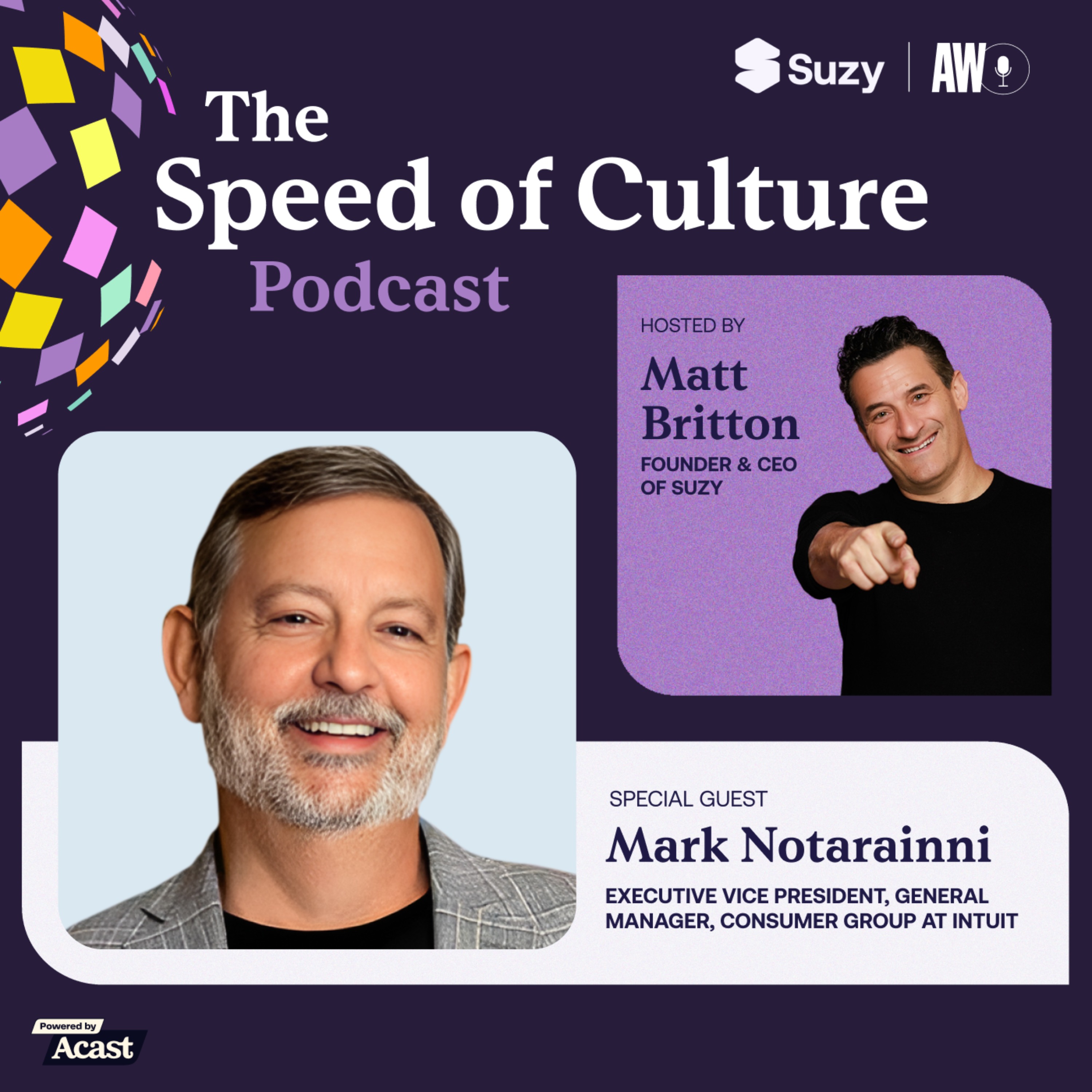
In Episode 263 of The Speed of Culture podcast, Matt Britton—CEO of Suzy, bestselling author of Generation AI and YouthNation, and one of the world's leading AI futurists—sits down with Mark Notarainni, EVP and General Manager of Intuit's Consumer Group. Notarainni oversees the platforms that touch the financial lives of tens of millions of Americans: TurboTax, Credit Karma, and a newly unified agentic AI consumer platform designed to deliver year-round financial outcomes. Their conversation surfaces the strategic realities behind that platform shift—and what it signals for every brand competing for consumer financial trust.
The Unified Platform Play: Why Intuit Merged TurboTax and Credit Karma Into One AI-Driven Experience
For years, TurboTax and Credit Karma operated as distinct products with distinct user relationships. TurboTax owned tax season. Credit Karma owned credit monitoring. Both were valuable. Neither was comprehensive. Intuit's consumer strategy under Notarainni has moved decisively to change that, launching an all-in-one agentic AI platform that combines both products into a single financial hub—one designed for year-round engagement rather than seasonal utility.
The business case behind that decision is compelling. Average revenue per user is approximately 30% higher for customers who use both TurboTax and Credit Karma than for those using TurboTax alone. That figure alone explains why Intuit invested in unification. But the deeper strategic logic is about consumer behavior, not just revenue. A person who files their taxes, monitors their credit score, manages debt, and gets guidance on a home loan—all within one ecosystem—develops a fundamentally different relationship with that platform than a single-use customer. They become financially dependent in the best sense of the word: engaged, trusting, and increasingly reliant on AI-powered recommendations to guide real decisions.
Matt Britton has observed this convergence pattern across industries in his work advising Fortune 500 companies. As he has argued in his AI keynote presentations, the most durable consumer platforms of the next decade will be those that embed themselves into daily life rather than intercepting consumers at discrete transaction moments. Intuit's consumer platform is a financial services case study in exactly that principle.
How AI Is Helping Consumers Manage Debt—and What That Means for Financial Brands
Debt is not an abstract policy problem for most American consumers. It is a daily source of stress, and the inability to navigate it effectively has real consequences for credit scores, housing access, and long-term wealth building. Fifty-seven percent of active Credit Karma members manage revolving debt. For Intuit, that statistic is not a liability—it is the core use case for the AI capabilities built into its consumer platform.
Notarainni describes how AI helps members understand their debt holistically: identifying which balances to prioritize, modeling the impact of different repayment strategies, and surfacing personalized loan options based on real-time credit data. This is not generic financial education. This is individualized guidance delivered at scale, made possible by the combination of vast data and increasingly capable large language models. Roughly one in nine U.S. credit-card and personal-loan originations now moves through Intuit's platform—a market-share figure that reflects just how central AI-powered matching has become to the lending ecosystem.
For financial brands watching this development, the signal is clear: consumers are migrating toward platforms that can do the cognitive work of financial management for them. The AI tools that win will not merely display data—they will synthesize it into clear, actionable next steps. Britton's financial services keynotes have long emphasized that the brands positioned to lead are those treating AI not as a feature but as the core delivery mechanism for value. Intuit's debt management capabilities represent that philosophy in production.
The Human Expertise Layer: Why AI Alone Is Not Enough in Personal Finance
One of the most important tensions in AI-driven financial services is the question of trust. Consumers will engage with automated tools for low-stakes tasks—checking a credit score, categorizing spending—but many hesitate when the stakes rise. Tax filings, mortgage decisions, debt consolidation strategies: these are moments when the fear of making a costly mistake drives demand for human reassurance.
Intuit has built its consumer platform with this tension explicitly in mind. The agentic AI system is supported by a network of 13,000 human experts across the United States—tax professionals, financial specialists, and advisors who can step in when the stakes require it. Notarainni describes this as the platform's "human-in-the-loop" design philosophy: AI handles speed and scale, humans provide accountability and confidence. The model is neither purely automated nor purely human-staffed. It is a carefully calibrated hybrid.
This approach resonates with what the data shows about consumer preferences. Among Gen Z and Millennial respondents in recent research, 31% of Gen Z and 24% of Millennials favor hybrid advice that combines technology and human insight over purely automated or purely human solutions. The preference for hybrid is not a transitional sentiment waiting to be replaced by full AI confidence—it reflects a durable human need for accountability in high-consequence decisions. Financial brands building their AI strategies around pure automation without a human escalation layer are likely misreading their own customers.
Britton's research for his bestselling book Generation AI reinforces this finding at a generational level. Even the most AI-native consumers—those who have grown up with algorithmic recommendations and voice assistants—distinguish between decisions they trust to machines and decisions they want humans to validate. Financial brands that honor that distinction will retain trust. Those that don't will learn the lesson the hard way.
Financial Literacy Is Hitting Younger Generations Differently—and AI Is Part of the Answer
The 2026 TIAA-GFLEC Personal Finance Index delivered a sobering finding: U.S. adults correctly answered just 47% of basic financial literacy questions—the weakest result in a decade of surveys. Gen Z fared worst of all, answering only 38% correctly, compared with 46% for Millennials, 49% for Gen X, and 54% for Baby Boomers. Financial literacy, as traditionally measured, is declining at precisely the moment when consumer financial decisions are becoming more complex.
What makes this paradox interesting—and what Notarainni explores in his conversation with Britton—is that Gen Z is simultaneously the generation most likely to turn to AI for financial guidance. Thirty percent of Gen Z respondents have used AI to get answers to finance questions, compared with just 8% of Boomers. Nearly two in five Gen Z and Millennial consumers have used AI to budget or run financial scenarios such as modeling a home purchase. The generation with the lowest traditional financial literacy scores is the most willing to adopt the tools that could compensate for that gap.
This creates a strategic inflection point for consumer finance brands. The question is no longer whether to invest in AI-powered financial education and guidance tools—it is whether those tools will be designed well enough to genuinely improve financial outcomes rather than simply increasing engagement metrics. Britton has argued in keynotes to enterprise leaders that brands serving younger consumers carry a responsibility to design AI that elevates capability rather than exploits confusion. For financial services specifically, that design imperative has direct consequences for regulatory exposure, brand trust, and long-term customer lifetime value.
Intuit's platform approach—combining automated guidance with expert access, and anchoring both in a comprehensive data profile—represents one model for closing the financial literacy gap through technology. Whether the industry broadly follows that blueprint or fragments into lower-quality alternatives will shape consumer financial health for a generation.
The Agentic AI Moment: What Year-Round Financial Engagement Means for Brand Strategy
The term "agentic AI" has moved quickly from academic circles into product roadmaps, and Intuit's consumer platform represents one of the clearest deployments of the concept in consumer finance. Agentic AI doesn't just respond to queries—it proactively initiates actions, monitors changes, and surfaces recommendations without waiting to be asked. For a platform like Credit Karma, that means alerting users to credit score changes that create refinancing opportunities, or flagging spending patterns that signal emerging debt risk before it becomes a crisis.
For brand strategists, this shift has implications that extend well beyond product design. A consumer who engages with a financial platform 365 days a year—rather than at tax time or when they check their credit score quarterly—generates a fundamentally different data footprint, and a fundamentally different brand relationship. The platform becomes infrastructural, embedded in financial decision-making at a level that creates switching costs measured not in convenience but in trust and history.
Britton's keynote work with enterprise audiences consistently returns to this theme: the brands that will define the next decade are those that make themselves genuinely indispensable to daily consumer life, not through lock-in mechanisms but through compounding value. Every interaction that helps a consumer make a better financial decision increases the platform's value proposition. Agentic AI is the infrastructure that makes compounding possible at scale. Intuit's consumer platform is the financial services proof of concept—and Credit Karma's 20% revenue growth in fiscal 2026, driven by agentic capabilities, is the early evidence that the model works.
Key Takeaways for Business Leaders
- Unify the consumer experience across product lines. Intuit's 30% revenue premium for cross-platform users demonstrates that integration is not just a user experience improvement—it is a material financial advantage. Brands operating siloed products should examine where consolidation creates both consumer and commercial value.
- Design AI that escalates to humans at high-stakes moments. Consumer trust in AI-powered finance advice is conditional. Fifty-seven percent of Credit Karma members carry revolving debt, and those consumers need confidence in the guidance they receive. Building accessible human expert layers into AI platforms is a competitive differentiator, not a cost to be minimized.
- Target the financial literacy gap as a growth opportunity. Gen Z's 38% financial literacy score and simultaneous 30% AI adoption rate for financial questions identify an underserved market. Brands that build genuinely educational AI tools—not just engagement drivers—will earn durable loyalty from the most digitally fluent consumer cohort in history.
- Invest in agentic AI for year-round engagement, not seasonal activation. Platforms designed around episodic consumer interactions are structurally disadvantaged against competitors offering continuous, proactive financial management. The shift from transactional to relational AI engagement is the defining product challenge of the next three years.
- Treat the AI-to-human handoff as a design priority. The hybrid model—AI for speed and scale, humans for accountability and confidence—reflects documented consumer preferences across Gen Z and Millennial segments. Financial brands that get this ratio right will outperform on both trust metrics and conversion rates.
Frequently Asked Questions
How is AI changing personal finance management for everyday consumers?
AI is transforming personal finance by enabling platforms like Intuit's TurboTax and Credit Karma to deliver real-time, personalized guidance at scale. Between 2024 and 2026, active AI use in personal finance more than doubled—from 30% to 75%—on Intuit's platforms. AI tools now help consumers manage debt, optimize credit scores, and model major financial decisions like home purchases without requiring a human advisor for every interaction.
Why do younger generations struggle with financial literacy despite using more financial apps?
The 2026 TIAA-GFLEC Personal Finance Index found Gen Z answered only 38% of basic financial literacy questions correctly—the lowest of any generation—while simultaneously being the demographic most likely to use AI for financial guidance. This paradox reflects the fact that app access and foundational financial knowledge are separate capabilities. The opportunity for financial brands lies in designing AI tools that build genuine financial capability rather than substituting for it.
What role do human experts play in AI-powered financial platforms?
Human expertise remains essential for high-stakes financial decisions, even as AI handles routine guidance and monitoring. Intuit's consumer platform pairs its agentic AI capabilities with a network of 13,000 U.S.-based human experts who can engage when complexity or stakes demand it. Research confirms that 31% of Gen Z and 24% of Millennials prefer this hybrid human-plus-AI model over purely automated advice.
How are financial services brands using AI to address consumer debt?
AI-powered platforms are enabling individualized debt management guidance at scale—analyzing credit profiles, modeling repayment strategies, and matching consumers with loan products suited to their specific financial situation. Roughly one in nine U.S. credit-card and personal-loan originations now flows through Intuit's platform, demonstrating how AI-driven matching has become core infrastructure for consumer lending. Brands that deliver this depth of personalization are capturing market share from traditional financial institutions.
The Bigger Picture: AI as the New Kitchen Table for Financial Conversations
Matt Britton has spent two decades studying how technology reshapes the relationship between consumers and the brands they trust. The conversation between Britton and Intuit's Mark Notarainni on Episode 263 of The Speed of Culture is not simply a product story about TurboTax and Credit Karma. It is a case study in what happens when AI matures from a novelty feature into foundational consumer infrastructure—and what that transition demands of every brand competing for financial trust.
The kitchen table, historically the place where American families made their most consequential financial decisions, is being digitally reconstructed—not to replace the human element, but to make genuine financial expertise accessible to the 75% of households that cannot easily afford a private financial advisor. The brands that build that table well will define consumer finance for the next generation.
Hear more perspectives on the intersection of AI, consumer behavior, and business transformation on The Speed of Culture podcast with Matt Britton. As agentic AI continues to rewrite the rules of consumer engagement, the leaders who stay informed will be the ones who lead.
Related Posts
Playing the Long Game: CarMax on Turning Fandom Into Brand Loyalty

Offline by Design: How Pinterest Turned Disconnection Into Earned Media
From Heritage to Happy Hour: How Campari Keeps Iconic Brands Moving With Culture