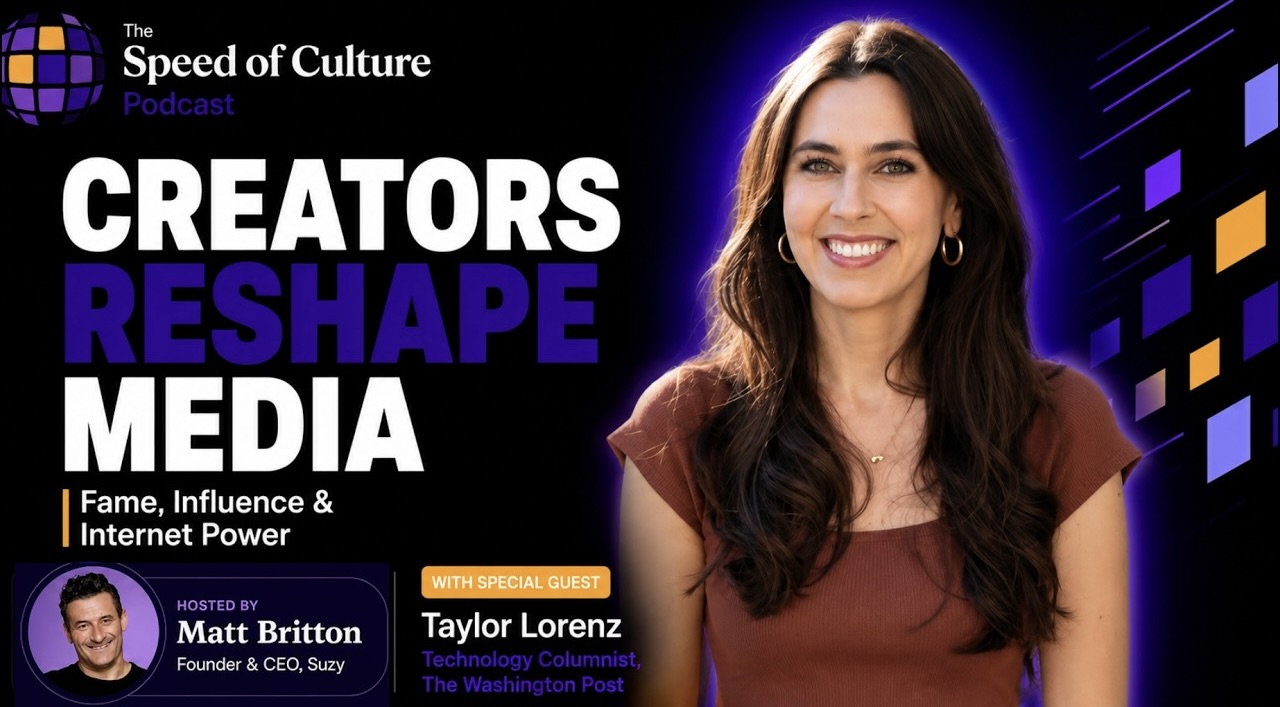
Behind the Screens of Social Media: Taylor Lorenz on Internet Culture and Digital Influence
In the latest episode of the Speed of Culture Podcast, Matt Britton, founder and CEO of Suzy, the AI-powered consumer intelligence platform, sits down with Taylor Lorenz, technology columnist at The Washington Post, to explore the hidden mechanisms shaping our digital landscape.
This compelling conversation unveils how social media platforms have fundamentally transformed the way we consume content, build personal brands, and understand influence in the modern era. As traditional media boundaries blur and creator-driven content dominates digital spaces, understanding the evolution of internet culture has never been more critical for brands, marketers, and consumers alike.
Taylor Lorenz brings unparalleled expertise to this discussion, having spent over a decade covering online culture and emerging digital trends. Her groundbreaking book, "Extremely Online: The Untold Story of Fame, Influence, and Power on the Internet," provides the foundational framework for this episode's deep dive into how ordinary people became internet celebrities, how platforms democratized content creation, and how the lines between journalism, entertainment, and personal branding have become increasingly blurred.
For executives and marketing leaders seeking to understand the shifting landscape of consumer behavior and digital influence, this episode offers essential insights backed by rigorous research and firsthand reporting from the front lines of internet culture.
Through the lens of the creator economy and the evolution of social media platforms, Lorenz and Britton examine the sociological and economic forces that have reshaped entertainment, news consumption, and personal identity formation. The conversation reflects the mission of the Speed of Culture Podcast, which brings together industry leaders and cultural experts to decode the trends driving consumer behavior and business strategy.
By analyzing the intersection of technology, culture, and commerce, this episode provides a roadmap for understanding how digital platforms continue to reshape industries and redefine what it means to be influential in a hyperconnected world.
The Evolution of Social Media: From Blogging to TikTok
The history of social media cannot be understood as a linear progression toward perfection but rather as a series of disruptions, pivots, and unexpected consequences. Taylor Lorenz's research traces this evolution from the blogging boom of the early 2000s through the rise of platforms like MySpace, YouTube, Vine, Instagram, and ultimately TikTok.
Each platform introduced new possibilities for self-expression, community building, and monetization, fundamentally altering the relationship between creators and audiences.
The early blogging era, roughly 2003–2008, represented a watershed moment in internet culture. What began as personal digital journals evolved into a sophisticated ecosystem of “mommy bloggers” who pioneered the art of monetizing personal brands.
These early creators documented their daily lives, parenting challenges, product discoveries, and lifestyle choices, building audiences in the hundreds of thousands. Their success demonstrated a crucial insight: audiences would follow authentic voices sharing genuine experiences, and brands would pay premium rates to reach these engaged communities.
This monetization model established the foundational economic principle that still governs the creator economy today: audience trust translates directly into commercial value.
The platform shift from blogs to social networks transformed the mechanics of content creation and audience engagement. MySpace allowed for greater customization and community features, while Facebook democratized social networking by making it accessible to mainstream audiences.
YouTube introduced video as the dominant content format, fundamentally changing how creators could tell stories and build parasocial relationships with their audiences. The platform’s recommendation algorithm became increasingly sophisticated, allowing creators to reach audiences far beyond their existing networks based on content quality and engagement patterns.
Vine’s six-second video format, which flourished from 2013 to 2017, represented a crucial turning point in the evolution of short-form content creation. The platform became a breeding ground for comedic creativity, with creators developing entirely new forms of humor optimized for the constraints of the format.
Many successful Vine creators leveraged their platform fame to launch careers in entertainment, music, and business. When Vine shut down in 2017, it marked the end of an era, but the lessons learned about short-form video viability proved invaluable as the market consolidated around TikTok.
Instagram’s transition from a static photo-sharing platform to a video and story-centric network reflected the industry’s recognition that video content drives engagement and retention. The introduction of Instagram Reels directly challenged TikTok’s dominance while offering creators an alternative platform for short-form video.
This competitive dynamic has accelerated the pace of platform innovation and creator opportunity, as each platform races to offer new features and monetization opportunities to attract top talent.
TikTok’s explosive growth since 2018 represents the maturation of the creator economy’s business model and the apex of platform-driven content optimization. The algorithm’s sophistication allows creators without existing fanbases to reach millions of users, democratizing success in ways previous platforms never fully achieved.
The platform’s emphasis on music, trending sounds, and collaborative trends creates a shared cultural reference point that spans geographies and age groups. For Gen Z audiences, TikTok hasn’t simply replaced other platforms; it has become the primary source of entertainment, cultural commentary, and information about the world.
Understanding this evolution matters because it shapes how brands must think about audience engagement and content strategy. The platforms that succeed are those that accurately read cultural shifts and provide tools that align with creator aspirations.
The platforms that fail to adapt, from Vine to MySpace, become cautionary tales about the cost of complacency in markets defined by rapid technological change and shifting user preferences.
The Journalist as Cultural Witness: Reporting on Internet Culture in Real Time
Taylor Lorenz’s career represents a new model of journalism: the cultural expert who develops deep expertise through participant observation in online communities while simultaneously serving as an analyst and critic of those same communities.
This dual role creates unique tensions and opportunities that define modern technology journalism. Unlike traditional beat reporters who cover industries from an external perspective, Lorenz has built her reputation by understanding internet culture from the inside while maintaining critical distance and editorial rigor.
The challenge of covering internet culture in real time involves several dimensions. First, the pace of change is extraordinarily rapid, with trends emerging and fading within weeks or months.
What was culturally relevant yesterday may be completely irrelevant today, requiring journalists to develop frameworks for distinguishing between temporary viral moments and genuine shifts in how people use technology and build identity.
Second, internet culture spans countless platforms, communities, and subcultures, making comprehensive coverage virtually impossible. Journalists must develop sophisticated heuristics for identifying which trends matter most and understanding why certain cultural moments resonate with audiences.
Third, the relationship between the journalist and the communities being covered creates ethical complexities. Journalists covering internet culture often have social media audiences themselves, creating the potential for conflicts of interest and questions about journalistic independence.
Additionally, many internet culture figures view critical coverage as unfair attack, leading to harassment campaigns and coordinated attacks on journalists who write critically about online communities. Lorenz has faced substantial online harassment for her reporting, which raises important questions about the cost of covering digital culture and the tools platforms have failed to provide for protecting journalists.
The role of journalism in documenting internet culture has become increasingly important as the consequences of digital trends ripple through society. When a TikTok trend influences teenager behavior, when influencer culture shapes consumer preferences, or when misinformation spreads rapidly across platforms, the stakes of accurate reporting rise significantly.
Journalists covering these areas serve a crucial function in helping general audiences understand complex digital phenomena and evaluate the implications for their own lives and identities.
Lorenz’s “Extremely Online” book extends her journalistic work by providing historical context and narrative structure to help readers understand how we arrived at the current moment. Rather than treating contemporary internet culture as inevitable or fixed, the book demonstrates how various historical contingencies, platform design choices, and creative decisions by individual creators shaped the ecosystem we inhabit today.
This historical perspective enables readers to think critically about future developments and understand that different technological futures remain possible depending on the choices we make today.
The Creator Economy: Monetization, Burnout, and the Future of Digital Work
The creator economy represents one of the most significant economic developments of the past two decades, fundamentally changing how people earn income, build careers, and structure their professional lives. What began as a niche phenomenon has evolved into a multibillion-dollar industry that competes directly with traditional employment for talent and consumer attention.
The economics of creator income have become increasingly complex and unequal. While early creators benefited from relatively generous revenue-sharing arrangements with platforms, current creators face more fragmented income streams including platform advertising revenue share, sponsorships and brand partnerships, subscription services, affiliate marketing, merchandise sales, and appearance fees.
This diversification theoretically reduces dependence on any single platform, but in practice requires substantial business sophistication to manage effectively. Most creators lack formal business training, accounting expertise, or legal knowledge, making them vulnerable to exploitative deals and poor financial decisions.
The 2023 creator economy landscape revealed significant challenges beneath the surface of continued growth. According to recent research, nearly half of independent creators report difficulty achieving sustainable success, with 41% reporting struggles with burnout.
The psychological toll of maintaining content production schedules, engaging with audiences, responding to criticism, and managing the emotional labor of sharing personal content with millions of strangers should not be underestimated. Many creators describe the pressure to constantly produce new content, remain relevant, and maintain algorithmic favor as exhausting and unsustainable.
The trend toward older creators entering the creator economy, with Gen X and Baby Boomers increasing from 27% in 2022 to 35% in 2023, reflects both opportunity and shifting attitudes toward self-employment.
These older creators often enter the space with established professional networks, financial stability, and lower pressure to generate income immediately, allowing them to experiment and find success in their niches. Simultaneously, this trend may represent retirement from traditional employment becoming increasingly unstable, pushing older workers toward the perceived flexibility of creator platforms.
Platform economics have shifted in ways that have increased creator dependence on brand partnerships and sponsorships rather than platform-provided revenue. This shift reflects the maturation of the advertising market and platforms’ desire to capture more revenue directly.
It also creates incentives for creators to focus on maintaining audience size and engagement rather than building sustainable creative practices. The result is a system that rewards virality and trend-chasing over depth and innovation.
The future of the creator economy remains uncertain. As the market matures and competition increases, the majority of creators will likely continue struggling to achieve sustainable income, while a small elite captures outsized rewards.
Understanding these dynamics matters for policymakers considering labor protections, for brands evaluating creator partnerships, and for aspiring creators considering whether to stake their careers on platform-dependent income.
Internet Culture as Current Events: How Online Trends Become Mainstream News
One of the most significant shifts in contemporary journalism has been the elevation of internet culture to mainstream news coverage. What was once relegated to tech blogs and niche publications now regularly appears in national newspapers, television news, and major magazines.
This shift reflects the growing influence of internet culture on broader society and the media industry’s recognition that digital trends have real-world consequences.
Taylor Lorenz’s beat demonstrates how internet culture stories intersect with traditional news categories. When a TikTok trend raises concerns about child safety, it becomes a story about regulation and child protection.
When creators face platform policy changes that affect their income, it becomes a labor story. When conspiracy theories spread on online platforms, it becomes a national security and public health story.
The internet itself is not separate from “the real world” but rather an integrated dimension of contemporary life where culture, commerce, politics, and identity are continuously negotiated.
The challenge for mainstream journalists covering internet culture involves translation and contextualization. Effective journalism requires explaining both the immediate story and the broader context in ways that serve diverse audience knowledge levels.
Internet culture stories also involve rapid iteration and correction as journalists learn more and context evolves. This complexity requires journalists to stay engaged with evolving narratives rather than treating stories as discrete events to be covered and moved past.
The importance of covering internet culture accurately extends beyond cultural consumption to affect how societies understand themselves and address shared challenges. The stakes of getting this coverage right are significant, making reporters like Taylor Lorenz essential to a functioning information ecosystem.
What Brands Must Understand About Creator Partnerships and Authenticity
For marketing leaders and brand executives, the insights from this episode carry direct implications for how brands engage with creators and build authentic connections with audiences. The creator economy is no longer a niche channel or experimental marketing tactic; it has become a fundamental component of how brands reach consumers and build brand affinity.
The first critical insight is that audience trust is the primary asset in creator partnerships. Audiences follow creators not because of the products they promote but because they trust the creator’s judgment and believe the creator’s recommendations reflect genuine beliefs rather than purely commercial interests.
The most successful brand partnerships occur when the creator genuinely uses and believes in the product and can articulate why the product aligns with their values and serves their audience.
The second insight is that creator success depends on long-term audience building rather than viral moments. Brands seeking sustainable marketing partnerships should prioritize creators with highly engaged smaller audiences over creators with large but passive audiences.
The third insight is that platform dynamics constantly shift, requiring brands and creators to remain adaptable and avoid over-dependence on any single channel.
The fourth insight is that transparency about creator compensation and motivations strengthens rather than weakens brand partnerships. Audiences increasingly expect disclosures about sponsored content and appreciate honesty about commercial relationships.
Finally, brands should recognize that creator partnerships are most effective when they support long-term relationship building rather than transactional content. This approach requires more patience and longer-term investment but generates stronger returns through authentic integration rather than obvious advertising.
The Future of Internet Culture: What’s Next for Digital Influence and Platform Evolution
As platforms mature and the creator economy reaches saturation in developed markets, several key questions shape the future trajectory of internet culture and digital influence.
First, the rise of AI-generated content and synthetic media will fundamentally challenge the value proposition of human creators. Creators who build genuine connections with audiences and offer unique perspective will thrive, while creators who simply chase trends may find their services more easily replaced by AI systems.
Second, regulatory pressure on platforms will reshape the incentives and constraints within which creators operate. Regulation of privacy, content moderation, algorithm transparency, and labor protections will force platforms to change business models and feature sets.
Third, audience fragmentation and platform consolidation appear to be moving simultaneously. Creators are increasingly using multiple platforms simultaneously, with each platform serving different audience segments and content formats.
Fourth, globalization and localization will increase simultaneously, enabling creators to build global audiences or deeply engaged local audiences with different business models attached to each approach.
Finally, the increasing professionalization of creator labor will lead to better infrastructure, business support, and labor protections as the creator economy matures.
Key Takeaways
- Creator Economy Requires Audience Trust: The most successful creator partnerships occur when audiences genuinely believe the creator’s recommendations reflect authentic beliefs rather than purely commercial interests.
- Internet Culture Is Changing Rapidly: From blogging to TikTok, each platform has democratized influence in different ways, and the pace of platform change continues to accelerate.
- Journalism on Internet Culture Is Essential: Independent journalists who understand digital ecosystems from the inside provide crucial context and analysis.
- Creator Burnout Is Real and Unsustainable: Nearly half of independent creators struggle to sustain success, with 41% reporting burnout.
- Platform Shifts Will Continue: Brands, creators, and audiences should remain adaptable and avoid over-reliance on any single platform.
Frequently Asked Questions
Who is Taylor Lorenz and why does her reporting on internet culture matter?
Taylor Lorenz is a technology columnist at The Washington Post who has spent over a decade covering online culture and internet trends. Her reporting matters because internet culture increasingly affects mainstream society, consumer behavior, and public policy. Her book “Extremely Online: The Untold Story of Fame, Influence, and Power on the Internet” provides historical perspective that helps readers understand how we arrived at the current moment.
How has social media evolved from blogging to TikTok?
Social media has evolved through distinct phases, from the blogging era (2003–2008) to social networks like MySpace and Facebook, to YouTube’s video dominance, Vine’s short-form innovation, Instagram’s evolution, and TikTok’s algorithm-driven discovery. Each phase created new opportunities while disrupting previous models.
Why are so many creators reporting burnout despite the creator economy’s growth?
Creator burnout results from constant content production pressure, emotional labor, inconsistent platform-dependent income, and the quantification of creative work through engagement metrics. Nearly 41% of creators report burnout, highlighting structural issues in current platform economics.
What should brands know about working with creators effectively?
Brands should prioritize authenticity, transparency, and long-term relationships. Smaller, highly engaged audiences often generate stronger returns than large passive followings, and honest disclosure strengthens trust rather than weakening it.
Looking Ahead: Understanding Your Audience in an AI-Powered Future
The insights from Taylor Lorenz on internet culture and creator economics directly align with the mission of Suzy, the AI-powered consumer intelligence platform founded by Matt Britton. As internet culture increasingly shapes consumer behavior and brand preferences, understanding how audiences form opinions and what content resonates becomes essential competitive intelligence.
For marketing leaders seeking to navigate the complex intersection of internet culture, creator partnerships, and consumer behavior, Suzy provides the research infrastructure to develop data-driven insights about emerging trends and cultural shifts.
The Speed of Culture Podcast continues to explore these intersections through conversations with cultural leaders and industry experts.
Additionally, Matt Britton’s book Generation AI: Using Artificial Intelligence to Reshape Business and Society explores how artificial intelligence is transforming industries and consumer behavior. As an AI keynote speaker and founder of Speaker HQ, Britton works with organizations to prepare for the AI-driven future shaping business strategy.
Understanding internet culture, creator economics, and the evolving landscape of digital influence is no longer optional for brands seeking to remain relevant and competitive. The insights from experts like Taylor Lorenz provide the strategic framework for building brands that resonate in an increasingly complex and rapidly evolving digital landscape.

%20(400%20x%20100%20px)%20(300%20x%2050%20px)%20(150%20x%2050%20px).avif)