Opening Section
In the rapidly evolving landscape of digital hiring platforms, few companies have achieved the scale and impact of Indeed. With 350 million unique monthly visitors, Indeed has fundamentally transformed how people search for jobs and how employers find talent. But behind this unprecedented reach lies a sophisticated marketing strategy rooted in a deceptively simple mission: “We Help People Get Jobs.”
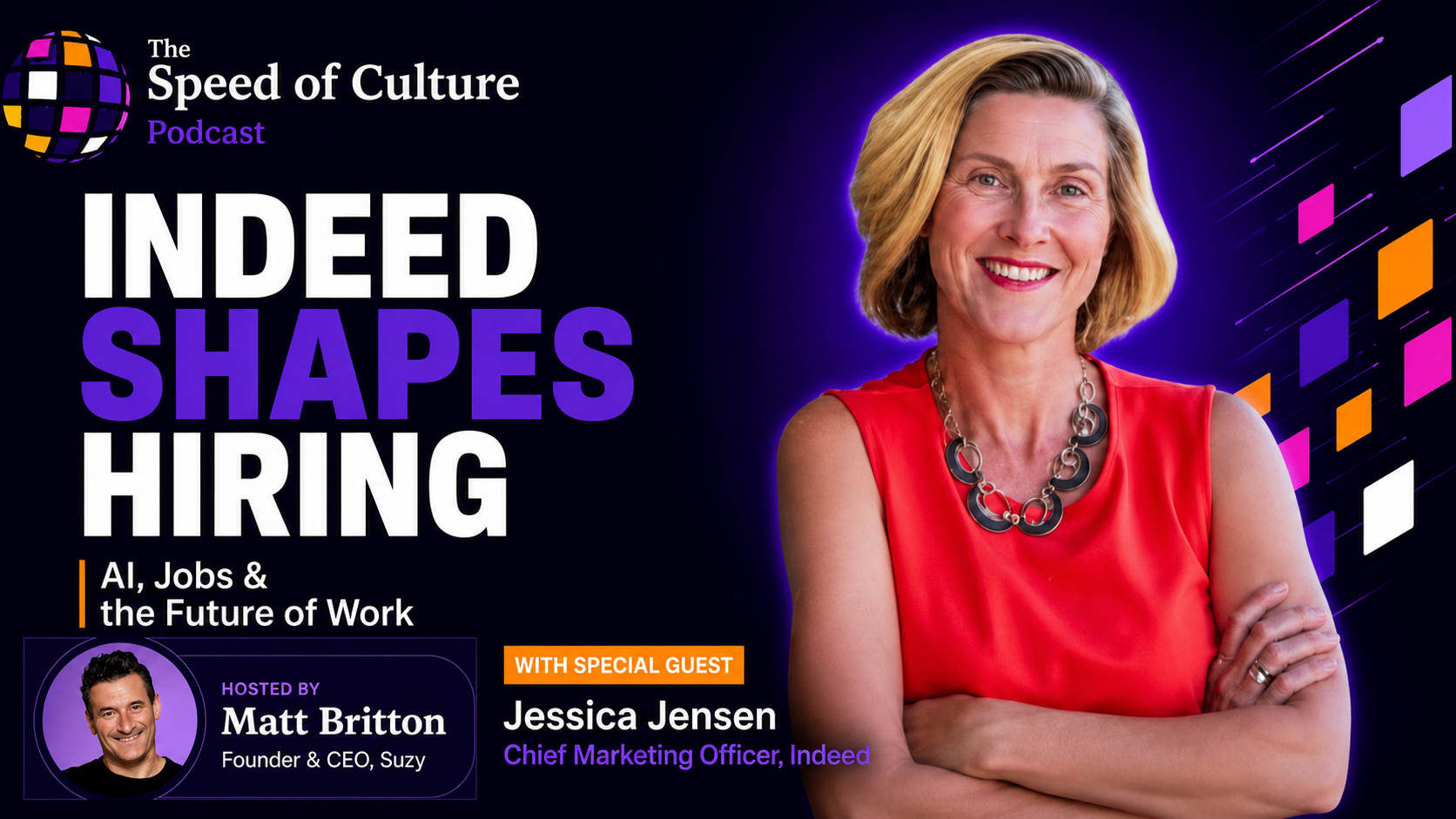
On September 13, 2023, Matt Britton, founder and CEO of Suzy, the AI-powered consumer intelligence platform, sat down with Jessica Jensen, Chief Marketing Officer at Indeed, for an in-depth conversation on The Speed of Culture Podcast. The discussion revealed how Indeed's marketing leadership navigates the complexities of serving 350 million monthly visitors while maintaining brand authenticity in an increasingly competitive hiring landscape.
Jensen, who is responsible for brand, communication, product, and acquisition marketing globally, shared critical insights into employer branding strategies, the democratization of employment opportunities, and how artificial intelligence is reshaping the job market in real-time.
This episode underscores a fundamental truth that resonates across industries: understanding consumer behavior at scale requires more than data, it demands empathy, strategic vision, and the courage to prioritize mission alignment over short-term metrics. For marketing leaders, HR executives, and employers seeking to attract top talent, Jensen's perspective offers a masterclass in building trust with both job seekers and hiring partners in an economy increasingly shaped by automation and AI.
The conversation between Britton and Jensen represents a critical moment in the evolution of recruitment marketing, where platforms must balance growth with responsibility, scale with authenticity, and technological innovation with human-centered values.
From 140 Million to 350 Million: How Indeed Scaled Its Global Reach
Indeed's journey from a niche job board to a global employment platform serving 350 million unique monthly visitors annually represents one of the most significant transformations in digital marketing history. This explosive growth hasn't been accidental, it reflects a deliberate, mission-driven approach to marketing that prioritizes the job seeker experience above all else.
Jessica Jensen's role as Chief Marketing Officer during this scaling phase has been instrumental. Her background spans some of technology's most demanding marketing environments, including leadership roles at Facebook, Apple, Yahoo, and OpenTable. This diverse experience gave her the strategic framework to approach Indeed's marketing challenge differently: not as a transactional platform competing on features, but as a democratic institution enabling people from all walks of life to access economic opportunity.
The sheer scale of Indeed's audience is staggering. Nearly 4 million employers post jobs monthly on the platform, which means Indeed serves an incredibly diverse workforce.
“We are trying to be known as the best place for jobs and for job seekers all over the world. And that can be truck drivers and lawyers and sales leaders and dishwashers. So we are an incredibly democratic platform and broad in terms of our reach and the job seekers we serve.”
This democratic approach fundamentally distinguishes Indeed's marketing strategy from competitors. Rather than targeting specific demographic segments or professional tiers, Indeed's marketing message speaks to the universal human need for meaningful work and economic dignity.
The growth from 140 million to 350 million unique monthly visitors in recent years reflects both market expansion and deep product-market fit. Every campaign, every communication, and every product decision traces back to the central promise: we are here to help people get jobs.
For marketing leaders seeking to scale globally, Indeed's trajectory offers a powerful lesson: scale follows authenticity. By maintaining unwavering focus on the customer mission and resisting the temptation to chase short-term metrics or demographic shortcuts, Indeed created a platform so valuable that it achieved network effects at an extraordinary pace.
The Mission-Driven Marketing Approach: “We Help People Get Jobs”
At the heart of Indeed's marketing strategy lies a deceptively simple but profoundly powerful mission statement: “We Help People Get Jobs.” It serves as a strategic framework that guides every decision Jessica Jensen's team makes, from brand campaigns to product acquisition marketing to employer communication strategies.
Mission-driven marketing operates differently than traditional performance marketing. While traditional approaches optimize for clicks, conversions, and cost-per-acquisition, mission-driven marketing prioritizes alignment between brand promise and customer outcome.
Indeed's investment in brand marketing reflects this philosophy. The company has invested heavily in emotional, cinematic brand campaigns that move beyond job descriptions and salary ranges to tell human stories. Campaigns such as the global “Stories” initiative positioned Indeed at the heart of people's career journeys, shifting from transactional marketing to transformational marketing.
This mission-aligned approach extends to employer marketing as well. Rather than simply selling job postings as a commodity product, Jensen's team positioned employer branding as a strategic investment. Employers who work with Indeed don't just fill positions faster; they build long-term employer brands that attract top talent across multiple recruitment cycles.
The mission framework also addresses trust, which is fundamental to a two-sided marketplace. By grounding all marketing communications in the mission to help people get jobs, Jensen's team reinforces the platform's fundamental promise: we are here to serve your interests, not exploit them.
For executives rebuilding trust in their brands during uncertain times, Indeed's approach demonstrates the enduring value of mission alignment. In an era of sophisticated AI-driven personalization and algorithmic manipulation, consumers respond powerfully to brands that maintain authentic commitment to their stated values.
Employer Branding in the Digital Age: Converting Hiring Challenge into Competitive Advantage
One of Jessica Jensen's most significant strategic contributions at Indeed has been positioning employer branding not as a marketing expense, but as a core hiring technology. This conceptual shift has transformed how companies approach talent acquisition in the modern job market.
The data supports this positioning. Employers who purchased Indeed's Employer Branding Ads saw an average 13% increase in started applications across Indeed and Glassdoor. Employers implementing the comprehensive Employer Branding Hub saw a 27% increase in total apply starts per job.
In many organizations, the marketing team and recruiting team operate in different silos with different KPIs. But Indeed's approach suggests these functions should be integrated. An effective employer brand marketed authentically to job seekers becomes a recruiting advantage that compounds over time.
The psychological principle underlying this strategy is powerful: 75% of active job seekers are likely to apply to a job if the employer actively manages its employer brand. Passive messaging about job openings is insufficient. Job seekers want to understand company culture, values, and work environment before applying.
Jensen's marketing team helped employers understand that this is a necessary investment that improves the efficiency of the entire hiring funnel. Companies that integrate employer brand marketing into their talent acquisition strategy achieve better long-term ROI than those focused solely on low-cost job postings.
Artificial Intelligence, Job Market Transformation, and Marketing in an AI-Driven Economy
Perhaps no topic loomed larger in Jessica Jensen's 2023 conversation with Matt Britton than the rapid emergence of generative AI and its impact on the job market. Indeed's research analyzing over 55 million job postings revealed both challenges and unprecedented opportunities in the AI-driven labor market.
The headline finding was striking: one in five jobs had high exposure to generative AI, meaning GenAI could theoretically perform 80% or more of the skills required for that role. However, while GenAI touches nearly every job, the technology was not good enough to perform jobs single-handedly.
Legal roles, human resources, marketing, and knowledge-work categories showed high potential for AI augmentation. In contrast, roles requiring human interaction (such as driving, childcare, nursing, and hospitality) remain relatively protected from near-term AI displacement.
For Indeed's marketing team, the opportunity was clear: help employers understand that AI adoption requires workers skilled in AI collaboration, not just AI-replaced workers. The narrative shifted from job elimination to job transformation, creating urgency for workforce development.
By publishing research, hosting webinars, and developing employer education content around AI and job market trends, Indeed established thought leadership in a critical conversation. In times of technological disruption, marketing's role shifts from selling products to helping customers navigate uncertainty.
Building Trust at Scale: The Long-Term View of Marketing Leadership
The most sophisticated insight from Jessica Jensen's marketing leadership is that in a market as large and as critical as employment, trust is the ultimate competitive advantage. Trust is the asset that allows Indeed to maintain its position despite competition from LinkedIn, traditional recruiting firms, and emerging startup platforms.
Building trust at a scale of 350 million monthly visitors requires consistency, transparency, and genuine commitment to serving both sides of the marketplace. It requires resisting pressure to optimize short-term metrics at the expense of long-term relationships.
Marketing in the modern era is inseparable from corporate responsibility, data privacy, and ethical business practices. When Indeed markets its platform to job seekers, it's implicitly promising that the platform respects their data and presents opportunities fairly.
For marketing leaders seeking to build enduring competitive advantage, Jensen's approach offers a clear template: align your company's operational reality with its marketing message, prioritize customer benefit over short-term metrics, and make trust-building investments even when ROI isn't immediately measurable.
Key Takeaways
- Mission Alignment Drives Scale: Indeed's growth from 140 million to 350 million unique monthly visitors reflects unwavering commitment to “We Help People Get Jobs.”
- Employer Branding Is Recruitment Technology: Companies investing in employer branding see 13–27% increases in application rates.
- AI Changes Job Requirements, Not Just Availability: Generative AI impacts up to 80% of skills in one in five roles, but transformation, not elimination, is the current reality.
- Trust Is the Ultimate Competitive Advantage: In two-sided marketplaces serving 350 million users, trust sustains leadership.
- Marketing Leaders Must Navigate Economic Uncertainty: In disruptive periods, marketing shifts toward education, thought leadership, and transparent communication.
FAQ: Frequently Asked Questions About Indeed's Marketing Strategy and the Future of Work
What makes Indeed different from other job platforms in its marketing approach?
Indeed differentiates through mission-driven marketing that prioritizes helping people get jobs above all else. Its democratic approach (serving truck drivers, lawyers, and dishwashers alike) combined with emotional brand-building campaigns creates a competitive moat that is difficult to replicate.
How should employers think about employer branding in a competitive talent market?
Employers should view employer branding as a core hiring technology. Data shows that active employer brand strategies drive 13–27% improvements in application rates. Communicating culture, values, and work environment across multiple channels creates long-term recruiting advantages.
How should job seekers and employers prepare for AI-driven job market changes?
Rather than fearing displacement, job seekers should develop skills in AI collaboration and augmentation. Employers should invest in workforce development programs that prepare workers to use AI tools effectively. The job market is transforming, not disappearing.
What lessons can marketing leaders in other industries learn from Indeed's approach?
The most transferable lesson is that mission alignment creates competitive advantage at scale. Companies that prioritize customer benefit, maintain authentic commitment to their mission, and invest in trust-building create enduring resilience.
Looking Ahead: Building the Future of Work
Jessica Jensen's conversation with Matt Britton on The Speed of Culture Podcast represented a critical moment in the evolution of recruitment marketing and the broader conversation about the future of work.
For leaders seeking to understand the AI-driven labor market transformation, this episode is essential viewing. Indeed's approach demonstrates that the most sophisticated marketing is about alignment between company mission, customer benefit, and business success.
Matt Britton's Generation AI explores these themes in greater depth, examining how artificial intelligence is reshaping industries, consumer behavior, and the future of work. Leaders interested in AI-driven business strategy can also explore Matt's work as an AI keynote speaker or connect through Speaker HQ for additional resources.
Marketing leaders seeking to deepen their understanding of real-time consumer intelligence should explore Suzy, the platform Matt Britton leads as CEO. For booking inquiries or speaking engagements, visit the contact page.
The Speed of Culture podcast, produced in partnership with Adweek and Suzy, continues to explore how brands navigate evolving consumer behavior, technological disruption, and the imperative to adapt marketing strategies for the modern era.

%20(400%20x%20100%20px)%20(300%20x%2050%20px)%20(150%20x%2050%20px).avif)